USENIX Security '22: Innovative Single-Round Keyword PIR Using Constant-Weight Equality 🔐
Discover a groundbreaking approach to Private Information Retrieval (PIR) showcased at USENIX Security '22, enabling efficient single-round keyword queries with constant-weight equality operators for enhanced privacy and performance.

USENIX
423 views • Oct 26, 2022
About this video
USENIX Security '22 - Constant-weight PIR: Single-round Keyword PIR via Constant-weight Equality Operators
Rasoul Akhavan Mahdavi and Florian Kerschbaum, University of Waterloo
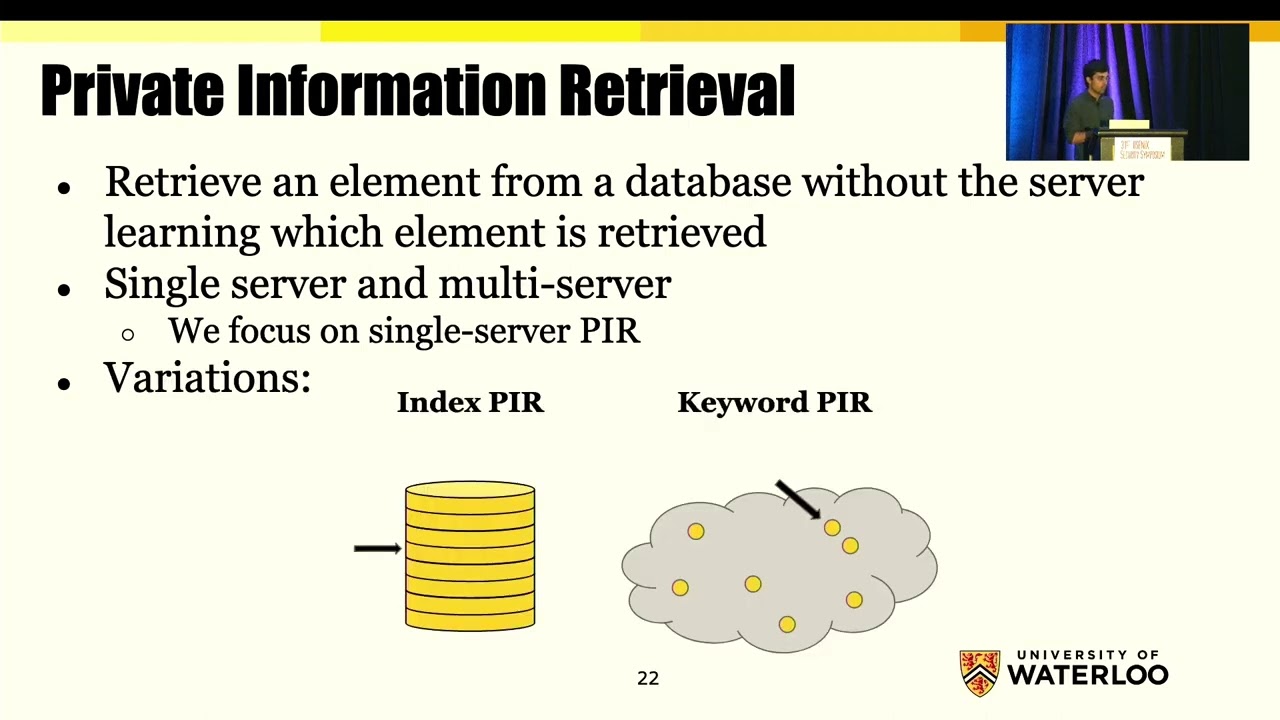
Equality operators are an essential building block in tasks over secure computation such as private information retrieval. In private information retrieval (PIR), a user queries a database such that the server does not learn which element is queried. In this work, we propose equality operators for constant-weight codewords. A constant-weight code is a collection of codewords that share the same Hamming weight. Constant-weight equality operators have a multiplicative depth that depends only on the Hamming weight of the code, not the bit-length of the elements. In our experiments, we show how these equality operators are up to 10 times faster than existing equality operators. Furthermore, we propose PIR using the constant-weight equality operator or constant-weight PIR, which is a PIR protocol using an approach previously deemed impractical. We show that for private retrieval of large, streaming data, constant-weight PIR has a smaller communication complexity and lower runtime compared to SEALPIR and MulPIR, respectively, which are two state-of-the-art solutions for PIR. Moreover, we show how constant-weight PIR can be extended to keyword PIR. In keyword PIR, the desired element is retrieved by a unique identifier pertaining to the sought item, e.g., the name of a file. Previous solutions to keyword PIR require one or multiple rounds of communication to reduce the problem to normal PIR. We show that constant-weight PIR is the first practical single-round solution to single-server keyword PIR.
View the full USENIX Security '22 program at https://www.usenix.org/conference/usenixsecurity22/technical-sessions
Rasoul Akhavan Mahdavi and Florian Kerschbaum, University of Waterloo
Equality operators are an essential building block in tasks over secure computation such as private information retrieval. In private information retrieval (PIR), a user queries a database such that the server does not learn which element is queried. In this work, we propose equality operators for constant-weight codewords. A constant-weight code is a collection of codewords that share the same Hamming weight. Constant-weight equality operators have a multiplicative depth that depends only on the Hamming weight of the code, not the bit-length of the elements. In our experiments, we show how these equality operators are up to 10 times faster than existing equality operators. Furthermore, we propose PIR using the constant-weight equality operator or constant-weight PIR, which is a PIR protocol using an approach previously deemed impractical. We show that for private retrieval of large, streaming data, constant-weight PIR has a smaller communication complexity and lower runtime compared to SEALPIR and MulPIR, respectively, which are two state-of-the-art solutions for PIR. Moreover, we show how constant-weight PIR can be extended to keyword PIR. In keyword PIR, the desired element is retrieved by a unique identifier pertaining to the sought item, e.g., the name of a file. Previous solutions to keyword PIR require one or multiple rounds of communication to reduce the problem to normal PIR. We show that constant-weight PIR is the first practical single-round solution to single-server keyword PIR.
View the full USENIX Security '22 program at https://www.usenix.org/conference/usenixsecurity22/technical-sessions
Tags and Topics
Browse our collection to discover more content in these categories.
Video Information
Views
423
Likes
1
Duration
13:16
Published
Oct 26, 2022
Related Trending Topics
LIVE TRENDSRelated trending topics. Click any trend to explore more videos.
No specific trending topics match this video yet.
Explore All Trends