USENIX Security '17: Breakthroughs in Computer Security, Privacy, & DNA Sequencing 🧬
Discover how synthesized DNA can compromise computer systems, leak privacy, and reveal new security vulnerabilities in this cutting-edge USENIX Security '17 presentation.
USENIX
1.6K views • Sep 15, 2017
About this video
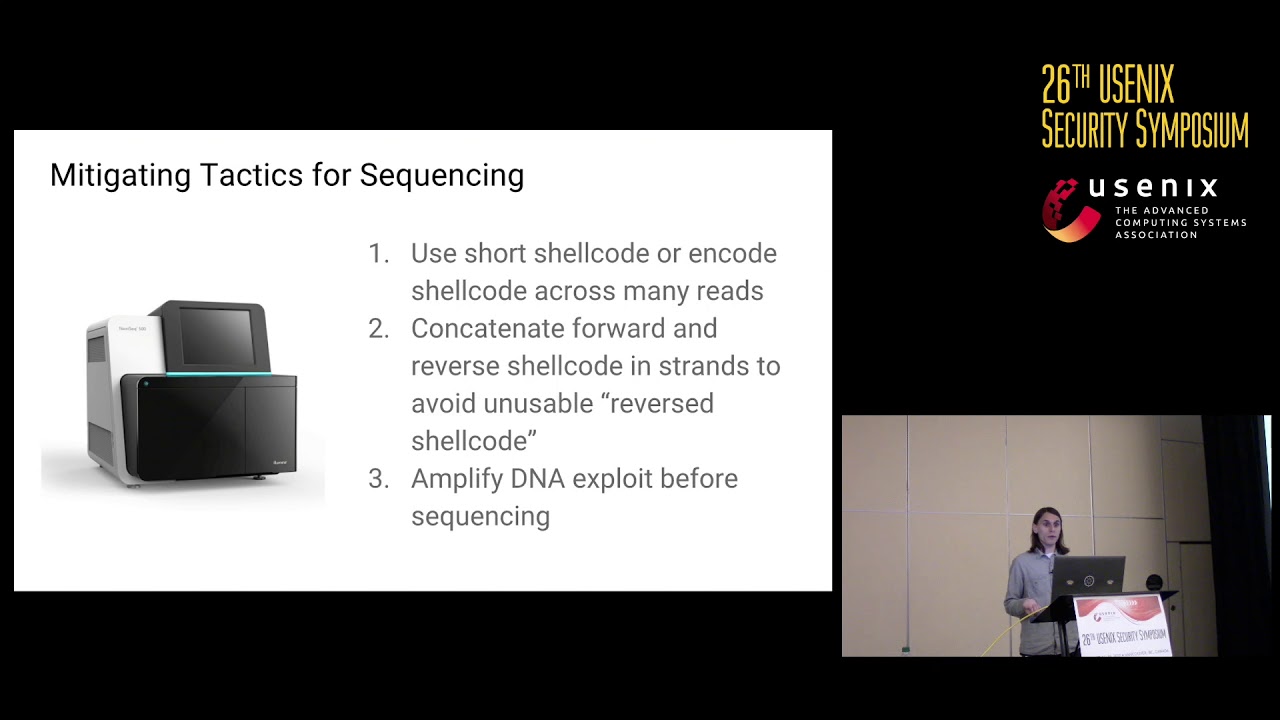
Computer Security, Privacy, and DNA Sequencing: Compromising Computers with Synthesized DNA, Privacy Leaks, and More
Peter Ney, Karl Koscher, Lee Organick, Luis Ceze, and Tadayoshi Kohno, University of Washington
The rapid improvement in DNA sequencing has sparked a big data revolution in genomic sciences, which has in turn led to a proliferation of bioinformatics tools. To date, these tools have encountered little adversarial pressure. This paper evaluates the robustness of such tools if (or when) adversarial attacks manifest. We demonstrate, for the first time, the synthesis of DNA which—when sequenced and processed—gives an attacker arbitrary remote code execution. To study the feasibility of creating and synthesizing a DNA-based exploit, we performed our attack on a modified downstream sequencing utility with a deliberately introduced vulnerability. After sequencing, we observed information leakage in our data due to sample bleeding. While this phenomena is known to the sequencing community, we provide the first discussion of how this leakage channel could be used adversarially to inject data or reveal sensitive information. We then evaluate the general security hygiene of common DNA processing programs, and unfortunately, find concrete evidence of poor security practices used throughout the field. Informed by our experiments and results, we develop a broad framework and guidelines to safeguard security and privacy in DNA synthesis, sequencing, and processing.
View the full program: https://www.usenix.org/sec17/program
Peter Ney, Karl Koscher, Lee Organick, Luis Ceze, and Tadayoshi Kohno, University of Washington
The rapid improvement in DNA sequencing has sparked a big data revolution in genomic sciences, which has in turn led to a proliferation of bioinformatics tools. To date, these tools have encountered little adversarial pressure. This paper evaluates the robustness of such tools if (or when) adversarial attacks manifest. We demonstrate, for the first time, the synthesis of DNA which—when sequenced and processed—gives an attacker arbitrary remote code execution. To study the feasibility of creating and synthesizing a DNA-based exploit, we performed our attack on a modified downstream sequencing utility with a deliberately introduced vulnerability. After sequencing, we observed information leakage in our data due to sample bleeding. While this phenomena is known to the sequencing community, we provide the first discussion of how this leakage channel could be used adversarially to inject data or reveal sensitive information. We then evaluate the general security hygiene of common DNA processing programs, and unfortunately, find concrete evidence of poor security practices used throughout the field. Informed by our experiments and results, we develop a broad framework and guidelines to safeguard security and privacy in DNA synthesis, sequencing, and processing.
View the full program: https://www.usenix.org/sec17/program
Tags and Topics
Browse our collection to discover more content in these categories.
Video Information
Views
1.6K
Likes
21
Duration
29:18
Published
Sep 15, 2017
User Reviews
4.4
(1) Related Trending Topics
LIVE TRENDSRelated trending topics. Click any trend to explore more videos.
No specific trending topics match this video yet.
Explore All Trends