USENIX Security '16: Breakthrough in Post-Quantum Key Exchange 🔐
Discover the latest advancements in post-quantum cryptography with 'A New Hope,' a groundbreaking key exchange protocol presented at USENIX Security '16 by leading experts from Ege University, CWI, and Infineon Technologies.

USENIX
468 views • Dec 2, 2021
About this video
Post-quantum Key Exchange—A New Hope
Erdem Alkim, Ege University; Léo Ducas, Centrum voor Wiskunde en Informatica; Thomas Pöppelmann, Infineon Technologies AG; Peter Schwabe, Radboud University
Winner of the 2016 Internet Defense Prize
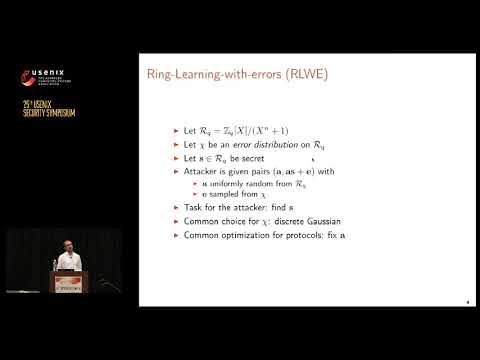
At IEEE Security & Privacy 2015, Bos, Costello, Naehrig, and Stebila proposed an instantiation of Peikert’s ring-learning-with-errors–based (Ring-LWE) key exchange protocol (PQCrypto 2014), together with an implementation integrated into OpenSSL, with the affirmed goal of providing post-quantum security for TLS. In this work we revisit their instantiation and stand-alone implementation. Specifically, we propose new parameters and a better suited error distribution, analyze the scheme’s hardness against attacks by quantum computers in a conservative way, introduce a new and more efficient error-reconciliation mechanism, and propose a defense against backdoors and all-for-the-price-of-one attacks. By these measures and for the same lattice dimension, we more than double the security parameter, halve the communication overhead, and speed up computation by more than a factor of 8 in a portable C implementation and by more than a factor of 27 in an optimized implementation targeting current Intel CPUs. These speedups are achieved with comprehensive protection against timing attacks.
View the full USENIX Security '16 program at https://www.usenix.org/conference/usenixsecurity16/technical-sessions
Erdem Alkim, Ege University; Léo Ducas, Centrum voor Wiskunde en Informatica; Thomas Pöppelmann, Infineon Technologies AG; Peter Schwabe, Radboud University
Winner of the 2016 Internet Defense Prize
At IEEE Security & Privacy 2015, Bos, Costello, Naehrig, and Stebila proposed an instantiation of Peikert’s ring-learning-with-errors–based (Ring-LWE) key exchange protocol (PQCrypto 2014), together with an implementation integrated into OpenSSL, with the affirmed goal of providing post-quantum security for TLS. In this work we revisit their instantiation and stand-alone implementation. Specifically, we propose new parameters and a better suited error distribution, analyze the scheme’s hardness against attacks by quantum computers in a conservative way, introduce a new and more efficient error-reconciliation mechanism, and propose a defense against backdoors and all-for-the-price-of-one attacks. By these measures and for the same lattice dimension, we more than double the security parameter, halve the communication overhead, and speed up computation by more than a factor of 8 in a portable C implementation and by more than a factor of 27 in an optimized implementation targeting current Intel CPUs. These speedups are achieved with comprehensive protection against timing attacks.
View the full USENIX Security '16 program at https://www.usenix.org/conference/usenixsecurity16/technical-sessions
Tags and Topics
Browse our collection to discover more content in these categories.
Video Information
Views
468
Likes
3
Duration
39:33
Published
Dec 2, 2021
Related Trending Topics
LIVE TRENDSRelated trending topics. Click any trend to explore more videos.
No specific trending topics match this video yet.
Explore All Trends