Speed's Test for Biceps Tendon & SLAP Lesions 🩺
Assess biceps tendon and SLAP lesions with Speed's test to evaluate shoulder integrity and injury.
Tim Fraticelli - PTProgress
9.1K views • Jan 10, 2020
About this video
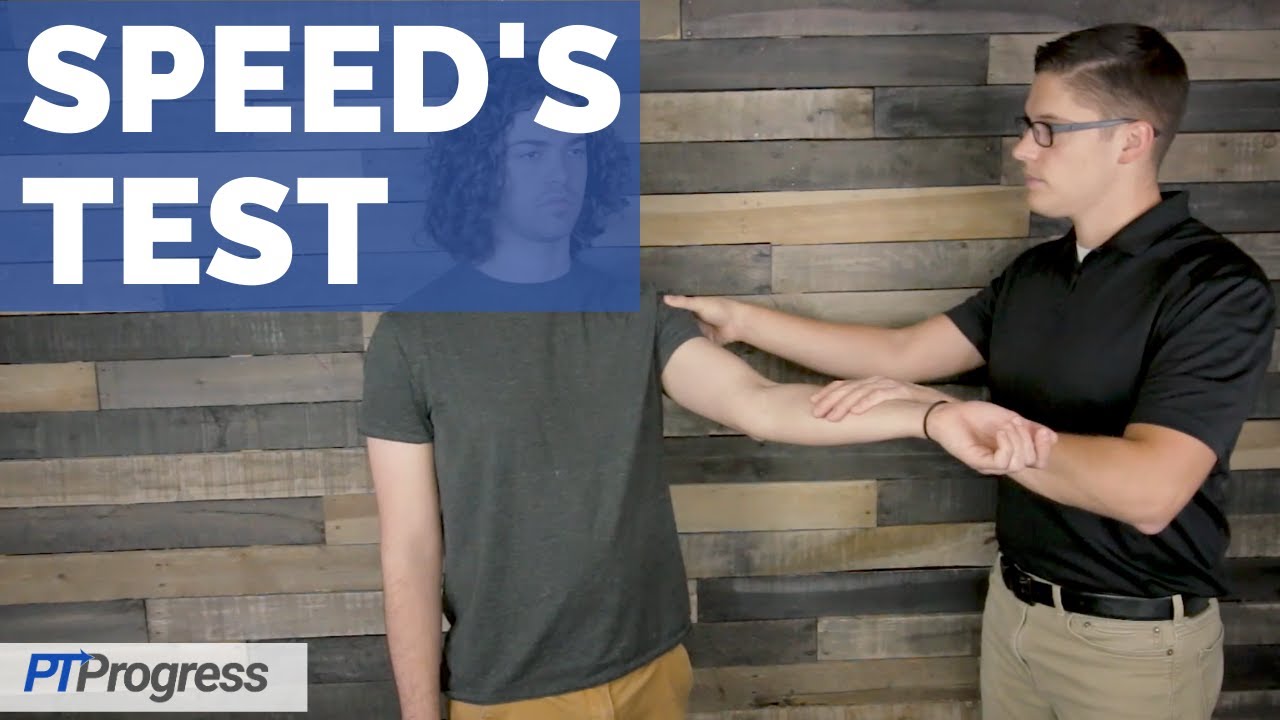
The Speed’s test is used to assess the integrity of the biceps tendon (long head) or labrum, specifically a Superior Labrum Anterior-Posterior (SLAP) Lesion.
How to Perform Speed’s Test
Position of Patient:
• Patient is sitting or standing
• Elbow fully extended and elevated to 90 degrees
• Fully supinate forearm (palm faces upward)
Performance: The examiner will apply a downward force to the patient’s arm at the 90 degree position. The patient’s arm lowers with resistance.
An alternative performance is to have the patient begin with arm at their side and to actively flex the shoulder with extended elbow and forearm supination while the examiner applies resistance from 0 to 90+ degrees of shoulder flexion.
The test may be performed with the forearm pronated (palm facing down) to compare symptoms. A pronated forearm usually results in less pain.
Test Interpretation
Positive Finding: Pain in biceps tendon or bicipital groove
Test Accuracy / Reliability / Evidence:
Speed’s Test Sensitivity and Specificity
Testing for Biceps Injury:
Sensitivity = 0.54
Specificity = 0.81
+LR = 2.77
-LR = 0.58
Testing for Labral Injury:
Sensitivity = 0.29
Specificity = 0.69
Research Source: https://www.ncbi.nlm.nih.gov/pubmed/18006674
How to Perform Speed’s Test
Position of Patient:
• Patient is sitting or standing
• Elbow fully extended and elevated to 90 degrees
• Fully supinate forearm (palm faces upward)
Performance: The examiner will apply a downward force to the patient’s arm at the 90 degree position. The patient’s arm lowers with resistance.
An alternative performance is to have the patient begin with arm at their side and to actively flex the shoulder with extended elbow and forearm supination while the examiner applies resistance from 0 to 90+ degrees of shoulder flexion.
The test may be performed with the forearm pronated (palm facing down) to compare symptoms. A pronated forearm usually results in less pain.
Test Interpretation
Positive Finding: Pain in biceps tendon or bicipital groove
Test Accuracy / Reliability / Evidence:
Speed’s Test Sensitivity and Specificity
Testing for Biceps Injury:
Sensitivity = 0.54
Specificity = 0.81
+LR = 2.77
-LR = 0.58
Testing for Labral Injury:
Sensitivity = 0.29
Specificity = 0.69
Research Source: https://www.ncbi.nlm.nih.gov/pubmed/18006674
Tags and Topics
Browse our collection to discover more content in these categories.
Video Information
Views
9.1K
Likes
51
Duration
0:55
Published
Jan 10, 2020
User Reviews
4.1
(1) Related Trending Topics
LIVE TRENDSRelated trending topics. Click any trend to explore more videos.
Trending Now