Linguistic Interaction in Humans and Machines
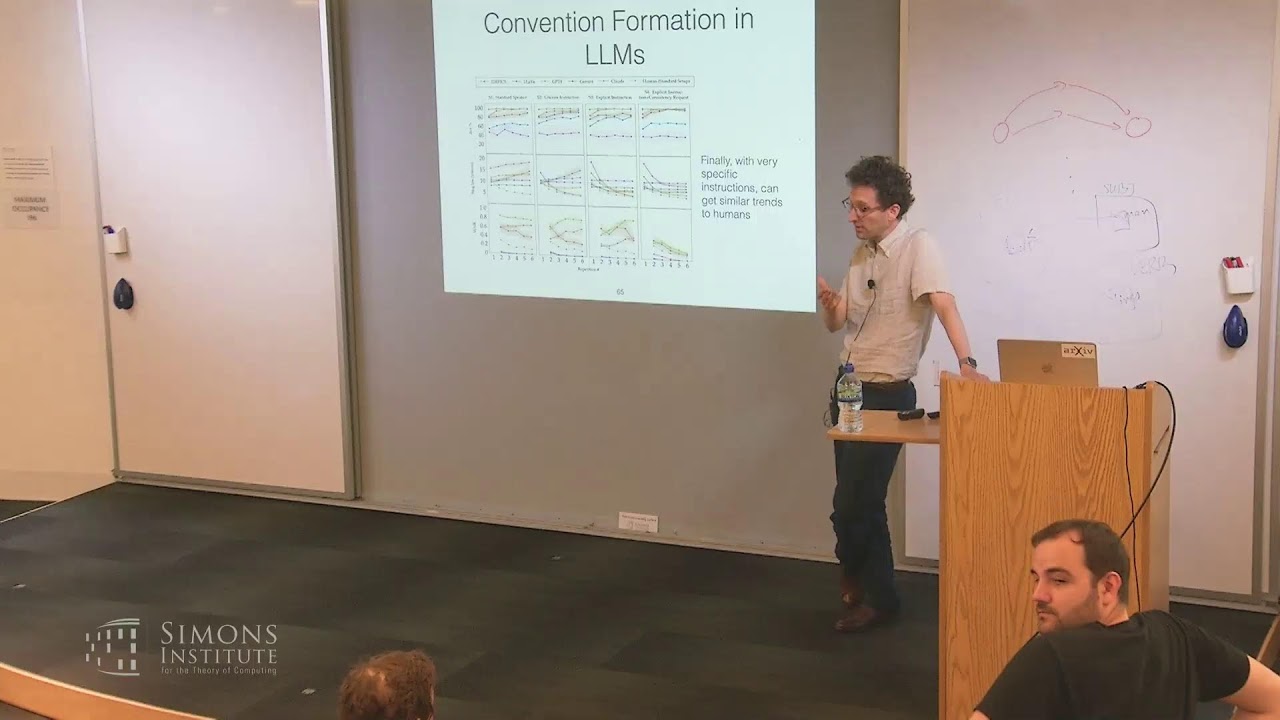
Yoav Artzi (Cornell University) discusses insights into higher-level intelligence through linguistic interactions between humans and AI, exploring how language shapes understanding and communication in artificial systems.

Simons Institute for the Theory of Computing
137 views • Aug 1, 2024
About this video
Yoav Artzi (Cornell University)
https://simons.berkeley.edu/talks/yoav-artzi-cornell-university-2024-06-25
Understanding Higher-Level Intelligence from AI, Psychology, and Neuroscience Perspectives
Contemporary machine learning (ML) models are capable, but opaque. This raises significant challenges in understanding both their internals and capabilities. This condition has some similarities to the challenges faced by researchers of human cognition. The rich methodological toolbox developed in the study of cognition offers a promising avenue to develop our understanding of ML models. Albeit, often not through simple direct application because of properties that distinguish ML from human cognition. Inversely, the adaptation of these methods for ML models creates new tools through which we can study human cognition. Overall, the synthesis of the fields is leading us to an exciting era, with significant research potential. I will describe four language-focused projects, alternating between ML and cognition: adapting methods from cognitive science to create a lens through which to study ML models, and turning that lens back on human cognition. Though this work, we diagnose human adaptation in linguistic interactions, and analyze the generalization and adaptation of ML models.
https://simons.berkeley.edu/talks/yoav-artzi-cornell-university-2024-06-25
Understanding Higher-Level Intelligence from AI, Psychology, and Neuroscience Perspectives
Contemporary machine learning (ML) models are capable, but opaque. This raises significant challenges in understanding both their internals and capabilities. This condition has some similarities to the challenges faced by researchers of human cognition. The rich methodological toolbox developed in the study of cognition offers a promising avenue to develop our understanding of ML models. Albeit, often not through simple direct application because of properties that distinguish ML from human cognition. Inversely, the adaptation of these methods for ML models creates new tools through which we can study human cognition. Overall, the synthesis of the fields is leading us to an exciting era, with significant research potential. I will describe four language-focused projects, alternating between ML and cognition: adapting methods from cognitive science to create a lens through which to study ML models, and turning that lens back on human cognition. Though this work, we diagnose human adaptation in linguistic interactions, and analyze the generalization and adaptation of ML models.
Tags and Topics
Browse our collection to discover more content in these categories.
Video Information
Views
137
Likes
3
Duration
50:46
Published
Aug 1, 2024
Related Trending Topics
LIVE TRENDSRelated trending topics. Click any trend to explore more videos.
No specific trending topics match this video yet.
Explore All Trends