Emerging Interactions Between Humans and Machines: From Social Physiology to Social Neuro-AI
An exploration of the evolving dynamics between humans and machines, bridging social physiology and the development of social neuro-artificial intelligence.
Simons Institute for the Theory of Computing
293 views • Aug 1, 2024
About this video
Guillaume Dumas (CR-CHUSJ / Mila - Quebec AI Institute, University of Montreal)
https://simons.berkeley.edu/talks/guillaume-dumas-cr-chusj-mila-quebec-ai-institute-university-montreal-2024-06-26
Understanding Higher-Level Intelligence from AI, Psychology, and Neuroscience Perspectives
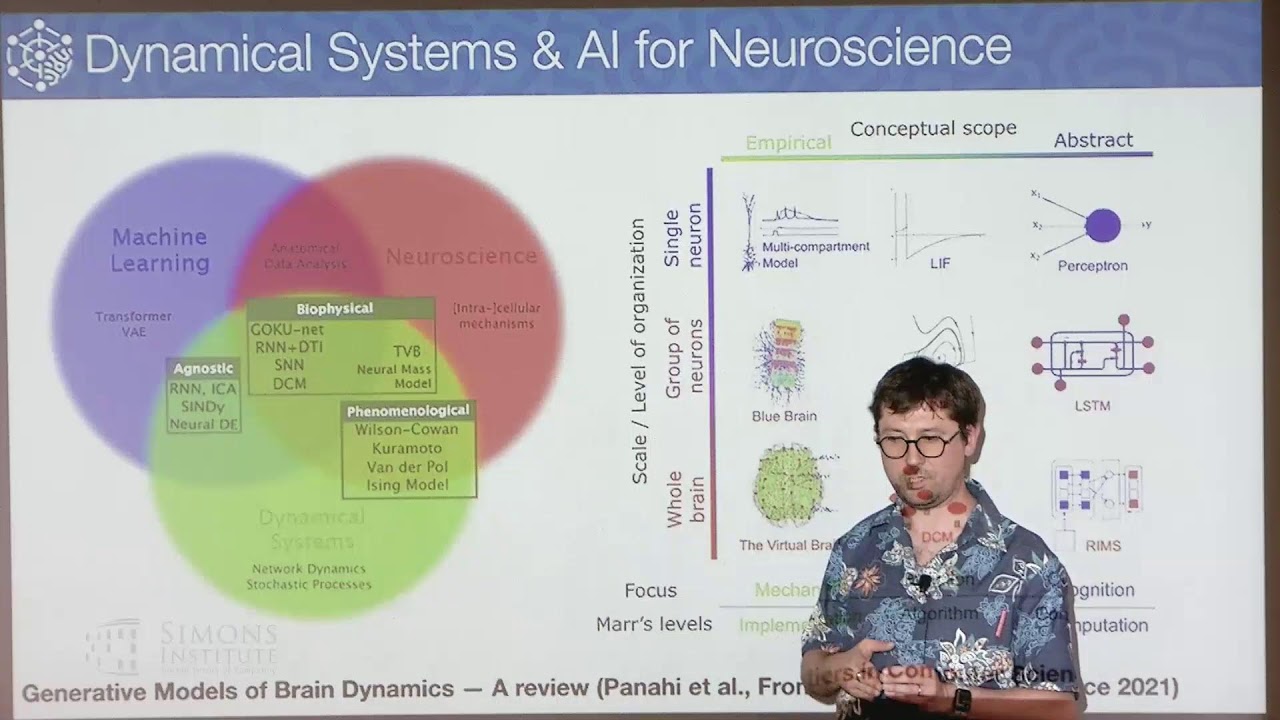
Cognitive sciences have approached social cognition from two complementary perspectives. On the one hand, social psychology and behavioural economics have mostly emphasized mentalizing, social perception, and our ability to model other minds. On the other hand, developmental psychology and motor neuroscience have more focused on imitating, social interaction, and our propensity to coordinate with others’ behaviour. This polarization leads to a « chicken-egg paradox » regarding the origin of social cognition in humans: while the former claim that we need to model others to interact with them; the later argue that we first need to interact with others to model their minds. Those two perspectives operate at different levels of explanation with different conceptual and mathematical formalisms. For instance, while Bayesian statistics captures social computations well during offline economic games, social coordination during sensorimotor coupling is better modelled using dynamical systems. In this talk, I will illustrate how we can operationalize a « social physiology » modelling human cognition as a multi-scale complex system that interfaces biological and social processes. The term « physiology » was introduced by Claude Bernard not as a medical subfield but rather as a systemic and integrative posture towards biological functions (1865). Here, we will expand this posture by including social functions, using experimental approaches in both natural and artificial agents. We will start with multi-brain neuroscience and how inter-brain connectivity provides a quantitative marker for bridging the gap between intra-personal mechanisms and inter-personal dynamics. Then, we will continue with neuro-inspired artificial intelligence and how the observations initially described in interactive social neuroscience can inspire architectures for virtual avatars and machine learning algorithms.
https://simons.berkeley.edu/talks/guillaume-dumas-cr-chusj-mila-quebec-ai-institute-university-montreal-2024-06-26
Understanding Higher-Level Intelligence from AI, Psychology, and Neuroscience Perspectives
Cognitive sciences have approached social cognition from two complementary perspectives. On the one hand, social psychology and behavioural economics have mostly emphasized mentalizing, social perception, and our ability to model other minds. On the other hand, developmental psychology and motor neuroscience have more focused on imitating, social interaction, and our propensity to coordinate with others’ behaviour. This polarization leads to a « chicken-egg paradox » regarding the origin of social cognition in humans: while the former claim that we need to model others to interact with them; the later argue that we first need to interact with others to model their minds. Those two perspectives operate at different levels of explanation with different conceptual and mathematical formalisms. For instance, while Bayesian statistics captures social computations well during offline economic games, social coordination during sensorimotor coupling is better modelled using dynamical systems. In this talk, I will illustrate how we can operationalize a « social physiology » modelling human cognition as a multi-scale complex system that interfaces biological and social processes. The term « physiology » was introduced by Claude Bernard not as a medical subfield but rather as a systemic and integrative posture towards biological functions (1865). Here, we will expand this posture by including social functions, using experimental approaches in both natural and artificial agents. We will start with multi-brain neuroscience and how inter-brain connectivity provides a quantitative marker for bridging the gap between intra-personal mechanisms and inter-personal dynamics. Then, we will continue with neuro-inspired artificial intelligence and how the observations initially described in interactive social neuroscience can inspire architectures for virtual avatars and machine learning algorithms.
Tags and Topics
Browse our collection to discover more content in these categories.
Video Information
Views
293
Likes
12
Duration
45:29
Published
Aug 1, 2024
Related Trending Topics
LIVE TRENDSRelated trending topics. Click any trend to explore more videos.
No specific trending topics match this video yet.
Explore All Trends