Huckel’s Rule & Aromaticity Explained for IIT JEE & NEET 🌿
Learn about aromatic, anti-aromatic, and non-aromatic compounds, and understand Huckel’s rule for competitive exams like IIT JEE, NEET, NET, and GATE.
One Chemistry
16.4K views • Aug 27, 2025
About this video
1. What is Aromaticity?
In organic chemistry, some compounds show special stability compared to others. This special stability is called aromaticity.
Aromatic compounds are cyclic (ring-shaped), planar (flat), and have delocalized π-electrons (electrons that are shared all around the ring instead of being fixed between two atoms).
Because of this delocalization, aromatic compounds are more stable than expected.
The most common example is benzene (C₆H₆). Even though it has alternating single and double bonds, all C–C bonds in benzene are of equal length because the electrons are delocalized.
2. Conditions for Aromaticity
A compound will be aromatic only if:
Cyclic: The molecule must form a closed ring.
Planar: The ring must be flat so that π-electrons can overlap.
Fully conjugated: Every atom in the ring should have a p-orbital for continuous electron delocalization.
Follow Huckel’s Rule (4n + 2 π-electrons).
3. Huckel’s Rule
The German scientist Erich Hückel gave a simple rule to check if a compound is aromatic.
For aromaticity: Number of π-electrons = 4n + 2
For aromaticity: Number of π-electrons = 4n + 2
Where n = 0, 1, 2, 3… (integer)
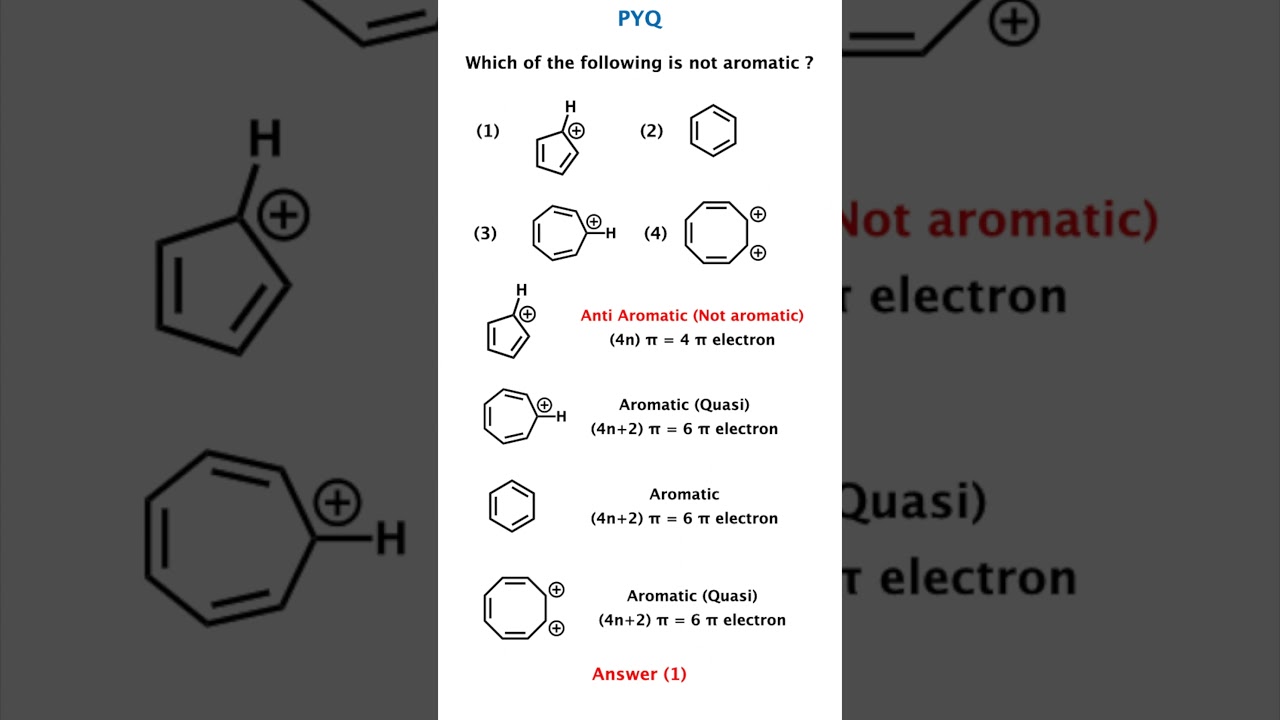
If the ring has 2, 6, 10, 14, … π-electrons, it is aromatic (stable).
If the ring has 4, 8, 12, 16, … π-electrons, it is anti-aromatic (unstable).
If it does not satisfy the cyclic/planar/conjugation conditions, it is non-aromatic.
4. Examples
Benzene (C₆H₆)
Has 6 π-electrons.
6 = 4n + 2 (with n = 1).
Therefore, benzene is aromatic and very stable.
Cyclobutadiene (C₄H₄)
Has 4 π-electrons.
4 = 4n (not 4n + 2).
Therefore, it is anti-aromatic and unstable.
Cyclooctatetraene (C₈H₈)
Has 8 π-electrons, but the molecule is not planar.
Therefore, it is non-aromatic.
5. Why is Aromaticity Important?
Aromatic compounds are more stable than normal cyclic compounds.
Their stability affects their reactivity: they undergo substitution reactions instead of addition reactions (unlike alkenes).
Understanding aromaticity is very important in organic chemistry, medicine, dyes, and polymers because many stable molecules are aromatic.
6. Summary
Aromaticity = unusual stability of certain cyclic, planar, conjugated compounds.
Conditions: cyclic + planar + conjugated + (4n + 2) π-electrons.
Huckel’s Rule: Aromatic if π-electrons = 4n + 2; Anti-aromatic if = 4n.
Examples: Benzene (aromatic), Cyclobutadiene (anti-aromatic), Cyclooctatetraene (non-aromatic).
In organic chemistry, some compounds show special stability compared to others. This special stability is called aromaticity.
Aromatic compounds are cyclic (ring-shaped), planar (flat), and have delocalized π-electrons (electrons that are shared all around the ring instead of being fixed between two atoms).
Because of this delocalization, aromatic compounds are more stable than expected.
The most common example is benzene (C₆H₆). Even though it has alternating single and double bonds, all C–C bonds in benzene are of equal length because the electrons are delocalized.
2. Conditions for Aromaticity
A compound will be aromatic only if:
Cyclic: The molecule must form a closed ring.
Planar: The ring must be flat so that π-electrons can overlap.
Fully conjugated: Every atom in the ring should have a p-orbital for continuous electron delocalization.
Follow Huckel’s Rule (4n + 2 π-electrons).
3. Huckel’s Rule
The German scientist Erich Hückel gave a simple rule to check if a compound is aromatic.
For aromaticity: Number of π-electrons = 4n + 2
For aromaticity: Number of π-electrons = 4n + 2
Where n = 0, 1, 2, 3… (integer)
If the ring has 2, 6, 10, 14, … π-electrons, it is aromatic (stable).
If the ring has 4, 8, 12, 16, … π-electrons, it is anti-aromatic (unstable).
If it does not satisfy the cyclic/planar/conjugation conditions, it is non-aromatic.
4. Examples
Benzene (C₆H₆)
Has 6 π-electrons.
6 = 4n + 2 (with n = 1).
Therefore, benzene is aromatic and very stable.
Cyclobutadiene (C₄H₄)
Has 4 π-electrons.
4 = 4n (not 4n + 2).
Therefore, it is anti-aromatic and unstable.
Cyclooctatetraene (C₈H₈)
Has 8 π-electrons, but the molecule is not planar.
Therefore, it is non-aromatic.
5. Why is Aromaticity Important?
Aromatic compounds are more stable than normal cyclic compounds.
Their stability affects their reactivity: they undergo substitution reactions instead of addition reactions (unlike alkenes).
Understanding aromaticity is very important in organic chemistry, medicine, dyes, and polymers because many stable molecules are aromatic.
6. Summary
Aromaticity = unusual stability of certain cyclic, planar, conjugated compounds.
Conditions: cyclic + planar + conjugated + (4n + 2) π-electrons.
Huckel’s Rule: Aromatic if π-electrons = 4n + 2; Anti-aromatic if = 4n.
Examples: Benzene (aromatic), Cyclobutadiene (anti-aromatic), Cyclooctatetraene (non-aromatic).
Tags and Topics
Browse our collection to discover more content in these categories.
Video Information
Views
16.4K
Likes
54
Duration
0:07
Published
Aug 27, 2025
User Reviews
4.0
(3)