Aromaticity & Stability 🔥 | Huckel’s Rule Made Easy
Learn aromaticity and stability with simple Huckel’s rule tricks for NEET & JEE Chemistry. Clear, quick, and exam-ready! 🧪

One Chemistry
13.3K views • Oct 2, 2025
About this video
Hey future doctors 🩺 & engineers 🛠️!
Do you ever feel Aromaticity = headache 😵? Don’t worry, we’ve got you covered with this fun, super clear, and exam-focused guide on Stability & Aromaticity.
This video will make Huckel’s Rule, aromatic vs non-aromatic vs anti-aromatic compounds, and stability factors crystal clear ✨. With cool analogies, real-life examples, and exam hacks, you’ll never forget these concepts again.
Whether you’re preparing for NEET 2025, JEE 2025, or Class 11–12 Chemistry, this is a must-watch video 🎯.
🌟 What You’ll Learn in this Video
✔ What is Aromaticity?
✔ Huckel’s Rule (4n+2 Rule) – made simple 👌
✔ Difference between Aromatic, Anti-aromatic, and Non-aromatic compounds.
✔ Why aromatic compounds are extra stable.
✔ Order of stability in different organic structures.
✔ Smart tricks to identify aromaticity in exams.
🌟 Step 1: Stability in Organic Chemistry
Stability = how comfortable a molecule is in its electronic arrangement ⚡.
More stability = lower energy, happier molecule 😃.
Less stability = higher energy, unstable, like a stressed student before exams 😓.
Factors affecting stability (just like in boiling point trends 🌡️):
Molecular mass – heavier doesn’t always mean stable.
Branching – spreads strain → increases stability.
Polarity & Charge Distribution – resonance & delocalization spread charge → more stable.
Hydrogen bonding – stabilizes molecules, just like friends supporting you in exams 🤝.
🌟 Step 2: What is Aromaticity?
Aromaticity is special stability shown by certain cyclic compounds.
But not all rings are aromatic! To be aromatic, the molecule must:
1️⃣ Be cyclic (closed loop).
2️⃣ Have planar structure (flat like a pizza 🍕).
3️⃣ Be conjugated (alternate single & double bonds, continuous overlap of p-orbitals).
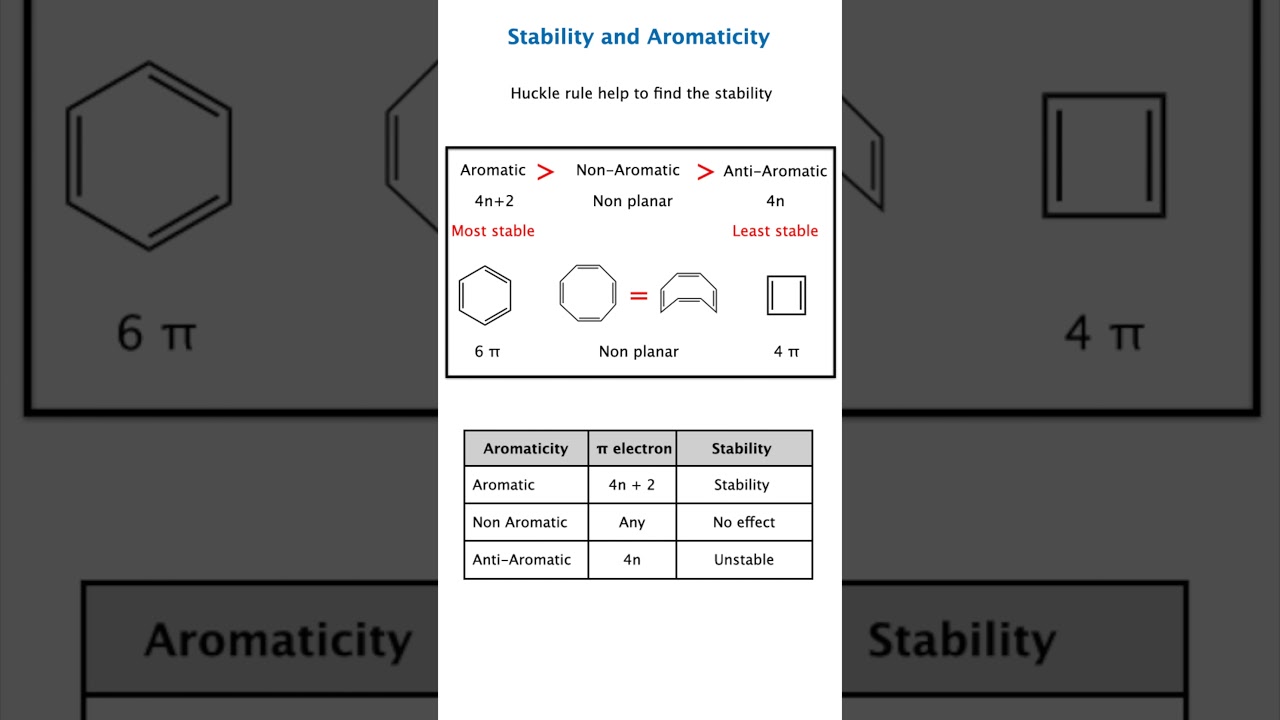
4️⃣ Follow Huckel’s Rule: 4n+2 π electrons (n = 0, 1, 2, …).
💡 Example: Benzene (C₆H₆) = 6 π electrons → satisfies 4n+2 → Aromatic & Super Stable.
🌟 Step 3: Types of Compounds
👉 Aromatic Compounds 😍
Follow Huckel’s Rule (4n+2 π electrons).
Are extra stable due to delocalization.
Example: Benzene, Naphthalene.
👉 Anti-Aromatic Compounds 😱
Cyclic, conjugated, planar BUT follow 4n π electrons.
Extra unstable because of electron crowding.
Example: Cyclobutadiene.
👉 Non-Aromatic Compounds 😴
Either non-planar, not conjugated, or not cyclic.
Do not follow Huckel’s rule.
Example: Cyclooctatetraene (non-planar).
🌟 Fun Analogy 🎉
Think of molecules as students in an exam hall:
Aromatic = Smart topper who has perfect notes 📚 → always stable.
Anti-aromatic = Confused student with wrong notes 😭 → unstable.
Non-aromatic = Didn’t even attend class 💤 → irrelevant for exam.
🌟 Exam Relevance (NEET + JEE)
✔ NEET often asks: “Which compound is aromatic/anti-aromatic/non-aromatic?”
✔ JEE loves twisting Huckel’s rule questions 😏.
✔ PYQs (previous year questions) repeatedly test benzene-like stability & anti-aromatic traps.
✔ Class 11–12 NCERT: Direct theory questions + multiple-choice MCQs.
🌟 Quick Exam Hacks 😎
✅ Count π electrons first (double bonds = 2 π electrons each).
✅ Apply Huckel’s Rule:
4n+2 = Aromatic → stable.
4n = Anti-aromatic → unstable.
✅ If not planar or conjugated → Non-aromatic.
✅ Remember: Aromatic Non-aromatic Anti-aromatic (in terms of stability).
✅ Benzene = gold standard of aromaticity → Always stable in exams 💯.
🌟 Why Watch This Video? 🚀
✔ Clear NCERT-based explanation 📘
✔ Fun analogies & memory tricks 🧠
✔ Covers all stability + aromaticity concepts in one video 🎥
✔ Super helpful for NEET 2025, JEE 2025, Boards
✔ Makes Organic Chemistry actually FUN 😍
By the end, you’ll be able to spot aromaticity in seconds – just like spotting your bestie in a crowd 😉.
#Aromaticity #StabilityInChemistry #HuckelsRule #AromaticCompounds #NEET2025 #JEE2025 #OrganicChemistry #NEETChemistry #JEEChemistry #ChemistryShorts #NCERTChemistry #AntiAromaticCompounds #NonAromaticCompounds #ChemistryMadeEasy #ChemistryIsFun #NEETPreparation #JEEPreparation #ChemistryTricks #ScienceMadeSimple #OrganicMechanism
Do you ever feel Aromaticity = headache 😵? Don’t worry, we’ve got you covered with this fun, super clear, and exam-focused guide on Stability & Aromaticity.
This video will make Huckel’s Rule, aromatic vs non-aromatic vs anti-aromatic compounds, and stability factors crystal clear ✨. With cool analogies, real-life examples, and exam hacks, you’ll never forget these concepts again.
Whether you’re preparing for NEET 2025, JEE 2025, or Class 11–12 Chemistry, this is a must-watch video 🎯.
🌟 What You’ll Learn in this Video
✔ What is Aromaticity?
✔ Huckel’s Rule (4n+2 Rule) – made simple 👌
✔ Difference between Aromatic, Anti-aromatic, and Non-aromatic compounds.
✔ Why aromatic compounds are extra stable.
✔ Order of stability in different organic structures.
✔ Smart tricks to identify aromaticity in exams.
🌟 Step 1: Stability in Organic Chemistry
Stability = how comfortable a molecule is in its electronic arrangement ⚡.
More stability = lower energy, happier molecule 😃.
Less stability = higher energy, unstable, like a stressed student before exams 😓.
Factors affecting stability (just like in boiling point trends 🌡️):
Molecular mass – heavier doesn’t always mean stable.
Branching – spreads strain → increases stability.
Polarity & Charge Distribution – resonance & delocalization spread charge → more stable.
Hydrogen bonding – stabilizes molecules, just like friends supporting you in exams 🤝.
🌟 Step 2: What is Aromaticity?
Aromaticity is special stability shown by certain cyclic compounds.
But not all rings are aromatic! To be aromatic, the molecule must:
1️⃣ Be cyclic (closed loop).
2️⃣ Have planar structure (flat like a pizza 🍕).
3️⃣ Be conjugated (alternate single & double bonds, continuous overlap of p-orbitals).
4️⃣ Follow Huckel’s Rule: 4n+2 π electrons (n = 0, 1, 2, …).
💡 Example: Benzene (C₆H₆) = 6 π electrons → satisfies 4n+2 → Aromatic & Super Stable.
🌟 Step 3: Types of Compounds
👉 Aromatic Compounds 😍
Follow Huckel’s Rule (4n+2 π electrons).
Are extra stable due to delocalization.
Example: Benzene, Naphthalene.
👉 Anti-Aromatic Compounds 😱
Cyclic, conjugated, planar BUT follow 4n π electrons.
Extra unstable because of electron crowding.
Example: Cyclobutadiene.
👉 Non-Aromatic Compounds 😴
Either non-planar, not conjugated, or not cyclic.
Do not follow Huckel’s rule.
Example: Cyclooctatetraene (non-planar).
🌟 Fun Analogy 🎉
Think of molecules as students in an exam hall:
Aromatic = Smart topper who has perfect notes 📚 → always stable.
Anti-aromatic = Confused student with wrong notes 😭 → unstable.
Non-aromatic = Didn’t even attend class 💤 → irrelevant for exam.
🌟 Exam Relevance (NEET + JEE)
✔ NEET often asks: “Which compound is aromatic/anti-aromatic/non-aromatic?”
✔ JEE loves twisting Huckel’s rule questions 😏.
✔ PYQs (previous year questions) repeatedly test benzene-like stability & anti-aromatic traps.
✔ Class 11–12 NCERT: Direct theory questions + multiple-choice MCQs.
🌟 Quick Exam Hacks 😎
✅ Count π electrons first (double bonds = 2 π electrons each).
✅ Apply Huckel’s Rule:
4n+2 = Aromatic → stable.
4n = Anti-aromatic → unstable.
✅ If not planar or conjugated → Non-aromatic.
✅ Remember: Aromatic Non-aromatic Anti-aromatic (in terms of stability).
✅ Benzene = gold standard of aromaticity → Always stable in exams 💯.
🌟 Why Watch This Video? 🚀
✔ Clear NCERT-based explanation 📘
✔ Fun analogies & memory tricks 🧠
✔ Covers all stability + aromaticity concepts in one video 🎥
✔ Super helpful for NEET 2025, JEE 2025, Boards
✔ Makes Organic Chemistry actually FUN 😍
By the end, you’ll be able to spot aromaticity in seconds – just like spotting your bestie in a crowd 😉.
#Aromaticity #StabilityInChemistry #HuckelsRule #AromaticCompounds #NEET2025 #JEE2025 #OrganicChemistry #NEETChemistry #JEEChemistry #ChemistryShorts #NCERTChemistry #AntiAromaticCompounds #NonAromaticCompounds #ChemistryMadeEasy #ChemistryIsFun #NEETPreparation #JEEPreparation #ChemistryTricks #ScienceMadeSimple #OrganicMechanism
Tags and Topics
Browse our collection to discover more content in these categories.
Video Information
Views
13.3K
Likes
109
Duration
0:06
Published
Oct 2, 2025
User Reviews
4.2
(2) Related Trending Topics
LIVE TRENDSRelated trending topics. Click any trend to explore more videos.