Unraveling the Mystery: The Complexity of Knots with Marc Lackenby 🧩
Join mathematician Marc Lackenby from Oxford as he explores the fascinating complexities of knots in this insightful lecture. Perfect for math enthusiasts and curious minds alike!

Harvard CMSA
290 views • Sep 23, 2024
About this video
CMSA/Tsinghua Math-Science Literature Lecture
9/18/24
Speaker: Marc Lackenby, University of Oxford
Title: The complexity of knots
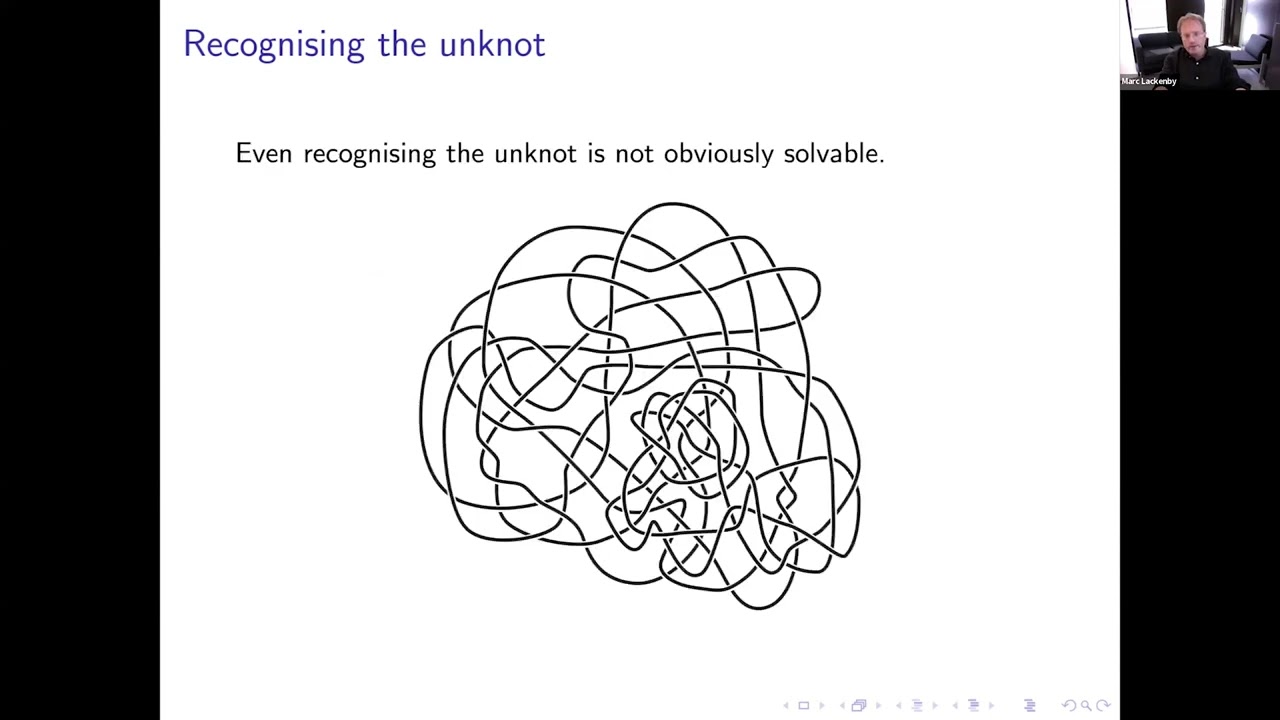
Abstract: In his final paper in 1954, Alan Turing wrote `No systematic method is yet known by which one can tell whether two knots are the same.’ Within the next 20 years, Wolfgang Haken and Geoffrey Hemion had discovered such a method. However, the computational complexity of this problem remains unknown. In my talk, I will give a survey on this area, that draws on the work of many low-dimensional topologists and geometers. Unfortunately, the current upper bounds on the computational complexity of the knot equivalence problem remain quite poor. However, there are some recent results indicating that, perhaps, knots are more tractable than they first seem. Specifically, I will explain a theorem that provides, for each knot type K, a polynomial p_K with the property that any two diagrams of K with n_1 and n_2 crossings differ by at most p_K(n_1) + p_K(n_2) Reidemeister moves.
9/18/24
Speaker: Marc Lackenby, University of Oxford
Title: The complexity of knots
Abstract: In his final paper in 1954, Alan Turing wrote `No systematic method is yet known by which one can tell whether two knots are the same.’ Within the next 20 years, Wolfgang Haken and Geoffrey Hemion had discovered such a method. However, the computational complexity of this problem remains unknown. In my talk, I will give a survey on this area, that draws on the work of many low-dimensional topologists and geometers. Unfortunately, the current upper bounds on the computational complexity of the knot equivalence problem remain quite poor. However, there are some recent results indicating that, perhaps, knots are more tractable than they first seem. Specifically, I will explain a theorem that provides, for each knot type K, a polynomial p_K with the property that any two diagrams of K with n_1 and n_2 crossings differ by at most p_K(n_1) + p_K(n_2) Reidemeister moves.
Video Information
Views
290
Likes
10
Duration
01:09:19
Published
Sep 23, 2024
Related Trending Topics
LIVE TRENDSRelated trending topics. Click any trend to explore more videos.