Understanding Brute-Force Attacks on MACs: Protecting Data Integrity 🔐
Learn how brute-force methods threaten Message Authentication Codes (MACs) and explore cryptographic techniques to safeguard data integrity in this comprehensive course.

Ho Quang Ninh
727 views • Nov 9, 2020
About this video
Link to this course:
https://click.linksynergy.com/deeplink?id=Gw/ETjJoU9M&mid=40328&murl=https%3A%2F%2Fwww.coursera.org%2Flearn%2Fcryptographic-hash-integrity-protection
Brute-Force Attack on MAC - Cryptographic Hash and Integrity Protection
Applied Cryptography Specialization
Welcome to Cryptographic Hash and Integrity Protection!
This course reviews cryptographic hash functions in general and their use in the forms of hash chain and hash tree (Merkle tree). Building on hash functions, the course describes message authentication focusing on message authentication code (MAC) based on symmetric keys. We then discuss digital signatures based on asymmetric cryptography, providing security properties such as non-repudiation which were unavailable in symmetric-cryptography-based message authentication.
This course is a part of the Applied Cryptography specialization.
course is excellent and I hope it would be better if there is an advanced level specialisation continuation for this specialisation,One of the best courses on hashing in cryptography...
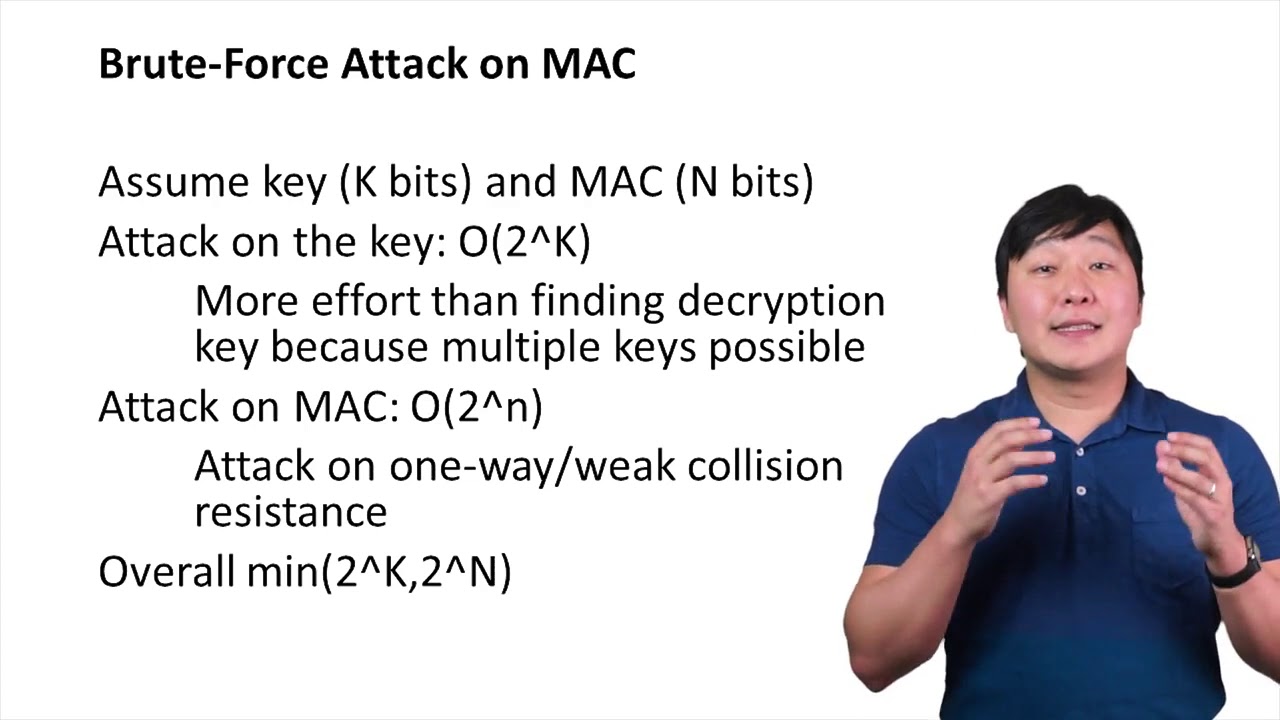
Message authentication is to protect the message integrity and to perform sender authentication. This module describes message authentication code (MAC) which is based on symmetric keys. It contrasts MAC with hash functions or general encryption/decryption techniques and quantify the brute force attack difficulty for MAC and discuss the security requirements for MAC. The module also reviews two MAC implementations in Data Authentication Algorithm (DAA) and Cipher-Based MAC (CMAC), which are based on the use of block ciphers.
Brute-Force Attack on MAC - Cryptographic Hash and Integrity Protection
Copyright Disclaimer under Section 107 of the copyright act 1976, allowance is made for fair use for purposes such as criticism, comment, news reporting, scholarship, and research. Fair use is a use permitted by copyright statute that might otherwise be infringing. Non-profit, educational or personal use tips the balance in favour of fair use.
https://click.linksynergy.com/deeplink?id=Gw/ETjJoU9M&mid=40328&murl=https%3A%2F%2Fwww.coursera.org%2Flearn%2Fcryptographic-hash-integrity-protection
Brute-Force Attack on MAC - Cryptographic Hash and Integrity Protection
Applied Cryptography Specialization
Welcome to Cryptographic Hash and Integrity Protection!
This course reviews cryptographic hash functions in general and their use in the forms of hash chain and hash tree (Merkle tree). Building on hash functions, the course describes message authentication focusing on message authentication code (MAC) based on symmetric keys. We then discuss digital signatures based on asymmetric cryptography, providing security properties such as non-repudiation which were unavailable in symmetric-cryptography-based message authentication.
This course is a part of the Applied Cryptography specialization.
course is excellent and I hope it would be better if there is an advanced level specialisation continuation for this specialisation,One of the best courses on hashing in cryptography...
Message authentication is to protect the message integrity and to perform sender authentication. This module describes message authentication code (MAC) which is based on symmetric keys. It contrasts MAC with hash functions or general encryption/decryption techniques and quantify the brute force attack difficulty for MAC and discuss the security requirements for MAC. The module also reviews two MAC implementations in Data Authentication Algorithm (DAA) and Cipher-Based MAC (CMAC), which are based on the use of block ciphers.
Brute-Force Attack on MAC - Cryptographic Hash and Integrity Protection
Copyright Disclaimer under Section 107 of the copyright act 1976, allowance is made for fair use for purposes such as criticism, comment, news reporting, scholarship, and research. Fair use is a use permitted by copyright statute that might otherwise be infringing. Non-profit, educational or personal use tips the balance in favour of fair use.
Tags and Topics
Browse our collection to discover more content in these categories.
Video Information
Views
727
Likes
5
Duration
3:13
Published
Nov 9, 2020
Related Trending Topics
LIVE TRENDSRelated trending topics. Click any trend to explore more videos.
No specific trending topics match this video yet.
Explore All Trends