Secure Private Keys from Memory Attacks with Hardware Transactional Memory 🔒
Discover how hardware transactional memory can defend private keys against memory disclosure attacks, enhancing security in cryptographic systems. Presented at IEEE 2015.

IEEE Symposium on Security and Privacy
499 views • Sep 12, 2015
About this video
Protecting Private Keys against Memory Disclosure Attacks Using Hardware Transactional Memory
Le Guan
Presented at the
2015 IEEE Symposium on Security & Privacy
May 18--20, 2015
San Jose, CA
http://www.ieee-security.org/TC/SP2015/
ABSTRACT
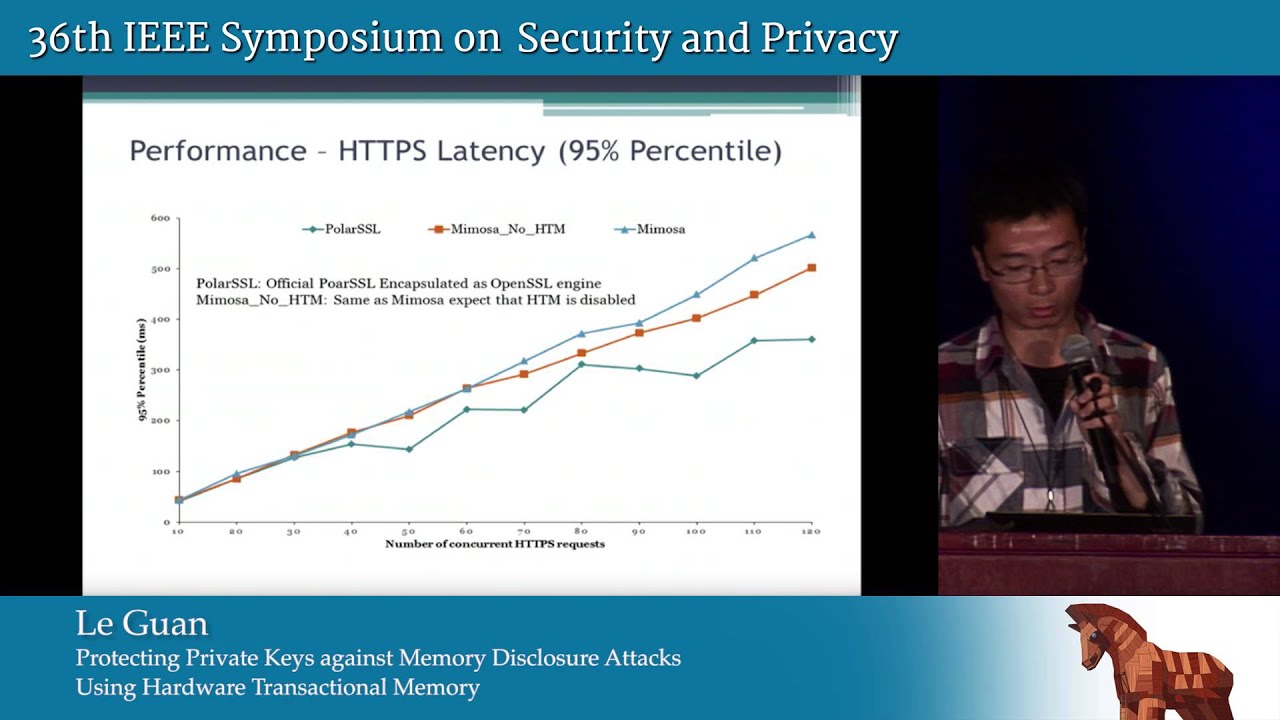
Cryptography plays an important role in computer and communication security. In practical implementations of cryptosystems, the cryptographic keys are usually loaded into the memory as plaintext, and then used in the cryptographic algorithms. Therefore, the private keys are subject to memory disclosure attacks that read unauthorized data from RAM. Such attacks could be performed through software methods (e.g., Open SSL Heart bleed) even when the integrity of the victim system's executable binaries is maintained. They could also be performed through physical methods (e.g., Cold-boot attacks on RAM chips) even when the system is free of software vulnerabilities. In this paper, we propose Mimosa that protects RSA private keys against the above software-based and physical memory attacks. When the Mimosa service is in idle, private keys are encrypted and reside in memory as cipher text. During the cryptographic computing, Mimosa uses hardware transactional memory (HTM) to ensure that (a) whenever a malicious process other than Mimosa attempts to read the plaintext private key, the transaction aborts and all sensitive data are automatically cleared with hardware mechanisms, due to the strong atomicity guarantee of HTM, and (b) all sensitive data, including private keys and intermediate states, appear as plaintext only within CPU-bound caches, and are never loaded to RAM chips. To the best of our knowledge, Mimosa is the first solution to use transactional memory to protect sensitive data against memory disclosure attacks. We have implemented Mimosa on a commodity machine with Intel Core i7 Haswell CPUs. Through extensive experiments, we show that Mimosa effectively protects cryptographic keys against various attacks that attempt to read sensitive data from memory, and it only introduces a small performance overhead.
Le Guan
Presented at the
2015 IEEE Symposium on Security & Privacy
May 18--20, 2015
San Jose, CA
http://www.ieee-security.org/TC/SP2015/
ABSTRACT
Cryptography plays an important role in computer and communication security. In practical implementations of cryptosystems, the cryptographic keys are usually loaded into the memory as plaintext, and then used in the cryptographic algorithms. Therefore, the private keys are subject to memory disclosure attacks that read unauthorized data from RAM. Such attacks could be performed through software methods (e.g., Open SSL Heart bleed) even when the integrity of the victim system's executable binaries is maintained. They could also be performed through physical methods (e.g., Cold-boot attacks on RAM chips) even when the system is free of software vulnerabilities. In this paper, we propose Mimosa that protects RSA private keys against the above software-based and physical memory attacks. When the Mimosa service is in idle, private keys are encrypted and reside in memory as cipher text. During the cryptographic computing, Mimosa uses hardware transactional memory (HTM) to ensure that (a) whenever a malicious process other than Mimosa attempts to read the plaintext private key, the transaction aborts and all sensitive data are automatically cleared with hardware mechanisms, due to the strong atomicity guarantee of HTM, and (b) all sensitive data, including private keys and intermediate states, appear as plaintext only within CPU-bound caches, and are never loaded to RAM chips. To the best of our knowledge, Mimosa is the first solution to use transactional memory to protect sensitive data against memory disclosure attacks. We have implemented Mimosa on a commodity machine with Intel Core i7 Haswell CPUs. Through extensive experiments, we show that Mimosa effectively protects cryptographic keys against various attacks that attempt to read sensitive data from memory, and it only introduces a small performance overhead.
Video Information
Views
499
Likes
4
Duration
18:53
Published
Sep 12, 2015
Related Trending Topics
LIVE TRENDSRelated trending topics. Click any trend to explore more videos.
No specific trending topics match this video yet.
Explore All Trends