Quantum Information Essentials: Algorithms & Cryptography Explained 🔐
Dive into the fundamentals of quantum information with this course segment. Explore qubits, quantum algorithms, and cryptography to understand how quantum tech is shaping the future of secure communication and computation.

NPTEL-NOC IITM
6.0K views • Aug 8, 2024
About this video
Welcome to 'Quantum Algorithms & Cryptography' course !
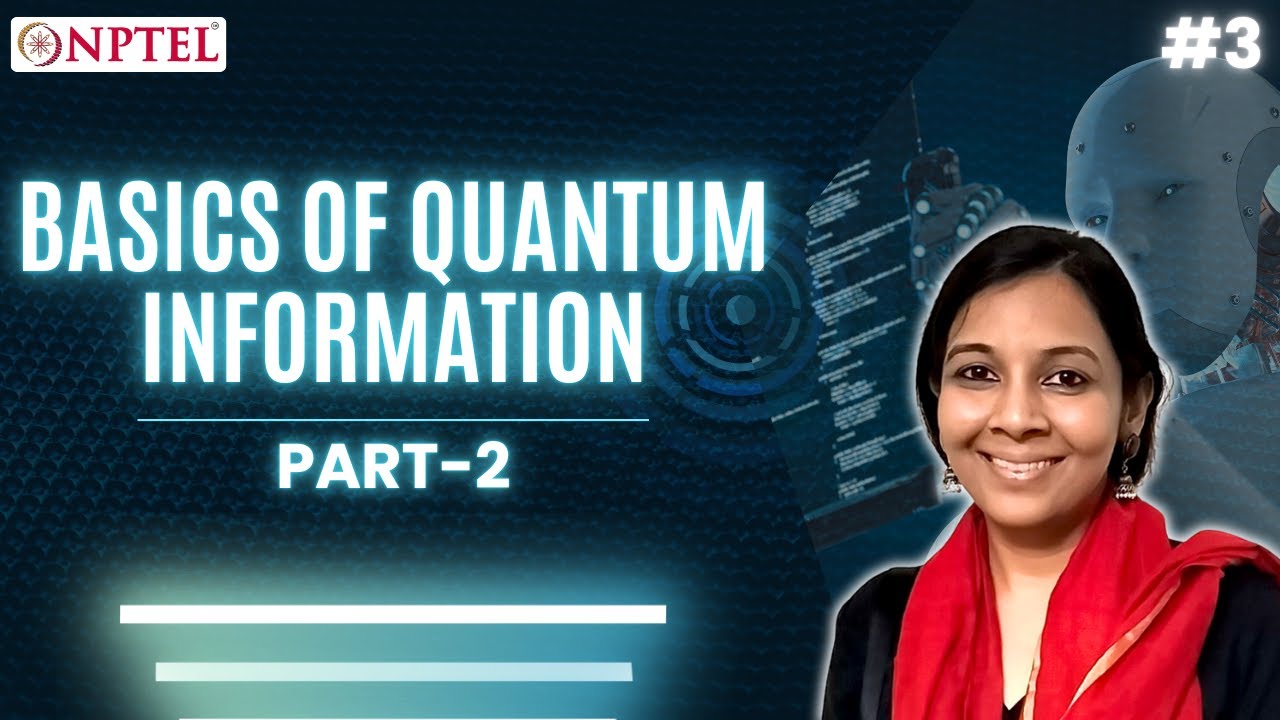
This lecture builds upon the basics of quantum information. It starts by providing examples of qubits represented in the standard basis. The lecture then emphasizes the concept of basis vectors and how quantum states can be expressed using different bases. It introduces the Hadamard basis as an alternative to the standard basis and demonstrates how to transform between these bases. The lecture moves on to discuss the representation of multiple qubits, extending the concept of basis vectors to higher dimensions to accommodate multiple quantum systems. It introduces the concept of entanglement, a unique phenomenon in quantum mechanics where the states of multiple qubits become correlated in a way that cannot be explained by classical physics. The lecture presents the Einstein-Podolsky-Rosen (EPR) state as a prominent example of an entangled state. The lecture formally defines the tensor product, a mathematical operation used to combine quantum states of multiple qubits. It illustrates the application of the tensor product to combine individual qubit states. The lecture then demonstrates how to generate true randomness by preparing a qubit in the Hadamard state and measuring it in the standard basis. Finally, the lecture introduces the notation for measuring quantum systems and discusses the implications of measurement on the quantum state, specifically the collapse of the wavefunction.
NPTEL Courses permit certifications that can be used for Course Credits in Indian Universities as per the UGC and AICTE notifications.
To understand various certification options for this course, please visit https://nptel.ac.in/courses/106106241
#Qubits #StandardBasis #HadamardBasis #MultipleQubits #Entanglement #EPRState #TensorProduct #TrueRandomness #Measurement
This lecture builds upon the basics of quantum information. It starts by providing examples of qubits represented in the standard basis. The lecture then emphasizes the concept of basis vectors and how quantum states can be expressed using different bases. It introduces the Hadamard basis as an alternative to the standard basis and demonstrates how to transform between these bases. The lecture moves on to discuss the representation of multiple qubits, extending the concept of basis vectors to higher dimensions to accommodate multiple quantum systems. It introduces the concept of entanglement, a unique phenomenon in quantum mechanics where the states of multiple qubits become correlated in a way that cannot be explained by classical physics. The lecture presents the Einstein-Podolsky-Rosen (EPR) state as a prominent example of an entangled state. The lecture formally defines the tensor product, a mathematical operation used to combine quantum states of multiple qubits. It illustrates the application of the tensor product to combine individual qubit states. The lecture then demonstrates how to generate true randomness by preparing a qubit in the Hadamard state and measuring it in the standard basis. Finally, the lecture introduces the notation for measuring quantum systems and discusses the implications of measurement on the quantum state, specifically the collapse of the wavefunction.
NPTEL Courses permit certifications that can be used for Course Credits in Indian Universities as per the UGC and AICTE notifications.
To understand various certification options for this course, please visit https://nptel.ac.in/courses/106106241
#Qubits #StandardBasis #HadamardBasis #MultipleQubits #Entanglement #EPRState #TensorProduct #TrueRandomness #Measurement
Tags and Topics
Browse our collection to discover more content in these categories.
Video Information
Views
6.0K
Likes
39
Duration
22:40
Published
Aug 8, 2024
User Reviews
4.1
(1) Related Trending Topics
LIVE TRENDSRelated trending topics. Click any trend to explore more videos.
No specific trending topics match this video yet.
Explore All Trends