PSW 2448 Computational Microscopy of SARS CoV 2 | Rommie Amaro
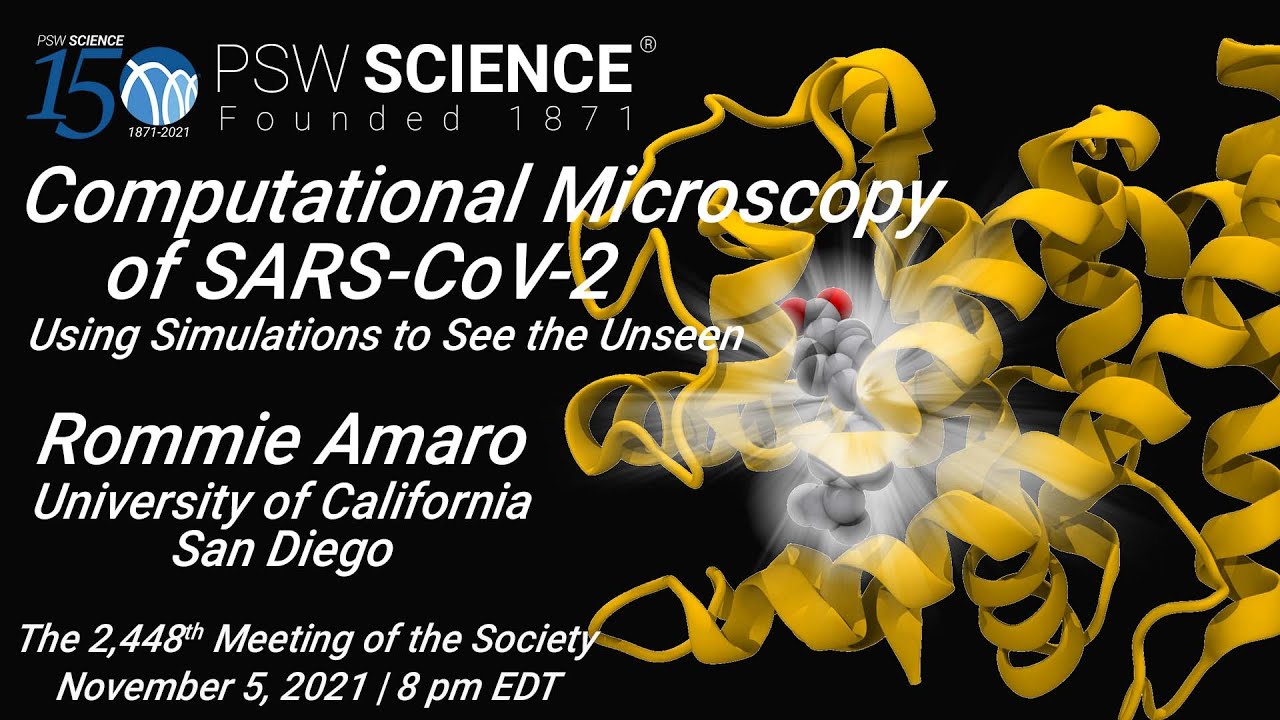
Lecture Starts at 13:23 www.pswscience.org PSW #2448 Computational Microscopy of SARS-CoV-2: Using Simulations to See the Unseen Rommie Amaro Professor, Depa...

PSW Science
763 views • Nov 8, 2021
About this video
Lecture Starts at 13:23
www.pswscience.org
PSW #2448
Computational Microscopy of SARS-CoV-2: Using Simulations to See the Unseen
Rommie Amaro
Professor, Department of Chemistry and Biochemistry
University of California, San Diego
With advances in the acquisition of biological structures, researchers can resolve near-atomic resolution structures of viral components. These studies give valuable information about what these proteins look like, which is important for understanding infection processes and developing therapeutic vaccines and drugs. However, these datasets are subject to experimental limitations and, although they are immensely informative, they cannot provide a complete picture of these molecular machines and how they work. For example, experimental structure determinations often require altering a protein’s amino acid sequence to improve its expression, to trap it in a particular state or alter its biophysical properties. Regions that are highly dynamic are often removed because they limit resolution. Often biological components, such as lipid membranes and glycans, are difficult if not impossible to structurally resolve by available instrumentation and methods. Computational simulations are not subject to the same limitations as experiments, and often can be used to augment and extend experimental datasets. Biophysical molecular dynamics simulations are one such technique that allows researchers to resolve the structures of experimentally determined biomolecular machines back to their original state, and to add components that elude experimental characterization.
This lecture will discuss the use of computational microscopy to understand the SARS-CoV-2 virus in atomic detail, to better understand molecular recognition between the virus and its host cell receptors and antibody binding to the virus, and to advance the design of more effective antibodies, and the search for novel therapeutics.
The lecture will focus on studies of the SARS-CoV-2 spike protein, its glycan shield, its interactions with the human ACE2 receptor, and efforts to model the SARS-CoV-2 virion and the virions of the SARS-CoV-2 escape variants. The lecture will also discuss research that is dramatically revising current models of airborne transmission of respiratory viruses by providing never-before-seen atomic level views of the SARS-CoV-2 virus within a respiratory aerosol.
Rommie Amaro is Professor and Endowed Chair in the Department of Chemistry and Biochemistry at the University of California, San Diego. Previously she was a member of the faculty of the Departments of Pharmaceutical Sciences, Computer Science, and Chemistry at UC – Irvine. Before joining the UC-Irvine faculty, Rommie did postdoctoral work at UC-San Diego, and she worked on condensed matter for Kraft Foods.
Rommie’s research is broadly concerned with the development and application of state-of-the-art computational methods to outstanding questions in molecular biophysics and drug discovery. In particular, she is working to develop multiscale simulation methods and novel modeling paradigms that scale from the level of atoms to the level of whole cells. She works closely with experimentalists to test these models and to use them in the design of empirical studies. And she is keenly interested in applying these methods to discover potential therapeutic agents.
Much of her research has been on influenza, Chlamydia, several less well studied diseases, and cancers. However, recently Rommie has been applying computational methods to understand the SARS-CoV-2 virus, how it binds and enters cells, and its mechanisms of action, with special attention to the spike protein.
Among other honors and awards, Rommie is the recipient of an NIH Kirschstein-National Research Service Award, an NIH New Innovator Award, a Presidential Early Career Award for Scientists, and an ACM Gordon Bell Special Prize for work on SARS-CoV-2. She has also been appointed to an endowed Professorship in the Department of Chemistry and Biochemistry at UC – San Diego.
Rommie earned a BS in Chemical Engineering and a PhD in Chemistry at the University of Illinois – Urbana-Champaign.
www.pswscience.org
www.pswscience.org
PSW #2448
Computational Microscopy of SARS-CoV-2: Using Simulations to See the Unseen
Rommie Amaro
Professor, Department of Chemistry and Biochemistry
University of California, San Diego
With advances in the acquisition of biological structures, researchers can resolve near-atomic resolution structures of viral components. These studies give valuable information about what these proteins look like, which is important for understanding infection processes and developing therapeutic vaccines and drugs. However, these datasets are subject to experimental limitations and, although they are immensely informative, they cannot provide a complete picture of these molecular machines and how they work. For example, experimental structure determinations often require altering a protein’s amino acid sequence to improve its expression, to trap it in a particular state or alter its biophysical properties. Regions that are highly dynamic are often removed because they limit resolution. Often biological components, such as lipid membranes and glycans, are difficult if not impossible to structurally resolve by available instrumentation and methods. Computational simulations are not subject to the same limitations as experiments, and often can be used to augment and extend experimental datasets. Biophysical molecular dynamics simulations are one such technique that allows researchers to resolve the structures of experimentally determined biomolecular machines back to their original state, and to add components that elude experimental characterization.
This lecture will discuss the use of computational microscopy to understand the SARS-CoV-2 virus in atomic detail, to better understand molecular recognition between the virus and its host cell receptors and antibody binding to the virus, and to advance the design of more effective antibodies, and the search for novel therapeutics.
The lecture will focus on studies of the SARS-CoV-2 spike protein, its glycan shield, its interactions with the human ACE2 receptor, and efforts to model the SARS-CoV-2 virion and the virions of the SARS-CoV-2 escape variants. The lecture will also discuss research that is dramatically revising current models of airborne transmission of respiratory viruses by providing never-before-seen atomic level views of the SARS-CoV-2 virus within a respiratory aerosol.
Rommie Amaro is Professor and Endowed Chair in the Department of Chemistry and Biochemistry at the University of California, San Diego. Previously she was a member of the faculty of the Departments of Pharmaceutical Sciences, Computer Science, and Chemistry at UC – Irvine. Before joining the UC-Irvine faculty, Rommie did postdoctoral work at UC-San Diego, and she worked on condensed matter for Kraft Foods.
Rommie’s research is broadly concerned with the development and application of state-of-the-art computational methods to outstanding questions in molecular biophysics and drug discovery. In particular, she is working to develop multiscale simulation methods and novel modeling paradigms that scale from the level of atoms to the level of whole cells. She works closely with experimentalists to test these models and to use them in the design of empirical studies. And she is keenly interested in applying these methods to discover potential therapeutic agents.
Much of her research has been on influenza, Chlamydia, several less well studied diseases, and cancers. However, recently Rommie has been applying computational methods to understand the SARS-CoV-2 virus, how it binds and enters cells, and its mechanisms of action, with special attention to the spike protein.
Among other honors and awards, Rommie is the recipient of an NIH Kirschstein-National Research Service Award, an NIH New Innovator Award, a Presidential Early Career Award for Scientists, and an ACM Gordon Bell Special Prize for work on SARS-CoV-2. She has also been appointed to an endowed Professorship in the Department of Chemistry and Biochemistry at UC – San Diego.
Rommie earned a BS in Chemical Engineering and a PhD in Chemistry at the University of Illinois – Urbana-Champaign.
www.pswscience.org
Tags and Topics
Browse our collection to discover more content in these categories.
Video Information
Views
763
Likes
31
Duration
02:21:38
Published
Nov 8, 2021
Related Trending Topics
LIVE TRENDSRelated trending topics. Click any trend to explore more videos.