Post-Quantum Multi-Party Computation in Constant Rounds
James Bartusek (UC Berkeley) Lattices: Algorithms, Complexity, and Cryptography Seminar, Apr. 21, 2020 This talk will describe the first constant-round clas...
Simons Institute for the Theory of Computing
672 views • Apr 23, 2020
About this video
James Bartusek (UC Berkeley)
Lattices: Algorithms, Complexity, and Cryptography
Seminar, Apr. 21, 2020
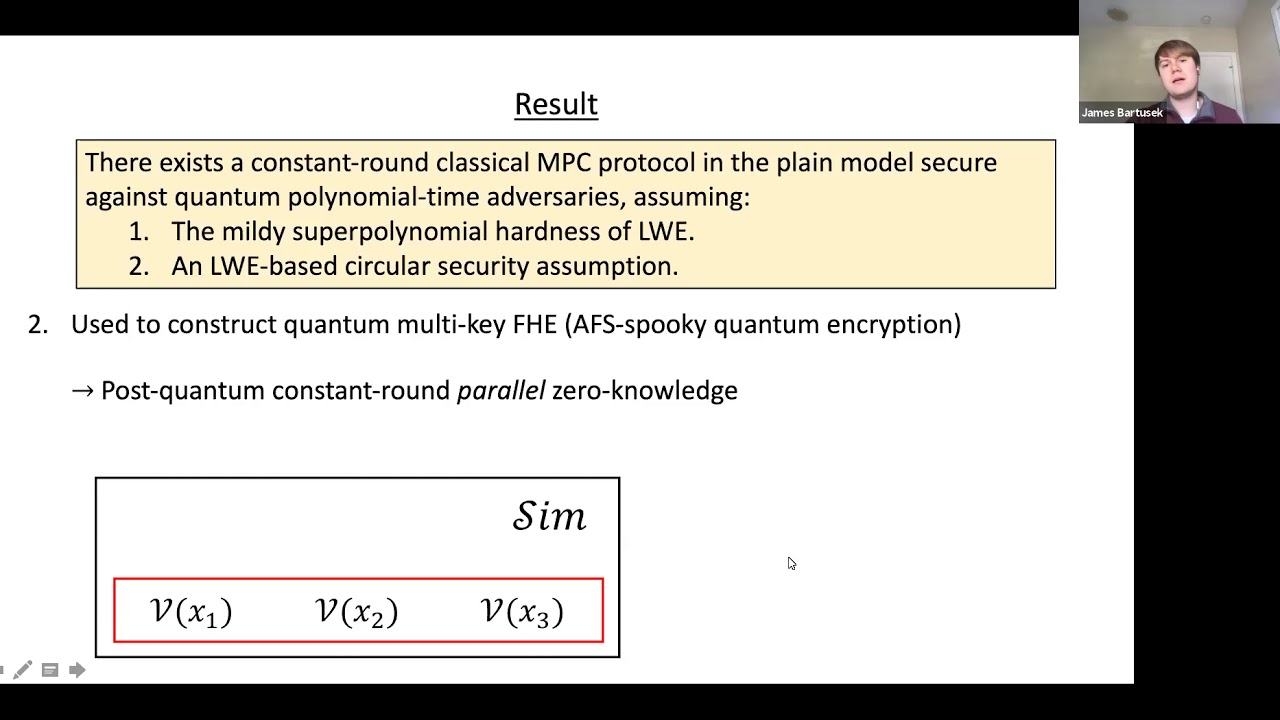
This talk will describe the first constant-round classical MPC protocol in the plain model secure against quantum polynomial-time adversaries. Security follows from the mildy superpolynomial hardness of LWE and an LWE-based circular security assumption. At a technical level, the protocol relies on a novel parallel no-cloning non-black-box simulation technique that uses the recently introduced no-cloning technique of Bitansky and Shmueli (STOC 2020) as a starting point. Parallel simulation is enabled by the first construction of spooky encryption for relations computable by quantum circuits. In addition, the protocol makes crucial use of post-quantum non-malleable commitments in the plain model, which are constructed by porting the techniques of Khurana and Sahai (FOCS 2017) to the post-quantum setting.
Based on joint work with Amit Agarwal, Vipul Goyal, Dakshita Khurana, and Giulio Malavolta.
Lattices: Algorithms, Complexity, and Cryptography
Seminar, Apr. 21, 2020
This talk will describe the first constant-round classical MPC protocol in the plain model secure against quantum polynomial-time adversaries. Security follows from the mildy superpolynomial hardness of LWE and an LWE-based circular security assumption. At a technical level, the protocol relies on a novel parallel no-cloning non-black-box simulation technique that uses the recently introduced no-cloning technique of Bitansky and Shmueli (STOC 2020) as a starting point. Parallel simulation is enabled by the first construction of spooky encryption for relations computable by quantum circuits. In addition, the protocol makes crucial use of post-quantum non-malleable commitments in the plain model, which are constructed by porting the techniques of Khurana and Sahai (FOCS 2017) to the post-quantum setting.
Based on joint work with Amit Agarwal, Vipul Goyal, Dakshita Khurana, and Giulio Malavolta.
Tags and Topics
Browse our collection to discover more content in these categories.
Video Information
Views
672
Likes
6
Duration
01:15:05
Published
Apr 23, 2020
Related Trending Topics
LIVE TRENDSRelated trending topics. Click any trend to explore more videos.
Trending Now