Comprehensive Review of General-Purpose Frameworks for Secure Multi-Party Computation 🔐
Explore the latest advancements in secure multi-party computation frameworks with insights from Marcella Hastings at IEEE Security & Privacy 2019. Learn how these versatile tools enhance privacy and security in collaborative computing.

IEEE Symposium on Security and Privacy
2.0K views • Jun 3, 2019
About this video
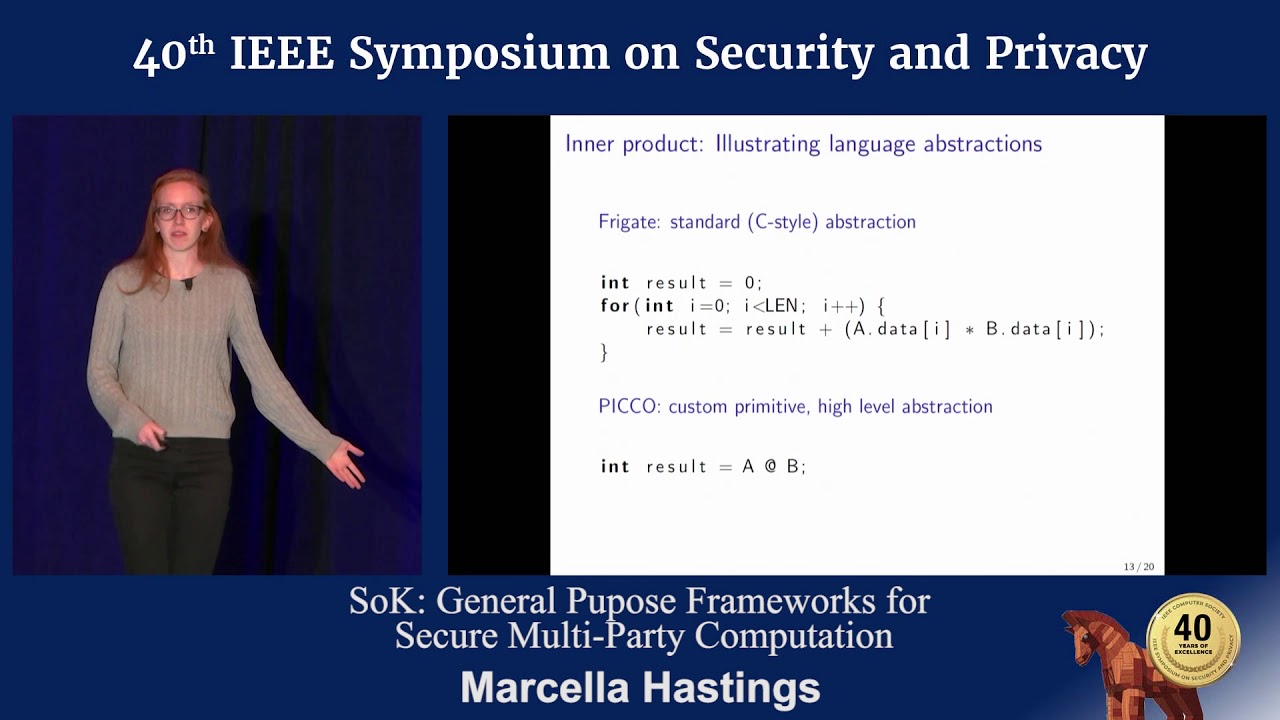
SoK: General Purpose Frameworks for Secure Multi-Party Computation - Marcella Hastings
Presented at the
2019 IEEE Symposium on Security & Privacy
May 20–22, 2019
San Francisco, CA
http://www.ieee-security.org/TC/SP2019/
Secure multi-party computation (MPC) allows a group of mutually distrustful parties to compute a joint function on their inputs without revealing any information beyond the result of the computation. This type of computation is extremely powerful and has wide-ranging applications in academia, industry, and government. Protocols for secure computation have existed for decades, but only recently have general-purpose compilers for executing MPC on arbitrary functions been developed. These projects rapidly improved the state of the art, and began to make MPC accessible to non-expert users.
However, the field is changing so rapidly that it is difficult even for experts to keep track of the varied capabilities of modern frameworks.
In this work, we survey general-purpose compilers for secure multi-party computation.
These tools provide high-level abstractions to describe arbitrary functions and execute secure computation protocols. We consider eleven systems: EMP-toolkit, Obliv-C, ObliVM, TinyGarble, SCALE-MAMBA (formerly SPDZ), Wysteria, Sharemind, PICCO, ABY,
Frigate and CBMC-GC. We evaluate these systems on a range of criteria, including language expressibility, capabilities of the cryptographic back-end, and accessibility to developers. We advocate for improved documentation of MPC frameworks, standardization within the community, and make recommendations for future directions in compiler development. Installing and running these systems can be challenging, and for each system, we also provide a complete virtual environment (Docker container) with all the necessary dependencies to run the compiler and our example programs.
Presented at the
2019 IEEE Symposium on Security & Privacy
May 20–22, 2019
San Francisco, CA
http://www.ieee-security.org/TC/SP2019/
Secure multi-party computation (MPC) allows a group of mutually distrustful parties to compute a joint function on their inputs without revealing any information beyond the result of the computation. This type of computation is extremely powerful and has wide-ranging applications in academia, industry, and government. Protocols for secure computation have existed for decades, but only recently have general-purpose compilers for executing MPC on arbitrary functions been developed. These projects rapidly improved the state of the art, and began to make MPC accessible to non-expert users.
However, the field is changing so rapidly that it is difficult even for experts to keep track of the varied capabilities of modern frameworks.
In this work, we survey general-purpose compilers for secure multi-party computation.
These tools provide high-level abstractions to describe arbitrary functions and execute secure computation protocols. We consider eleven systems: EMP-toolkit, Obliv-C, ObliVM, TinyGarble, SCALE-MAMBA (formerly SPDZ), Wysteria, Sharemind, PICCO, ABY,
Frigate and CBMC-GC. We evaluate these systems on a range of criteria, including language expressibility, capabilities of the cryptographic back-end, and accessibility to developers. We advocate for improved documentation of MPC frameworks, standardization within the community, and make recommendations for future directions in compiler development. Installing and running these systems can be challenging, and for each system, we also provide a complete virtual environment (Docker container) with all the necessary dependencies to run the compiler and our example programs.
Video Information
Views
2.0K
Likes
40
Duration
18:50
Published
Jun 3, 2019
User Reviews
4.5
(2) Related Trending Topics
LIVE TRENDSRelated trending topics. Click any trend to explore more videos.
No specific trending topics match this video yet.
Explore All Trends