Innovative Neuro-Evolution Techniques for Multirotor Drone Landing 🛬
Discover how Washington and Lee undergraduate student Coletta Fuller and I are advancing drone landing strategies using NEAT, a cutting-edge neural evolution method. Watch the groundbreaking work in action!

Simon Levy
229 views • Nov 25, 2020
About this video
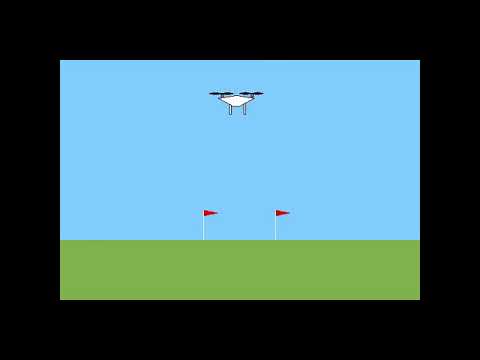
This video shows work being done with Washington and Lee undergraduate student Coletta Fuller. Coletta and I are using the NEAT (Neural Evolution of Augmenting Topologies) algorithm to evolve autonomous multirotor behaviors like landing. This video shows a simplified version of the multirotor, similar to the famous Lunar Lander game, that uses six degrees of freedom to represent the vehicle state (x,y coordinates and their first derivatives, plus roll angle and its first derivatives) and two degrees of freedom of control (left and right motors). In around one minute (on an eight- or twelve-CPU computer), the NEAT algorithm learns to land the copter with a very high score (over 200), competitive with Deep Reinforcement Learning (DRL) approaches. As the video shows, the NEAT algorithm evolves very simple neural nets, in some cases without any hidden units, and arrives at different strategies for the same problem. We are currently working to extend this approach to a full 3D model, and other behaviors, such as predation.
Code: https://github.com/simondlevy/gym-copter https://github.com/simondlevy/NEAT-Gym
Music: The Red Clay Ramblers, "Cajun Billy"
Code: https://github.com/simondlevy/gym-copter https://github.com/simondlevy/NEAT-Gym
Music: The Red Clay Ramblers, "Cajun Billy"
Video Information
Views
229
Likes
2
Duration
0:38
Published
Nov 25, 2020
Related Trending Topics
LIVE TRENDSRelated trending topics. Click any trend to explore more videos.
No specific trending topics match this video yet.
Explore All Trends