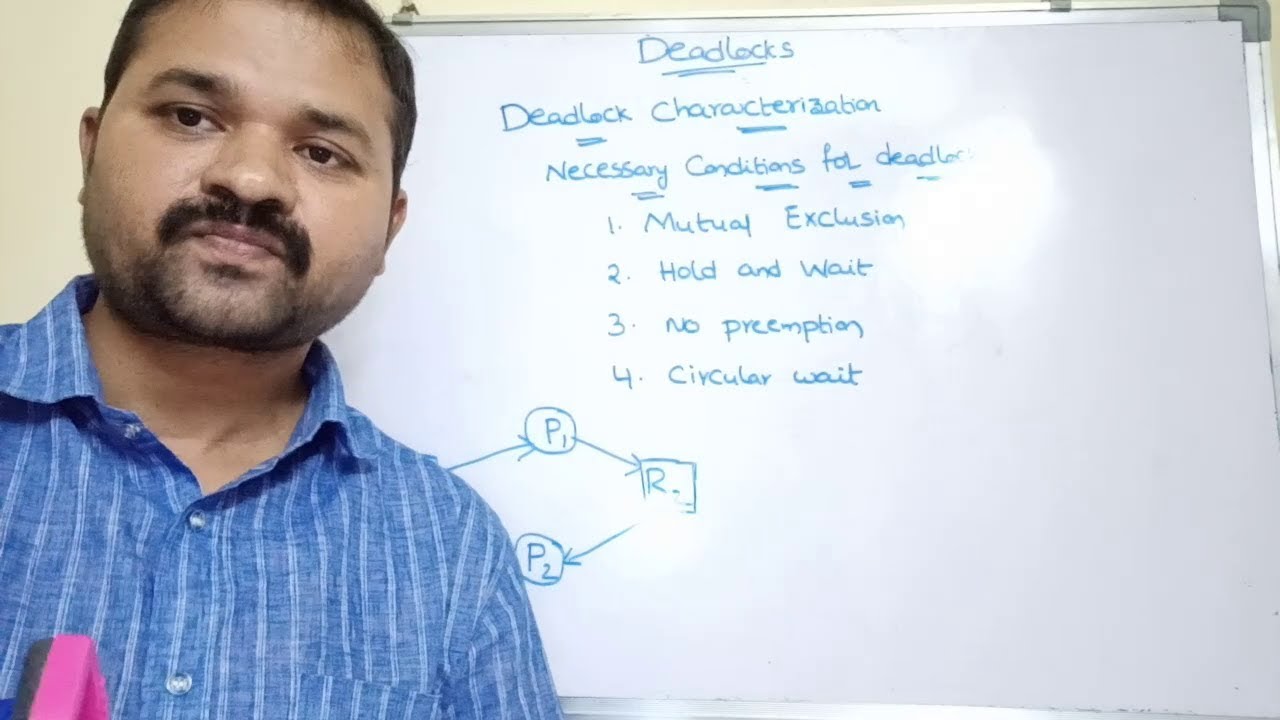
Deadlock Characterization Part 1: Necessary Conditions for Deadlock
This lecture covers the concept of deadlocks in operating systems, focusing on the necessary conditions that lead to deadlock situations involving multiple processes competing for resources.

Sudhakar Atchala
152.3K views • Oct 4, 2019
About this video
#deadlocks #deadlockcharacterization #operatingsystemlectures
A deadlock happens in operating system when two or more processes need some resource to complete their execution that is held by the other process.
A deadlock occurs if the four Coffman conditions hold true. But these conditions are not mutually exclusive. They are given as follows:
Mutual Exclusion
There should be a resource that can only be held by one process at a time. In the diagram below, there is a single instance of Resource 1 and it is held by Process 1 only.
Hold and Wait
A process can hold multiple resources and still request more resources from other processes which are holding them. In the diagram given below, Process 2 holds Resource 2 and Resource 3 and is requesting the Resource 1 which is held by Process 1.
No Preemption
A resource cannot be preempted from a process by force. A process can only release a resource voluntarily. In the diagram below, Process 2 cannot preempt Resource 1 from Process 1. It will only be released when Process 1 relinquishes it voluntarily after its execution is complete.
Circular Wait
A process is waiting for the resource held by the second process, which is waiting for the resource held by the third process and so on, till the last process is waiting for a resource held by the first process. This forms a circular chain. For example: Process 1 is allocated Resource2 and it is requesting Resource 1. Similarly, Process 2 is allocated Resource 1 and it is requesting Resource 2. This forms a circular wait loop.
A deadlock happens in operating system when two or more processes need some resource to complete their execution that is held by the other process.
A deadlock occurs if the four Coffman conditions hold true. But these conditions are not mutually exclusive. They are given as follows:
Mutual Exclusion
There should be a resource that can only be held by one process at a time. In the diagram below, there is a single instance of Resource 1 and it is held by Process 1 only.
Hold and Wait
A process can hold multiple resources and still request more resources from other processes which are holding them. In the diagram given below, Process 2 holds Resource 2 and Resource 3 and is requesting the Resource 1 which is held by Process 1.
No Preemption
A resource cannot be preempted from a process by force. A process can only release a resource voluntarily. In the diagram below, Process 2 cannot preempt Resource 1 from Process 1. It will only be released when Process 1 relinquishes it voluntarily after its execution is complete.
Circular Wait
A process is waiting for the resource held by the second process, which is waiting for the resource held by the third process and so on, till the last process is waiting for a resource held by the first process. This forms a circular chain. For example: Process 1 is allocated Resource2 and it is requesting Resource 1. Similarly, Process 2 is allocated Resource 1 and it is requesting Resource 2. This forms a circular wait loop.
Tags and Topics
Browse our collection to discover more content in these categories.
Video Information
Views
152.3K
Likes
2.5K
Duration
6:55
Published
Oct 4, 2019
User Reviews
4.7
(30) Related Trending Topics
LIVE TRENDSRelated trending topics. Click any trend to explore more videos.
No specific trending topics match this video yet.
Explore All Trends