Cutting-Edge Developments in Code-Based Encryption & Digital Signatures 🔐
Explore the latest breakthroughs in code-based cryptography and digital signatures presented by Paolo Santini at the Post-Quantum Cifris Seminar. Stay ahead in quantum-resistant security!
De Componendis Cifris
259 views • Nov 24, 2021
About this video
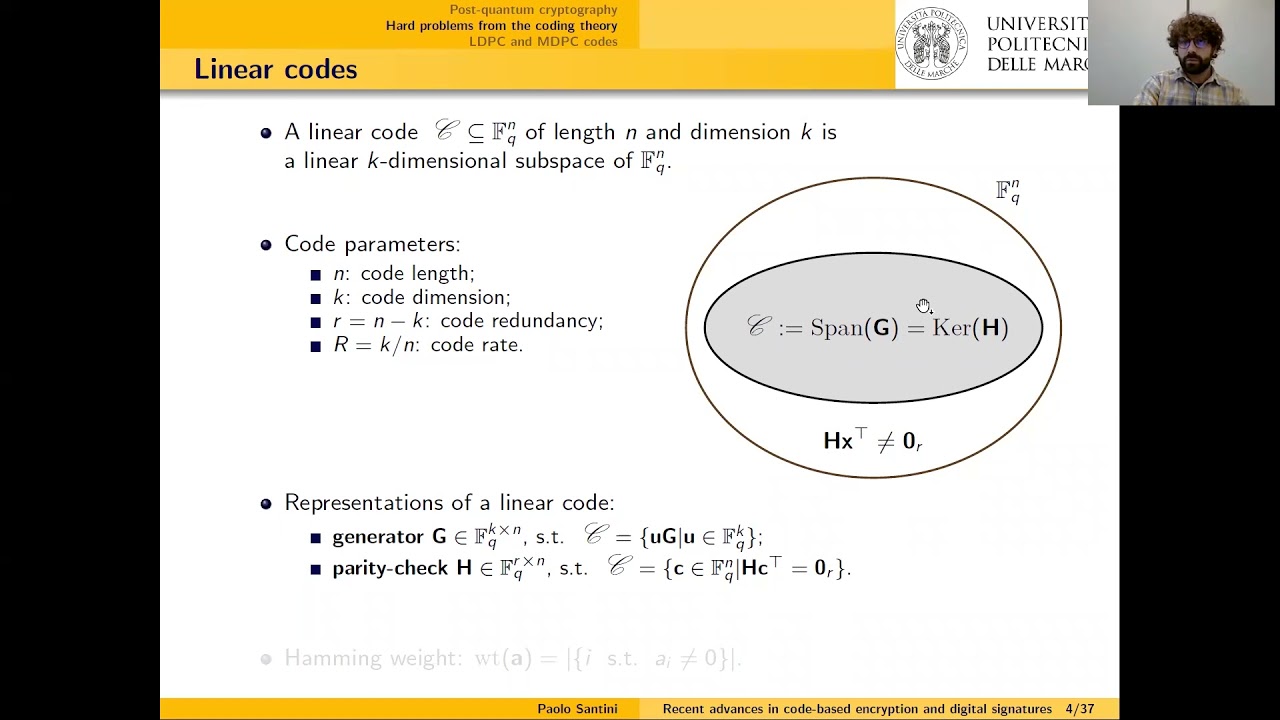
"Recent advances in code-based encryption and digital signatures" - Paolo Santini.
Seminario Post-Quantum Cifris.
Il seminario è introdotto dal professor Marco Baldi, coordinatore del nostro team Post-Quantum.
Abstract: Code-based cryptography is widely recognized as one of the most promising solutions to build efficient public-key cryptosystems with post-quantum security. Initiated by Robert McEliece in 1978, this kind of cryptosystems is constructed around the so-called Syndrome Decoding Problem (SDP), that is, the problem of decoding a random looking linear code. The original McEliece proposal, based on binary Goppa codes, is still essentially unbroken but features rather large public keys and is not well suited to be turned into a digital signature scheme. Along the years, researchers have proposed several alternatives, aiming to face these issues. In this talk we will recall the most important modern solutions, such as encryption schemes based on Low-Density Parity-Check (LDPC) and Moderate-Density Parity-Check (MDPC) codes, and signature schemes obtained from random and pseudo-random codes.We will outline the pros and cons of the considered schemes, and eventually mention possible research goals and directions.
PQCifris: http://www.decifris.it/PQCifris.html
De Componendis Cifris: https://www.decifris.it
Seminario Post-Quantum Cifris.
Il seminario è introdotto dal professor Marco Baldi, coordinatore del nostro team Post-Quantum.
Abstract: Code-based cryptography is widely recognized as one of the most promising solutions to build efficient public-key cryptosystems with post-quantum security. Initiated by Robert McEliece in 1978, this kind of cryptosystems is constructed around the so-called Syndrome Decoding Problem (SDP), that is, the problem of decoding a random looking linear code. The original McEliece proposal, based on binary Goppa codes, is still essentially unbroken but features rather large public keys and is not well suited to be turned into a digital signature scheme. Along the years, researchers have proposed several alternatives, aiming to face these issues. In this talk we will recall the most important modern solutions, such as encryption schemes based on Low-Density Parity-Check (LDPC) and Moderate-Density Parity-Check (MDPC) codes, and signature schemes obtained from random and pseudo-random codes.We will outline the pros and cons of the considered schemes, and eventually mention possible research goals and directions.
PQCifris: http://www.decifris.it/PQCifris.html
De Componendis Cifris: https://www.decifris.it
Video Information
Views
259
Likes
11
Duration
01:04:04
Published
Nov 24, 2021
Related Trending Topics
LIVE TRENDSRelated trending topics. Click any trend to explore more videos.
No specific trending topics match this video yet.
Explore All Trends