Computational Microscopy for Sub-Cellular Insights 🧬
Dr. Juan M. Vanegas explores molecular modeling and simulations to study sub-cellular functions in biological systems.

PhysicsatUVM
88 views • Mar 4, 2016
About this video
Dr. Juan M. Vanegas
Nanobiology Department
Center for Biological and Materials Sciences
Sandia National Laboratories
Computer simulations are emerging as a new form of “microscopy” that can dynamically probe structure-function relationships in biological systems at the nanometer scale. While biology can span vastly different scales, from single cells to tissues to entire organisms, every function arises from interactions at the atomic and molecular level. However, determining the connection between the structure of biomolecules and their function continues to be an exceptional challenge both experimentally and theoretically.
I will present an overview of classical and ab initio molecular simulation techniques and their application to problems in mechanical signal transduction and enzymatic catalysis. Focusing on the bacterial mechanosensitive channel MscL, I will show how a unique association pattern of lipids at specific sites in MscL may mediate gating of MscL by membrane tension or other stimuli. This result is important to bridging continuum models of mechanosensation and molecular features of the channel.
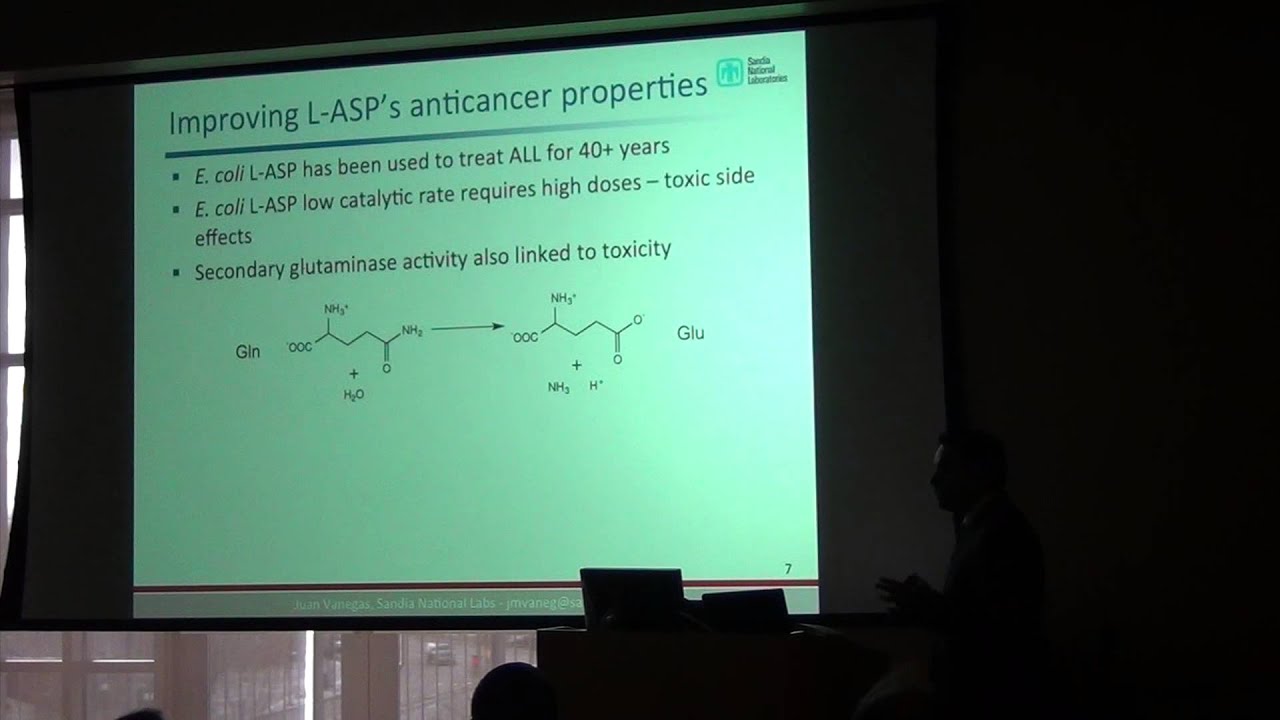
Shifting from mechanosensation toward rational engineering of L-asparaginase (L-ASP, an anticancer enzyme), I will show how substrate specificity in L-ASP can be tuned by altering certain residues in the active site. Furthermore, the initial stages of the L-ASP reaction (unknown for 40+ years!) indicate that the substrate plays an active role during catalysis – a feature that may provide future pathways to engineer L-ASP variants for improved clinical treatments of leukemia.
Nanobiology Department
Center for Biological and Materials Sciences
Sandia National Laboratories
Computer simulations are emerging as a new form of “microscopy” that can dynamically probe structure-function relationships in biological systems at the nanometer scale. While biology can span vastly different scales, from single cells to tissues to entire organisms, every function arises from interactions at the atomic and molecular level. However, determining the connection between the structure of biomolecules and their function continues to be an exceptional challenge both experimentally and theoretically.
I will present an overview of classical and ab initio molecular simulation techniques and their application to problems in mechanical signal transduction and enzymatic catalysis. Focusing on the bacterial mechanosensitive channel MscL, I will show how a unique association pattern of lipids at specific sites in MscL may mediate gating of MscL by membrane tension or other stimuli. This result is important to bridging continuum models of mechanosensation and molecular features of the channel.
Shifting from mechanosensation toward rational engineering of L-asparaginase (L-ASP, an anticancer enzyme), I will show how substrate specificity in L-ASP can be tuned by altering certain residues in the active site. Furthermore, the initial stages of the L-ASP reaction (unknown for 40+ years!) indicate that the substrate plays an active role during catalysis – a feature that may provide future pathways to engineer L-ASP variants for improved clinical treatments of leukemia.
Tags and Topics
Browse our collection to discover more content in these categories.
Video Information
Views
88
Duration
01:03:55
Published
Mar 4, 2016