Aromatic vs Antiaromatic vs Nonaromatic
🌿 Hexatriene Structure 🔄 Conjugated Systems 🔗 Cyclic and Non-Cyclic Compounds 💡 Hybridization and Planarity 🧪 Pi Electrons and Aromaticity Aromaticity ...

Chad's Prep
7.3K views • Feb 19, 2026
About this video
🌿 Hexatriene Structure
🔄 Conjugated Systems
🔗 Cyclic and Non-Cyclic Compounds
💡 Hybridization and Planarity
🧪 Pi Electrons and Aromaticity
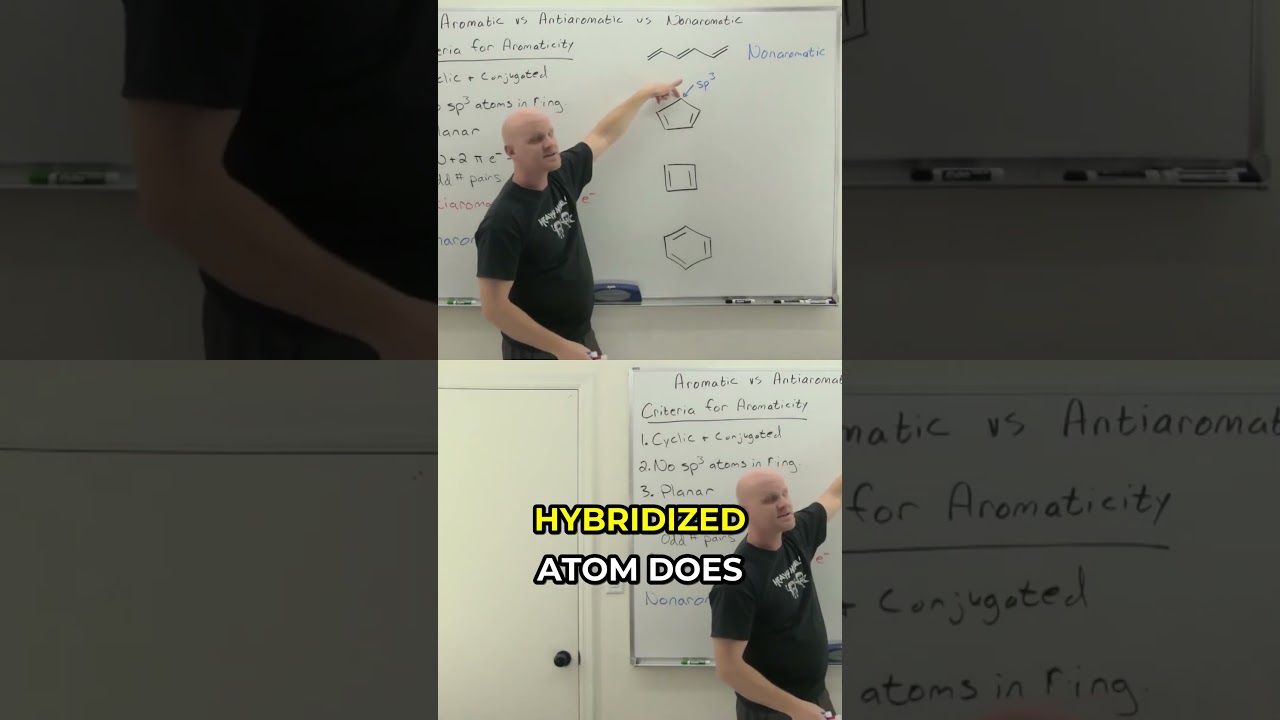
Aromaticity is a fascinating concept in organic chemistry, determining how molecules like benzene achieve stability through a cyclic, conjugated system. Structures such as 1,3,5-hexatriene illustrate non-cyclic, conjugated systems, differentiating them from aromatic compounds due to their linear configuration. Understanding the distinction between cyclic and non-cyclic conjugation is essential for grasping molecular stability.
The analysis of hybridization plays a critical role in identifying aromatic compounds, where sp2 hybridization allows for complete conjugation within a ring, unlike sp3 hybridization which disrupts this continuity. The presence of an sp3 atom in a ring prevents the formation of a fully delocalized pi electron system, thus categorizing such structures as non-aromatic.
Anti-aromatic compounds, despite being cyclic and fully conjugated, possess a pi electron count that leads to instability, unlike aromatic compounds which follow the 4n+2 rule for electron count. Benzene serves as a classic example of aromaticity, with its cyclic structure, delocalized pi electrons, and adherence to the 4n+2 electron rule, providing a stable configuration that is energetically favorable.
#organicchemistry #aromaticity #huckelrule
🔄 Conjugated Systems
🔗 Cyclic and Non-Cyclic Compounds
💡 Hybridization and Planarity
🧪 Pi Electrons and Aromaticity
Aromaticity is a fascinating concept in organic chemistry, determining how molecules like benzene achieve stability through a cyclic, conjugated system. Structures such as 1,3,5-hexatriene illustrate non-cyclic, conjugated systems, differentiating them from aromatic compounds due to their linear configuration. Understanding the distinction between cyclic and non-cyclic conjugation is essential for grasping molecular stability.
The analysis of hybridization plays a critical role in identifying aromatic compounds, where sp2 hybridization allows for complete conjugation within a ring, unlike sp3 hybridization which disrupts this continuity. The presence of an sp3 atom in a ring prevents the formation of a fully delocalized pi electron system, thus categorizing such structures as non-aromatic.
Anti-aromatic compounds, despite being cyclic and fully conjugated, possess a pi electron count that leads to instability, unlike aromatic compounds which follow the 4n+2 rule for electron count. Benzene serves as a classic example of aromaticity, with its cyclic structure, delocalized pi electrons, and adherence to the 4n+2 electron rule, providing a stable configuration that is energetically favorable.
#organicchemistry #aromaticity #huckelrule
Tags and Topics
Browse our collection to discover more content in these categories.
Video Information
Views
7.3K
Likes
372
Duration
2:47
Published
Feb 19, 2026
User Reviews
4.6
(1) Related Trending Topics
LIVE TRENDSRelated trending topics. Click any trend to explore more videos.
Trending Now