Advances in Computational Modeling for Spine Research 🦴
Explore the latest developments in computational modeling techniques transforming spine research. Join Fabio Galbusera's plenary lecture to learn how these innovations are shaping diagnosis and treatment strategies.

Disc4All European Innovative Training Network
148 views • Aug 17, 2022
About this video
Fabio Galbusera (Schulthess Clinic in Zürich, Switzerland)
Plenary Lecture, Thursday May 26th, 2022, 12:30-13:30, Chair: Andrea Nuesch
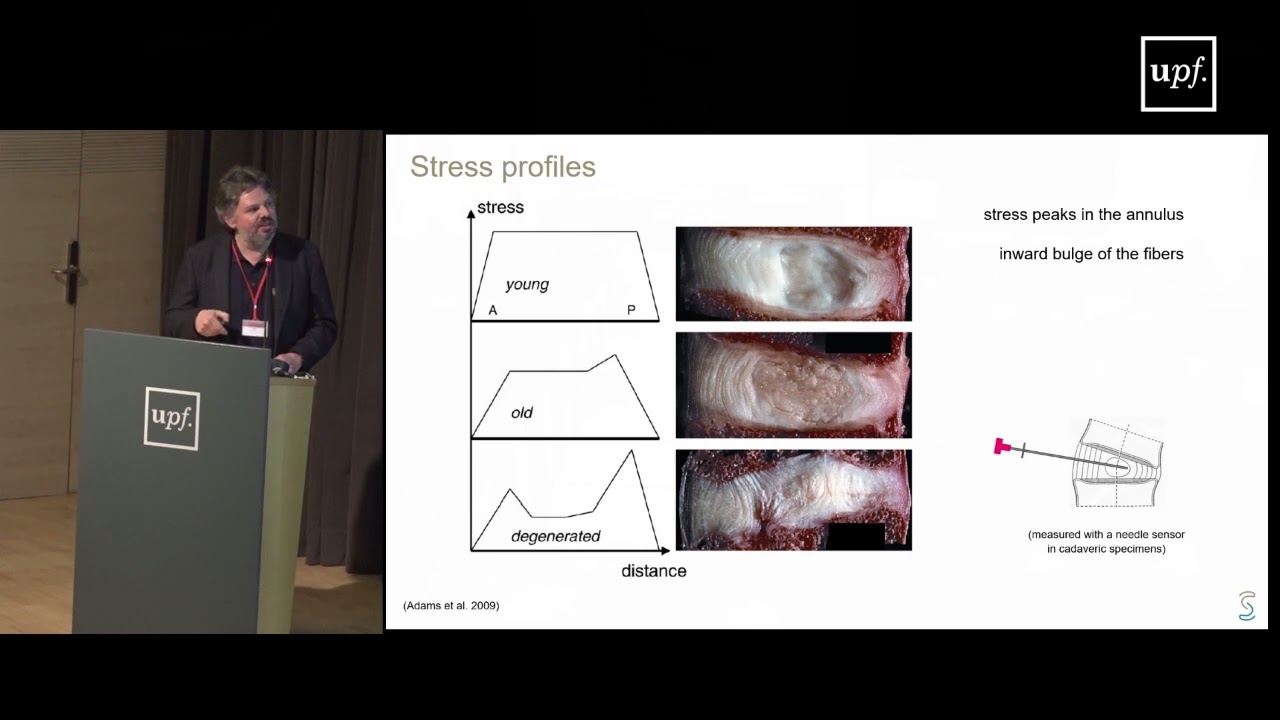
Abstract: The application of numerical methods in spine biomechanics began in the 1980s, targeting several research questions such as the stress and strain distribution in vertebrae and intervertebral discs under various loading conditions. With the development of more sophisticated models and an increase in computer capacity, the applications of numerical models of the spine continued to expand and currently include the analysis and optimization of surgical treatments, the investigation of aetiology of diseases such as idiopathic scoliosis and disc degeneration, the prediction of the risk of vertebral fractures, the healing and remodelling of bone after fixation, the development and analysis of spinal implants, and the effect of conservative treatments such as bracing and plaster casting. The body of literature about computational modelling in spine research is very large, including papers about various implants for the treatment of degenerative disorders, deformities, trauma and tumors, and covers various scales from bone and intervertebral disc microstructure to the whole spine from head to pelvis. A driving motivation for computational models is to evaluate surgical strategies and the stresses acting in the implants and the surrounding anatomical regions, in order to identify the risk of mechanical failure of the implant itself or its interface with the adjacent anatomy. A major goal of computational modelling is indeed to simulate different treatment options prior to orthopaedic intervention in order to identify the “optimal” surgical strategy, potentially leading to an improvement of the outcome and a reduction of the complication rates.
Biosketch: He is an engineer, Research Associate at the Schulthess Clinic in Zürich, Switzerland. He has been the head of the Laboratory of Biological Structures Mechanics at IRCCS Istituto Ortopedico Galeazzi, Milan. He received his M.S. degree in Biomedical Engineering at the Politecnico di Milano, Italy and the Ph.D. at the Institute of Orthopaedic Research and Biomechanics, Center of Musculoskeletal Research Ulm, Germany. His main research interests are the biomechanics of the spine, the use of numerical models for its investigation as well as spinal imaging, about which he published more than 130 papers in international peer-reviewed journals. He is member of the International Society for the Study of the Lumbar Spine (ISSLS), of the Spine Society of Europe (EUROSPINE), of the European Society of Biomechanics (ESB) and of the European Society of Radiology (ESR), and is currently part of the Editorial Boards of Journal of Biomechanics, European Spine Journal, Frontiers in Bioengineering and Biotechnology and of European Radiology Experimental.
Plenary Lecture, Thursday May 26th, 2022, 12:30-13:30, Chair: Andrea Nuesch
Abstract: The application of numerical methods in spine biomechanics began in the 1980s, targeting several research questions such as the stress and strain distribution in vertebrae and intervertebral discs under various loading conditions. With the development of more sophisticated models and an increase in computer capacity, the applications of numerical models of the spine continued to expand and currently include the analysis and optimization of surgical treatments, the investigation of aetiology of diseases such as idiopathic scoliosis and disc degeneration, the prediction of the risk of vertebral fractures, the healing and remodelling of bone after fixation, the development and analysis of spinal implants, and the effect of conservative treatments such as bracing and plaster casting. The body of literature about computational modelling in spine research is very large, including papers about various implants for the treatment of degenerative disorders, deformities, trauma and tumors, and covers various scales from bone and intervertebral disc microstructure to the whole spine from head to pelvis. A driving motivation for computational models is to evaluate surgical strategies and the stresses acting in the implants and the surrounding anatomical regions, in order to identify the risk of mechanical failure of the implant itself or its interface with the adjacent anatomy. A major goal of computational modelling is indeed to simulate different treatment options prior to orthopaedic intervention in order to identify the “optimal” surgical strategy, potentially leading to an improvement of the outcome and a reduction of the complication rates.
Biosketch: He is an engineer, Research Associate at the Schulthess Clinic in Zürich, Switzerland. He has been the head of the Laboratory of Biological Structures Mechanics at IRCCS Istituto Ortopedico Galeazzi, Milan. He received his M.S. degree in Biomedical Engineering at the Politecnico di Milano, Italy and the Ph.D. at the Institute of Orthopaedic Research and Biomechanics, Center of Musculoskeletal Research Ulm, Germany. His main research interests are the biomechanics of the spine, the use of numerical models for its investigation as well as spinal imaging, about which he published more than 130 papers in international peer-reviewed journals. He is member of the International Society for the Study of the Lumbar Spine (ISSLS), of the Spine Society of Europe (EUROSPINE), of the European Society of Biomechanics (ESB) and of the European Society of Radiology (ESR), and is currently part of the Editorial Boards of Journal of Biomechanics, European Spine Journal, Frontiers in Bioengineering and Biotechnology and of European Radiology Experimental.
Video Information
Views
148
Likes
1
Duration
59:38
Published
Aug 17, 2022
Related Trending Topics
LIVE TRENDSRelated trending topics. Click any trend to explore more videos.
No specific trending topics match this video yet.
Explore All Trends