Youth & Arab Spring: Democratic Changes? 🌍
Explores how the Arab Spring impacted youth involvement and democratic opportunities in the region's history.

DiplomacyChannel
43 views • Oct 19, 2021
About this video
The Arab Spring stands within the historical panorama as a watershed between how the riots were organized and carried out before and after the spread of social media. It is precisely this, therefore, the princeps element that places young people in a prominent position regarding the organization of revolutions and the legacy they have left.
What should not be overshadowed, in fact, is not simply the use of social media as a means to reach a large number of people, but the absence of any form of hierarchy within the same media. This element, unknown or secondary in the revolutions that occurred before 2010, has led to a drastic expansion of popular participation and, above all, of young people from the countries concerned.
At first glance, the absence of a hierarchy and the expansion of popular participation could be sufficient conditions for a democratic opening. However, it is essential not to forget the substantial difference between democracy and oclocracy; the first, indicating a government of the demos, the second, representing a deteriorated stage of government in which power is in the hands of the masses.
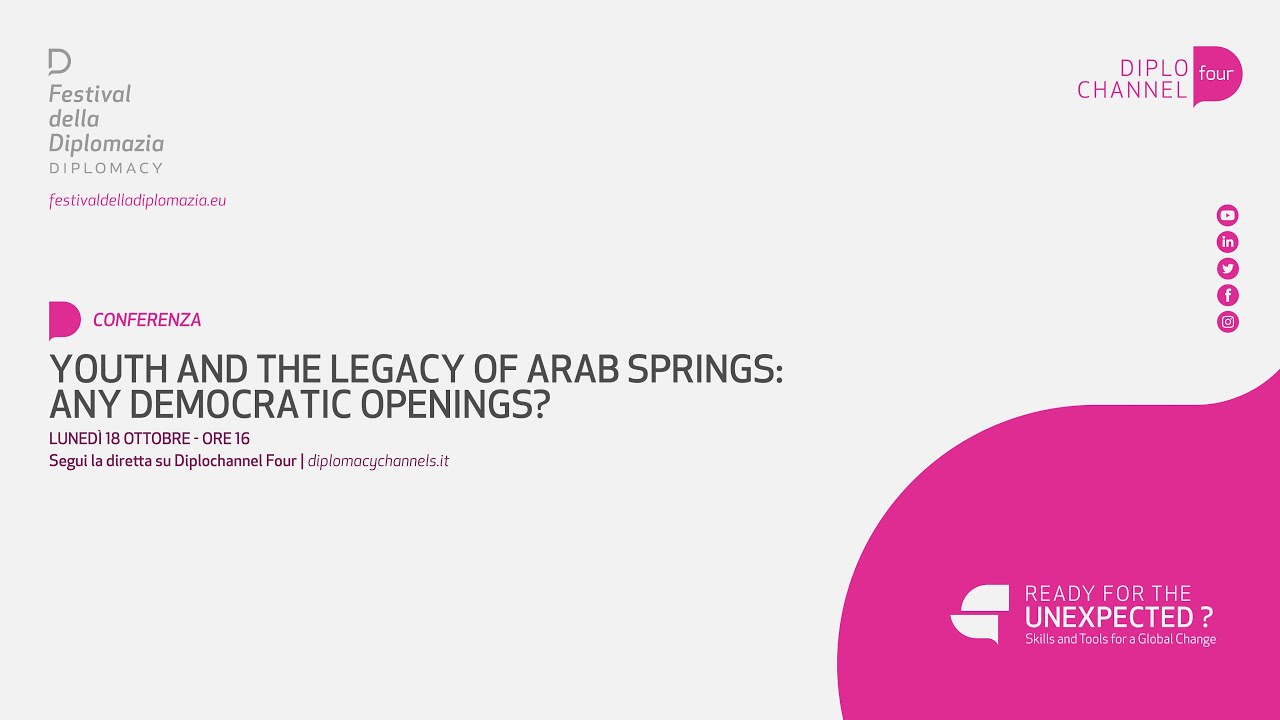
It is still difficult to establish whether the Arab Spring marked a starting point for democracy in the countries that have been involved. Perhaps this was the case, or perhaps it is not possible to generalize and it is necessary to analyze the progress and regressions that occurred in each Arab state in those years. Since this is such a delicate discussion and still under debate, the Diplomacy Festival in Rome has decided to host the event "Youth and the legacy of Arab springs: any democratic openings?", In which this issue will be discussed in detail. .
What should not be overshadowed, in fact, is not simply the use of social media as a means to reach a large number of people, but the absence of any form of hierarchy within the same media. This element, unknown or secondary in the revolutions that occurred before 2010, has led to a drastic expansion of popular participation and, above all, of young people from the countries concerned.
At first glance, the absence of a hierarchy and the expansion of popular participation could be sufficient conditions for a democratic opening. However, it is essential not to forget the substantial difference between democracy and oclocracy; the first, indicating a government of the demos, the second, representing a deteriorated stage of government in which power is in the hands of the masses.
It is still difficult to establish whether the Arab Spring marked a starting point for democracy in the countries that have been involved. Perhaps this was the case, or perhaps it is not possible to generalize and it is necessary to analyze the progress and regressions that occurred in each Arab state in those years. Since this is such a delicate discussion and still under debate, the Diplomacy Festival in Rome has decided to host the event "Youth and the legacy of Arab springs: any democratic openings?", In which this issue will be discussed in detail. .
Video Information
Views
43
Likes
1
Duration
01:28:36
Published
Oct 19, 2021
Related Trending Topics
LIVE TRENDSRelated trending topics. Click any trend to explore more videos.
No specific trending topics match this video yet.
Explore All Trends