Who Invented Cryptography?
Explore the origins of cryptography and its historical development in this comprehensive lecture. Also learn about the specific years when February has five Sundays and details about right-angled triangles.
Gresham College
1.7K views • Sep 7, 2023
About this video
Watch the full lecture here: https://www.gresham.ac.uk/watch-now/number-theory
In which years does February have five Sundays? How many right-angled triangles with whole-number sides have a side of length 29? How many shuffles are needed to restore the order of the cards in a pack with two Jokers? Are any of the numbers 11, 111, 1111, 11111, . . . perfect squares? Can one construct a regular polygon with 100 sides if measuring is forbidden? How do prime numbers help to keep our credit cards secure?
These are all questions in number theory, the branch of mathematics that’s primarily concerned with our counting numbers, 1, 2, 3, etc. Of particular importance are the prime numbers, the ‘building blocks’ of our number system.
The subject is an old one, dating back to the ancient Greeks, and for many years has been studied for its intrinsic beauty and elegance, not least because several of its challenges are so easy to state that everyone can understand them, and yet no-one has ever been able to resolve them.
This lecture situates the above problems and puzzles in their historical context, drawing on the work of many of the greatest mathematicians of the past, such as Euclid, Fermat, Euler and Gauss. Indeed, as Gauss, sometimes described as the ‘Prince of Mathematics’, has claimed: Mathematics is the Queen of the Sciences, and Number Theory is the Queen of Mathematics.
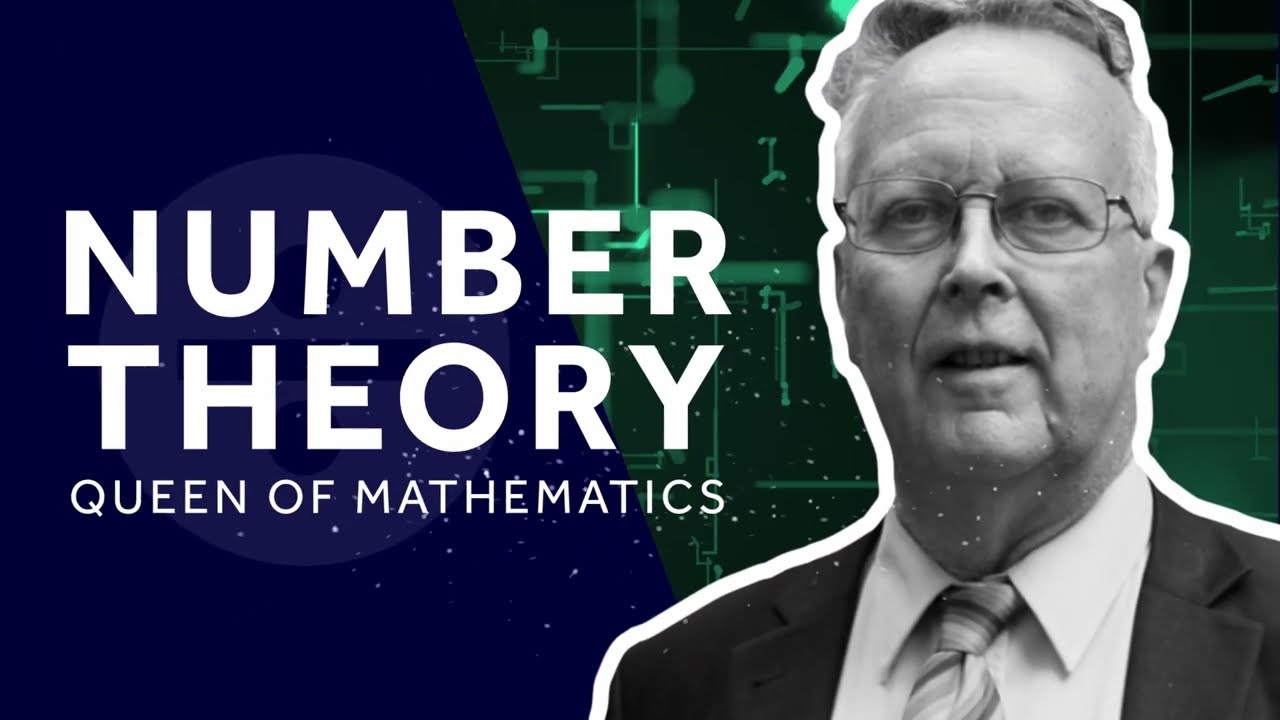
An excerpt taken from a lecture by Professor Robin Wilson called 'Number Theory: Queen of Mathematics'
In which years does February have five Sundays? How many right-angled triangles with whole-number sides have a side of length 29? How many shuffles are needed to restore the order of the cards in a pack with two Jokers? Are any of the numbers 11, 111, 1111, 11111, . . . perfect squares? Can one construct a regular polygon with 100 sides if measuring is forbidden? How do prime numbers help to keep our credit cards secure?
These are all questions in number theory, the branch of mathematics that’s primarily concerned with our counting numbers, 1, 2, 3, etc. Of particular importance are the prime numbers, the ‘building blocks’ of our number system.
The subject is an old one, dating back to the ancient Greeks, and for many years has been studied for its intrinsic beauty and elegance, not least because several of its challenges are so easy to state that everyone can understand them, and yet no-one has ever been able to resolve them.
This lecture situates the above problems and puzzles in their historical context, drawing on the work of many of the greatest mathematicians of the past, such as Euclid, Fermat, Euler and Gauss. Indeed, as Gauss, sometimes described as the ‘Prince of Mathematics’, has claimed: Mathematics is the Queen of the Sciences, and Number Theory is the Queen of Mathematics.
An excerpt taken from a lecture by Professor Robin Wilson called 'Number Theory: Queen of Mathematics'
Tags and Topics
Browse our collection to discover more content in these categories.
Video Information
Views
1.7K
Likes
57
Duration
1:39
Published
Sep 7, 2023
User Reviews
4.5
(1) Related Trending Topics
LIVE TRENDSRelated trending topics. Click any trend to explore more videos.
No specific trending topics match this video yet.
Explore All Trends