What Are Aftershocks? Essential Facts You Need to Know 🌍
Discover what aftershocks are, why they happen, and how they can impact earthquake recovery. Stay informed about Earth's dynamic movements and safety tips.

You Should Know
131 views • Apr 7, 2025
About this video
Earth is an active place full of storms, fast-moving river and ocean currents, volcanoes, and earthquakes. Continents are slowly but constantly moving, and the stresses that build up in the rocks that stem from pushing, pulling, and twisting forces eventually result in the sudden violent fracturing of the rocks.
Earthquakes—that is, sudden episodes of shaking ground—are caused by seismic waves (which result from the energy released by the breaking and slippage of one set of rocks against another). Aftershock is the term used to describe a shaking event that follows an earthquake. But what exactly is an aftershock, and what is it about an aftershock that makes it different from an earthquake?
Aftershocks are themselves earthquakes, but they are more accurately described as the lower-magnitude (or lower-intensity) tremors that follow the principal earthquake or main shock (that is, the largest earthquake in a sequence of earthquakes). When an earthquake occurs some of the energy released from the sudden fracturing of rock is transferred to the rocks nearby, which adds to the pushing, pulling, and twisting stresses already placed on them.
When these stresses are too much for the rocks to bear, they break as well, releasing a new round of pent-up energy and creating new faults in the rock. In this way, earthquakes beget aftershocks, and aftershocks beget smaller-and-smaller aftershocks. Aftershocks tend to be the most severe and happen more frequently in the hours and days that follow an earthquake.
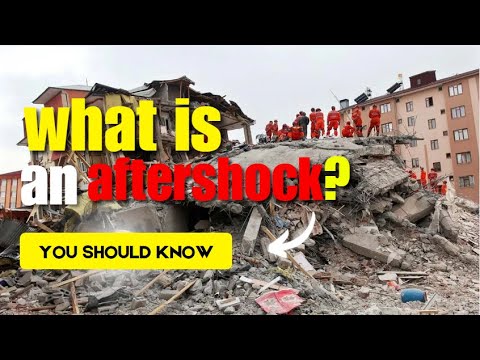
However, their magnitude and frequency decrease over time. Although the shaking intensity associated with most aftershocks is relatively small compared with that of the principal earthquake, it can be large enough to hamper rescue efforts by further destabilizing buildings and other structures. In addition, aftershocks can be stressful for local residents coping with the damage and loss of life wrought by the principal quake.
Earthquakes—that is, sudden episodes of shaking ground—are caused by seismic waves (which result from the energy released by the breaking and slippage of one set of rocks against another). Aftershock is the term used to describe a shaking event that follows an earthquake. But what exactly is an aftershock, and what is it about an aftershock that makes it different from an earthquake?
Aftershocks are themselves earthquakes, but they are more accurately described as the lower-magnitude (or lower-intensity) tremors that follow the principal earthquake or main shock (that is, the largest earthquake in a sequence of earthquakes). When an earthquake occurs some of the energy released from the sudden fracturing of rock is transferred to the rocks nearby, which adds to the pushing, pulling, and twisting stresses already placed on them.
When these stresses are too much for the rocks to bear, they break as well, releasing a new round of pent-up energy and creating new faults in the rock. In this way, earthquakes beget aftershocks, and aftershocks beget smaller-and-smaller aftershocks. Aftershocks tend to be the most severe and happen more frequently in the hours and days that follow an earthquake.
However, their magnitude and frequency decrease over time. Although the shaking intensity associated with most aftershocks is relatively small compared with that of the principal earthquake, it can be large enough to hamper rescue efforts by further destabilizing buildings and other structures. In addition, aftershocks can be stressful for local residents coping with the damage and loss of life wrought by the principal quake.
Tags and Topics
Browse our collection to discover more content in these categories.
Video Information
Views
131
Duration
1:50
Published
Apr 7, 2025
Related Trending Topics
LIVE TRENDSRelated trending topics. Click any trend to explore more videos.
Trending Now