Unlocking Turbulent Combustion at Exascale: Insights from Jacqueline Chen 🔥
Join renowned scientist Jacqueline Chen as she explores the future of Direct Numerical Simulation (DNS) in turbulent combustion, pushing the boundaries of computational science at the Exascale level. Don't miss this illuminating seminar!

MIT CCSE
330 views • Dec 7, 2020
About this video
Title:
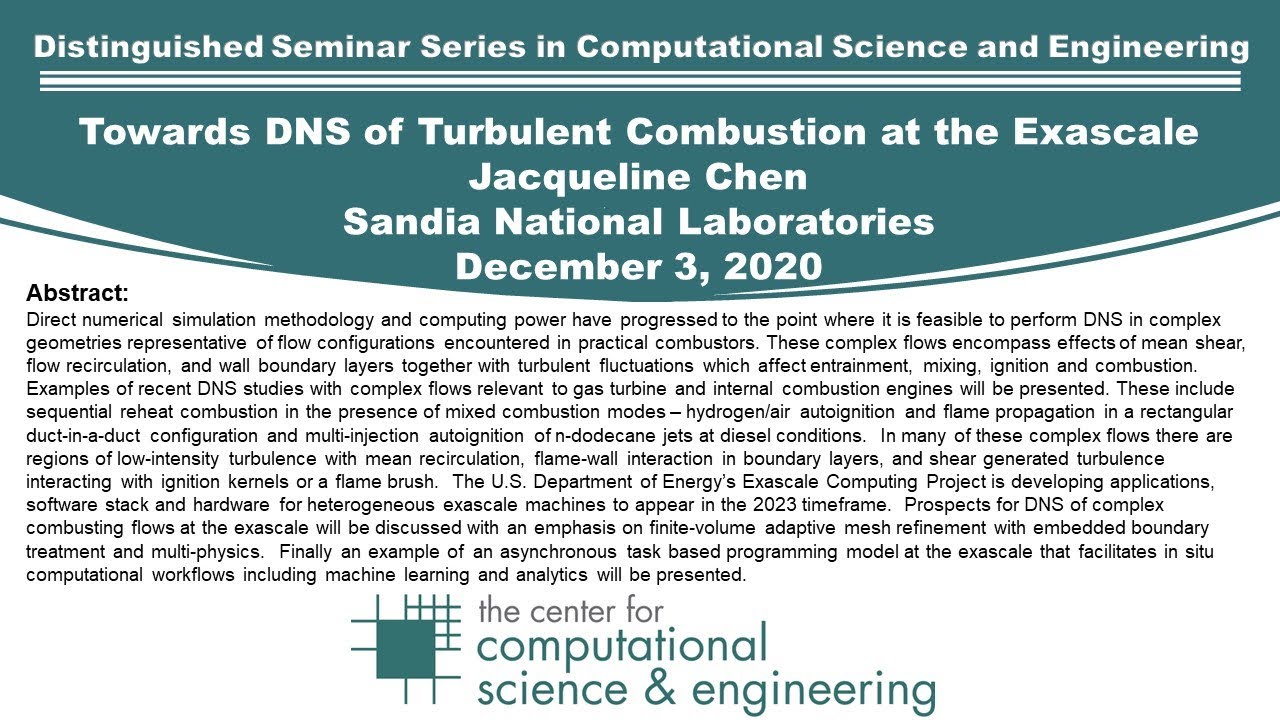
Towards DNS of Turbulent Combustion at the Exascale
Speaker:
Jacqueline Chen
Senior Scientist, Combustion Research Facility
Sandia National Laboratories
Abstract:
Direct numerical simulation methodology and computing power have progressed to the point where it is feasible to perform DNS in complex geometries representative of flow configurations encountered in practical combustors. These complex flows encompass effects of mean shear, flow recirculation, and wall boundary layers together with turbulent fluctuations which affect entrainment, mixing, ignition and combustion. Examples of recent DNS studies with complex flows relevant to gas turbine and internal combustion engines will be presented. These include sequential reheat combustion in the presence of mixed combustion modes – hydrogen/air autoignition and flame propagation in a rectangular duct-in-a-duct configuration and multi-injection autoignition of n-dodecane jets at diesel conditions. In many of these complex flows there are regions of low-intensity turbulence with mean recirculation, flame-wall interaction in boundary layers, and shear generated turbulence interacting with ignition kernels or a flame brush. The U.S. Department of Energy’s Exascale Computing Project is developing applications, software stack and hardware for heterogeneous exascale machines to appear in the 2023 timeframe. Prospects for DNS of complex combusting flows at the exascale will be discussed with an emphasis on finite-volume adaptive mesh refinement with embedded boundary treatment and multi-physics. Finally an example of an asynchronous task based programming model at the exascale that facilitates in situ computational workflows including machine learning and analytics will be presented.
Jacqueline Chen1, Aditya Konduri1, Martin Rieth1, Hemanth Kolla1, Andrea Gruber2, Mirko Bothien3, and Marc Day4
1 Sandia National Laboratories; 2SINTEF Energy; 3Ansaldo Energia;
4Lawrence Berkeley National Laboratory
Towards DNS of Turbulent Combustion at the Exascale
Speaker:
Jacqueline Chen
Senior Scientist, Combustion Research Facility
Sandia National Laboratories
Abstract:
Direct numerical simulation methodology and computing power have progressed to the point where it is feasible to perform DNS in complex geometries representative of flow configurations encountered in practical combustors. These complex flows encompass effects of mean shear, flow recirculation, and wall boundary layers together with turbulent fluctuations which affect entrainment, mixing, ignition and combustion. Examples of recent DNS studies with complex flows relevant to gas turbine and internal combustion engines will be presented. These include sequential reheat combustion in the presence of mixed combustion modes – hydrogen/air autoignition and flame propagation in a rectangular duct-in-a-duct configuration and multi-injection autoignition of n-dodecane jets at diesel conditions. In many of these complex flows there are regions of low-intensity turbulence with mean recirculation, flame-wall interaction in boundary layers, and shear generated turbulence interacting with ignition kernels or a flame brush. The U.S. Department of Energy’s Exascale Computing Project is developing applications, software stack and hardware for heterogeneous exascale machines to appear in the 2023 timeframe. Prospects for DNS of complex combusting flows at the exascale will be discussed with an emphasis on finite-volume adaptive mesh refinement with embedded boundary treatment and multi-physics. Finally an example of an asynchronous task based programming model at the exascale that facilitates in situ computational workflows including machine learning and analytics will be presented.
Jacqueline Chen1, Aditya Konduri1, Martin Rieth1, Hemanth Kolla1, Andrea Gruber2, Mirko Bothien3, and Marc Day4
1 Sandia National Laboratories; 2SINTEF Energy; 3Ansaldo Energia;
4Lawrence Berkeley National Laboratory
Video Information
Views
330
Likes
8
Duration
01:11:14
Published
Dec 7, 2020
Related Trending Topics
LIVE TRENDSRelated trending topics. Click any trend to explore more videos.
No specific trending topics match this video yet.
Explore All Trends