Unlocking the Secrets of Infinite Groups: The Hidden Subgroup Problem 🔍
Discover how the Hidden Subgroup Problem applies to infinite groups and its implications for quantum computing and lattice theory in this insightful talk by Greg Kuperberg.

Simons Institute for the Theory of Computing
1.0K views • Jun 14, 2022
About this video
Greg Kuperberg (UC Davis)
https://simons.berkeley.edu/talks/resolution-brown-susskind-conjecture
Quantum and Lattices Joint Reunion Workshop
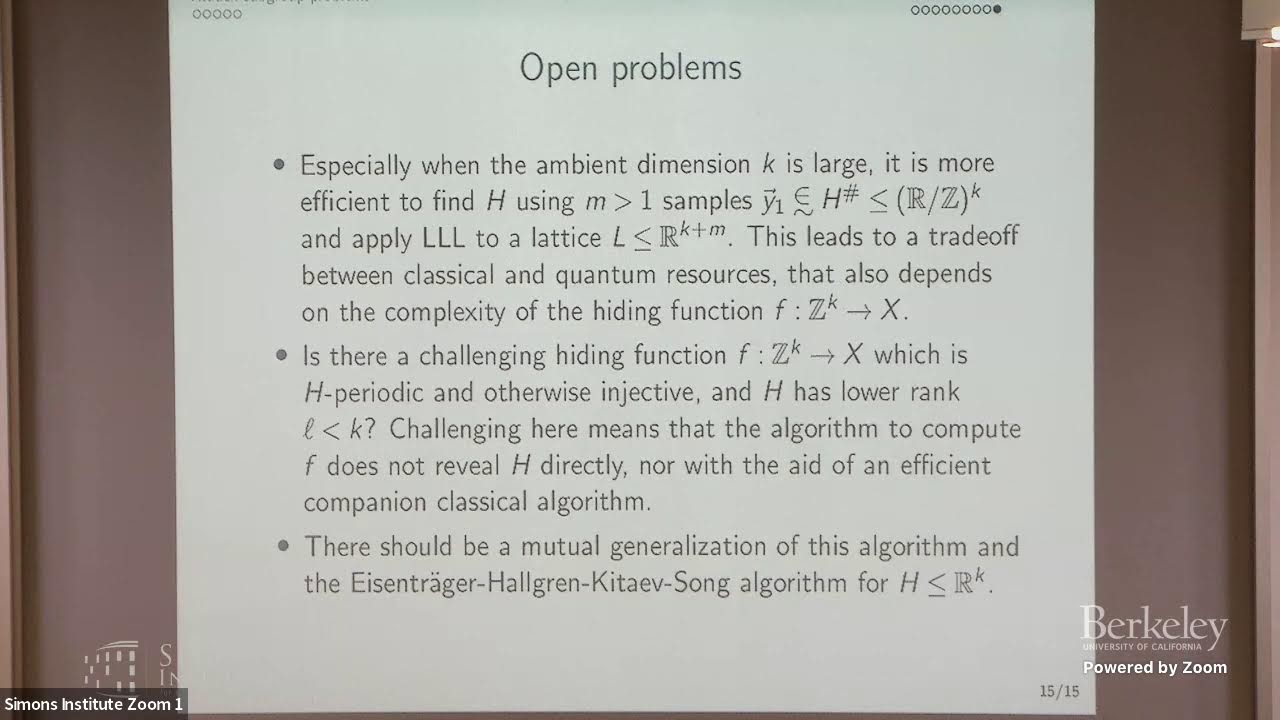
The hidden subgroup problem (HSP) is one of the main frameworks for quantum algorithms for algebraic problems, in particular for problems with a rigorous exponential quantum advantage, at least relative to an oracle or with cryptographic assumptions. The input to HSP is a function f on a group G which is periodic with respect to a subgroup H, and otherwise injective; the problem is to compute H. Although HSP was motivated by Shor's algorithm, which solves the problem when G is the integers, much of the research since then has been in the case when G is a finite group instead.
I will talk about HSP for discrete infinite groups for cases other than Shor's algorithm and the Shor-Kitaev algorithm. In particular, the hidden subgroup problem is NP-hard for the group of rationals, so that a superpolynomial quantum advantage is implausible. I will also discuss a polynomial-time quantum algorithm for HSP when G is a multidimensional lattice ℤ^d and the hidden subgroup H has any rank. This algorithm extends the celebrated Shor-Kitaev algorithm, which assumes that H has maximal rank.
https://simons.berkeley.edu/talks/resolution-brown-susskind-conjecture
Quantum and Lattices Joint Reunion Workshop
The hidden subgroup problem (HSP) is one of the main frameworks for quantum algorithms for algebraic problems, in particular for problems with a rigorous exponential quantum advantage, at least relative to an oracle or with cryptographic assumptions. The input to HSP is a function f on a group G which is periodic with respect to a subgroup H, and otherwise injective; the problem is to compute H. Although HSP was motivated by Shor's algorithm, which solves the problem when G is the integers, much of the research since then has been in the case when G is a finite group instead.
I will talk about HSP for discrete infinite groups for cases other than Shor's algorithm and the Shor-Kitaev algorithm. In particular, the hidden subgroup problem is NP-hard for the group of rationals, so that a superpolynomial quantum advantage is implausible. I will also discuss a polynomial-time quantum algorithm for HSP when G is a multidimensional lattice ℤ^d and the hidden subgroup H has any rank. This algorithm extends the celebrated Shor-Kitaev algorithm, which assumes that H has maximal rank.
Tags and Topics
Browse our collection to discover more content in these categories.
Video Information
Views
1.0K
Likes
29
Duration
40:21
Published
Jun 14, 2022
User Reviews
4.5
(1) Related Trending Topics
LIVE TRENDSRelated trending topics. Click any trend to explore more videos.
Trending Now