Unlocking the Limits of Device-Independent Quantum Key Distribution 🔐
Discover the latest research by Karol Horodecki on the upper bounds of key generation rates in device-independent quantum key distribution, advancing secure quantum communication.
Centrum Fizyki Teoretycznej PAN
157 views • Apr 20, 2021
About this video
Karol Horodecki (ICTQT & University of Gdańsk).
Upper bounds on the rate in device-independent quantum key distribution
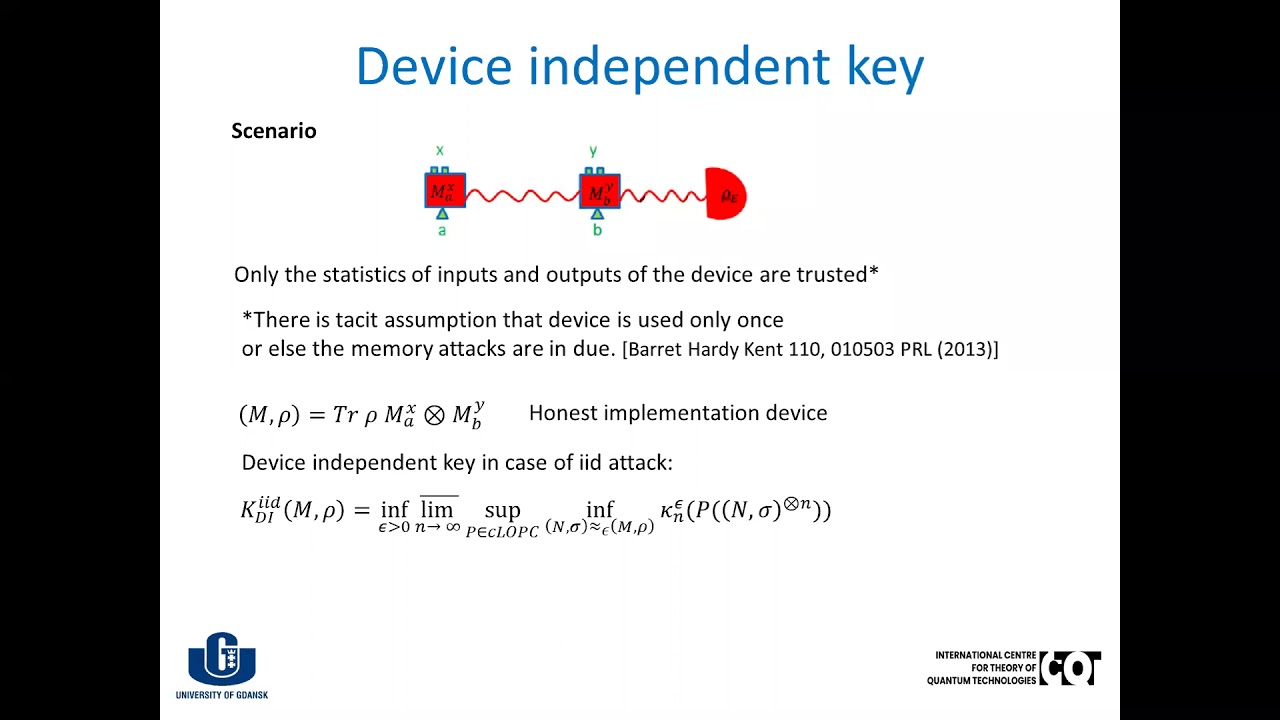
Quantum key distribution (QKD) is a method that distributes a secret key to a sender and a receiver by the transmission of quantum particles (e.g. photons). Device-independent quantum key distribution (DIQKD) is a version of QKD with a stronger notion of security, in that the sender and receiver base their protocol only on the statistics of input and outputs of their devices as inspired by Bell’s theorem. We study the rate at which DIQKD can be carried out for a given bipartite quantum state distributed between the sender and receiver or a quantum channel connecting them. We provide upper bounds on the achievable rate going beyond the upper bounds possible for QKD. In particular, we construct states and channels where the QKD rate is significant while the DIQKD rate is negligible. This gap is illustrated for a practical case arising when using standard post-processing techniques for entangled two-qubit states.
Quantum Information and Quantum Computing Seminars CTP PAS
2021-03-11
Upper bounds on the rate in device-independent quantum key distribution
Quantum key distribution (QKD) is a method that distributes a secret key to a sender and a receiver by the transmission of quantum particles (e.g. photons). Device-independent quantum key distribution (DIQKD) is a version of QKD with a stronger notion of security, in that the sender and receiver base their protocol only on the statistics of input and outputs of their devices as inspired by Bell’s theorem. We study the rate at which DIQKD can be carried out for a given bipartite quantum state distributed between the sender and receiver or a quantum channel connecting them. We provide upper bounds on the achievable rate going beyond the upper bounds possible for QKD. In particular, we construct states and channels where the QKD rate is significant while the DIQKD rate is negligible. This gap is illustrated for a practical case arising when using standard post-processing techniques for entangled two-qubit states.
Quantum Information and Quantum Computing Seminars CTP PAS
2021-03-11
Tags and Topics
Browse our collection to discover more content in these categories.
Video Information
Views
157
Likes
3
Duration
01:06:53
Published
Apr 20, 2021
Related Trending Topics
LIVE TRENDSRelated trending topics. Click any trend to explore more videos.
No specific trending topics match this video yet.
Explore All Trends