Unlocking the Future of Quantum Computing: Petros Wallden on Algorithms for Causal Sets 🔍
Join the QSimFP Seminar featuring Petros Wallden from the University of Edinburgh as he explores groundbreaking quantum algorithms for causal sets. Recorded on 13 May 2024—don't miss this insightful session on the intersection of quantum computing and bla
QSimFP
54 views • Sep 6, 2024
About this video
QSimFP Seminar (Quantum Black Hole Theme): "Quantum algorithms for causal sets" by Petros Wallden from University of Edinburgh
Recorded on 13 May 2024 - Bio & Abstract below)
The Quantum Simulator for Fundamental Physics (QSimFP) consortium, including 15 investigators from 7 UK Research Organisations and 5 International Partners was formed in 2018-2020. Funding through the Quantum Technology for Fundamental Physics initiative started in November 2020 with the project duration of 3 years and 5 months. Our programme unites the quantum-technology and fundamental-physics communities, with leading scientists from both camps now working together and focusing on common goals. https://qsimfp.org/
Bio & Abstract:
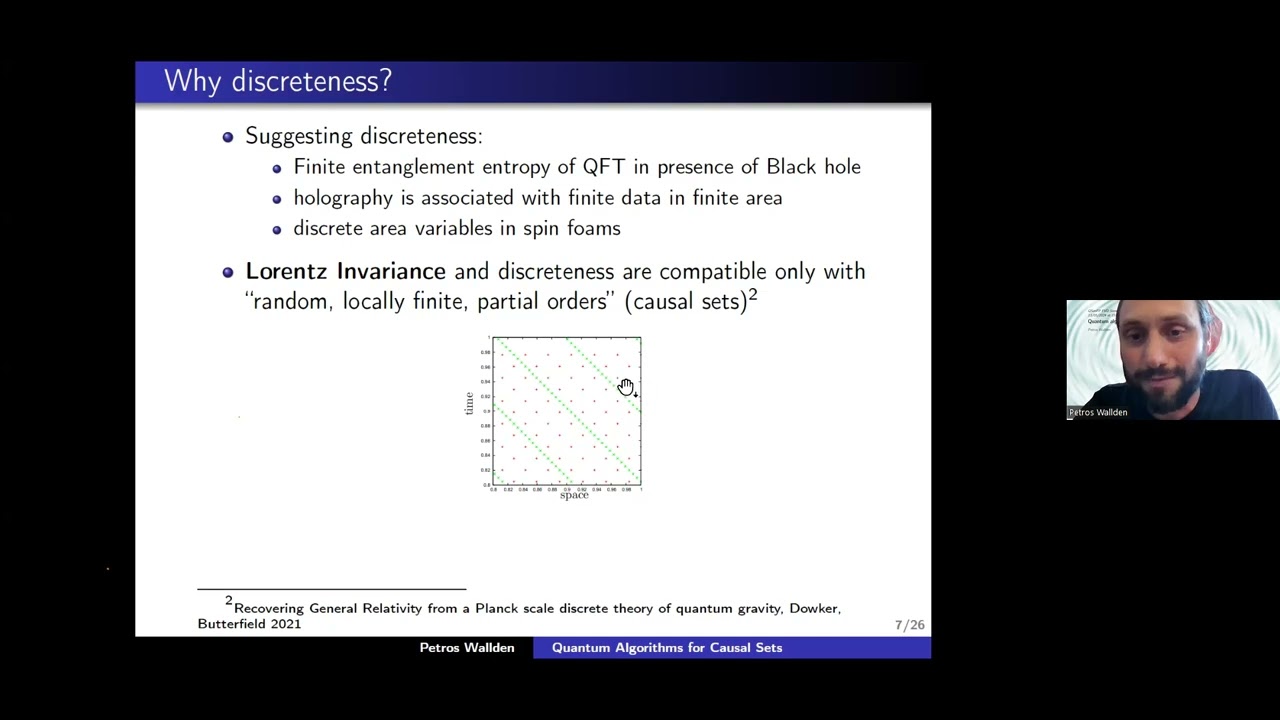
Abstract: Causal sets is an approach to quantum gravity that spacetime is fundamentally a “discrete” partially ordered set. The Lorentz invariance in such discrete structures results in “random” partial orders with high valence, making certain analytical calculations harder and the need for computational methods more important. Computational methods, on the other hand, are also challenging since the computational complexity of most interesting questions puts strict bounds on what can really be explored. Quantum computers promise significant, in certain cases exponential, speed-ups. Our focus is to analyse instances where quantum algorithms could provide useful speed-ups for causal sets questions. In this talk I will first briefly introduce causal sets and then some basic elements of quantum computing and quantum algorithms. Then I will give a brief exposition on certain causal sets questions and initial results and future thoughts on tackling them using quantum algorithms. Questions considered include: the calculation of Benincasa-Dowker action (causal sets analogue of Einstein-Hilbert action), the dimensionally restricted quantum gravity partition function and kinematic questions such as the emergence of continuous geometry.
Bio: Petros Wallden is Reader (Associate Professor) in Quantum Informatics at the School of Informatics at the University of Edinburgh, is Deputy Director of the Quantum Software Lab and leads the Quantum Software activities of the Quantum Computing and Simulation Hub. His current research focuses on quantum algorithms and quantum machine learning, quantum cryptography and verification/benchmarking of quantum computing while in the past he has worked on quantum foundations and quantum gravity having obtained his PhD in Theoretical Physics from Imperial College. He is editor for the journal Quantum and the journal Cryptography and was two times general chair of the IACR international conference on Public Key Cryptography.
Recorded on 13 May 2024 - Bio & Abstract below)
The Quantum Simulator for Fundamental Physics (QSimFP) consortium, including 15 investigators from 7 UK Research Organisations and 5 International Partners was formed in 2018-2020. Funding through the Quantum Technology for Fundamental Physics initiative started in November 2020 with the project duration of 3 years and 5 months. Our programme unites the quantum-technology and fundamental-physics communities, with leading scientists from both camps now working together and focusing on common goals. https://qsimfp.org/
Bio & Abstract:
Abstract: Causal sets is an approach to quantum gravity that spacetime is fundamentally a “discrete” partially ordered set. The Lorentz invariance in such discrete structures results in “random” partial orders with high valence, making certain analytical calculations harder and the need for computational methods more important. Computational methods, on the other hand, are also challenging since the computational complexity of most interesting questions puts strict bounds on what can really be explored. Quantum computers promise significant, in certain cases exponential, speed-ups. Our focus is to analyse instances where quantum algorithms could provide useful speed-ups for causal sets questions. In this talk I will first briefly introduce causal sets and then some basic elements of quantum computing and quantum algorithms. Then I will give a brief exposition on certain causal sets questions and initial results and future thoughts on tackling them using quantum algorithms. Questions considered include: the calculation of Benincasa-Dowker action (causal sets analogue of Einstein-Hilbert action), the dimensionally restricted quantum gravity partition function and kinematic questions such as the emergence of continuous geometry.
Bio: Petros Wallden is Reader (Associate Professor) in Quantum Informatics at the School of Informatics at the University of Edinburgh, is Deputy Director of the Quantum Software Lab and leads the Quantum Software activities of the Quantum Computing and Simulation Hub. His current research focuses on quantum algorithms and quantum machine learning, quantum cryptography and verification/benchmarking of quantum computing while in the past he has worked on quantum foundations and quantum gravity having obtained his PhD in Theoretical Physics from Imperial College. He is editor for the journal Quantum and the journal Cryptography and was two times general chair of the IACR international conference on Public Key Cryptography.
Video Information
Views
54
Duration
50:15
Published
Sep 6, 2024
Related Trending Topics
LIVE TRENDSRelated trending topics. Click any trend to explore more videos.
No specific trending topics match this video yet.
Explore All Trends