Unlocking Speed in Fully Homomorphic Encryption: Batched and Reconfigurable LUT Evaluation 🚀
Discover how Leonard Schild from KU Leuven introduces innovative techniques to accelerate transciphering in fully homomorphic encryption through batched and reconfigurable LUT evaluation in this insightful COSIC seminar.

COSIC - Computer Security and Industrial Cryptography
79 views • Aug 29, 2024
About this video
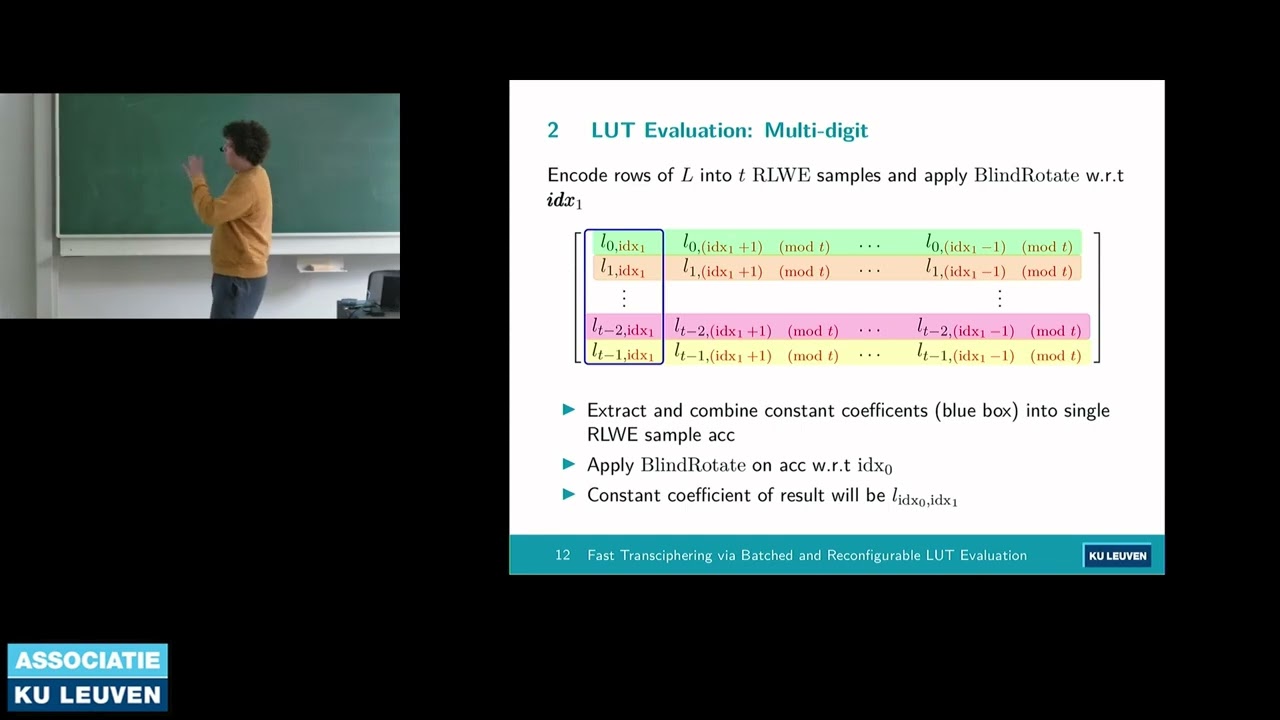
COSIC seminar – Fast Transciphering via Batched and Reconfigurable LUT Evaluation – Leonard Schild (KU Leuven)
Fully homomorphic encryption provides a way to perform computations in a privacy preserving manner. However, despite years of optimization, modern methods may still be too computationally expensive for devices limited by speed or memory constraints. A paradigm that may bridge this gap consists of transciphering: as fully homomorphic schemes can perform most computations obliviously, they can
also execute the decryption circuit of any conventional block or stream cipher. Hence, less powerful systems may continue to encrypt their data using classical ciphers that may offer hardware support (e.g., AES) and outsourcing the task of transforming the ciphertexts into their homomorphic equivalent to more powerful systems. In this work, we advance transciphering methods that leverage accumulator-based schemes such as Torus-FHE (TFHE) or FHEW. To this end, we propose a novel method to homomorphically evaluate look-up tables in a setting in which encrypted digits are provided on base 2. At a high level, our method relies on the fact that functions with binary range, i.e., mapping values to {0, 1}, can be evaluated at the same computational cost as negacyclic functions, relying only on the default functionality
of accumulator based schemes. To test our algorithm, we implement the AES-128 encryption circuit in OPENFHE and report timings of 67 s for a single block, which is 25% faster than the state of the art and in general, up to 300% faster than other recent works. Furthermore, we achieve this speedup without relying on an instantiation that leverages a power of 2 modulus and can exploit the natural modulo arithmetic of modern processors.
Fully homomorphic encryption provides a way to perform computations in a privacy preserving manner. However, despite years of optimization, modern methods may still be too computationally expensive for devices limited by speed or memory constraints. A paradigm that may bridge this gap consists of transciphering: as fully homomorphic schemes can perform most computations obliviously, they can
also execute the decryption circuit of any conventional block or stream cipher. Hence, less powerful systems may continue to encrypt their data using classical ciphers that may offer hardware support (e.g., AES) and outsourcing the task of transforming the ciphertexts into their homomorphic equivalent to more powerful systems. In this work, we advance transciphering methods that leverage accumulator-based schemes such as Torus-FHE (TFHE) or FHEW. To this end, we propose a novel method to homomorphically evaluate look-up tables in a setting in which encrypted digits are provided on base 2. At a high level, our method relies on the fact that functions with binary range, i.e., mapping values to {0, 1}, can be evaluated at the same computational cost as negacyclic functions, relying only on the default functionality
of accumulator based schemes. To test our algorithm, we implement the AES-128 encryption circuit in OPENFHE and report timings of 67 s for a single block, which is 25% faster than the state of the art and in general, up to 300% faster than other recent works. Furthermore, we achieve this speedup without relying on an instantiation that leverages a power of 2 modulus and can exploit the natural modulo arithmetic of modern processors.
Tags and Topics
Browse our collection to discover more content in these categories.
Video Information
Views
79
Likes
3
Duration
17:51
Published
Aug 29, 2024
Related Trending Topics
LIVE TRENDSRelated trending topics. Click any trend to explore more videos.
Trending Now