Unlocking SNARGs Beyond Non-Signaling Assumptions 🔓
Explore groundbreaking advancements in SNARGs that go beyond traditional non-signaling assumptions, revealing minimal complexity prerequisites. Join Yael Tauman Kalai from Microsoft Research for insightful breakthroughs in cryptography.

Simons Institute for the Theory of Computing
538 views • May 3, 2023
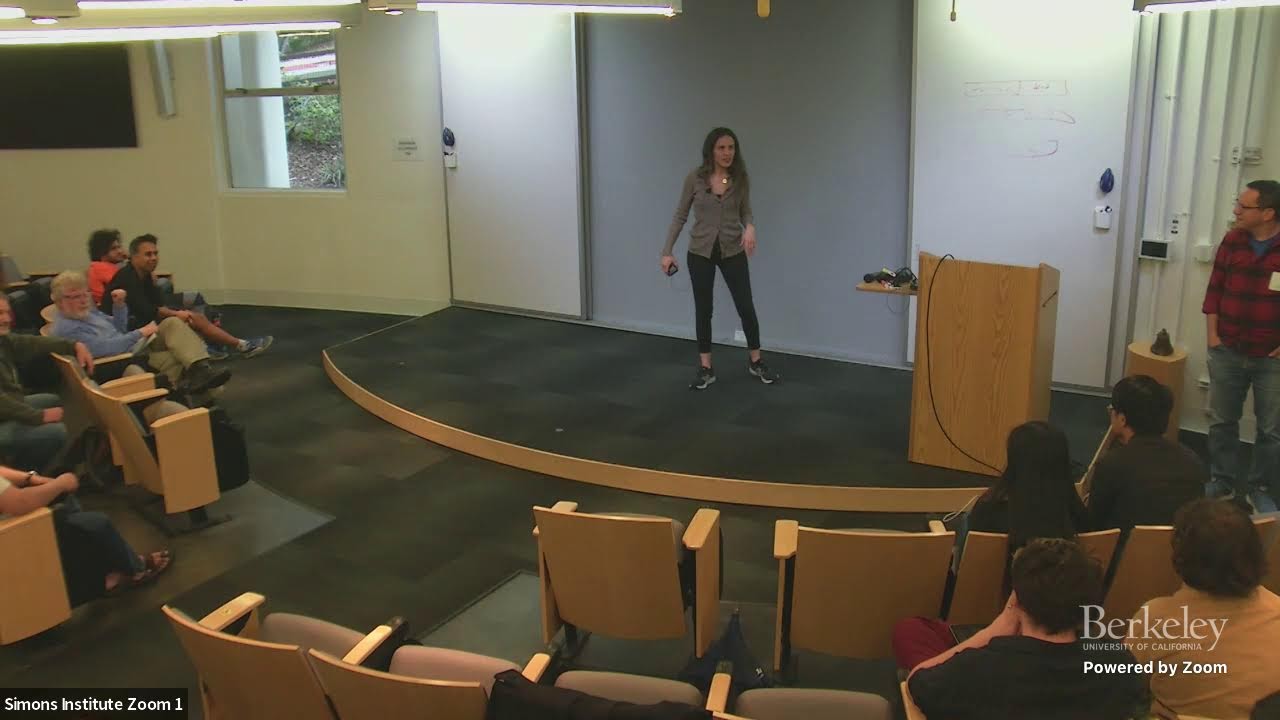
About this video
Yael Tauman Kalai (Microsoft Research)
https://simons.berkeley.edu/talks/yael-tauman-kalai-microsoft-research-2023-05-02
Minimal Complexity Assumptions for Cryptography
We construct a SNARG for the class of monotone policy batch NP languages, under the LWE assumption. This class is a subclass of NP that is associated with a monotone function f and an NP language L, and contains instances (x_1,…,x_k) such that f(b_1,…,b_k)=1 where b_j=1 if and only if x_j is in L.
This is the first SNARG under standard hardness assumptions for a sub-class of NP that is not known to have a (computational) non-signaling PCP (which small locality). Indeed, our approach necessarily departs from the previous framework used to construct SNARGs from standard assumptions.
The main novel ingredient used in our SNARG construction is a predicate-extractable hash (PEH) family, which is a primitive that generalizes the notion of a somewhere extractable hash. Whereas a somewhere extractable hash allows to extract a single input coordinate, our PEH extracts a global property of the input. We view this primitive to be of independent interest and believe that it will find other applications.
https://simons.berkeley.edu/talks/yael-tauman-kalai-microsoft-research-2023-05-02
Minimal Complexity Assumptions for Cryptography
We construct a SNARG for the class of monotone policy batch NP languages, under the LWE assumption. This class is a subclass of NP that is associated with a monotone function f and an NP language L, and contains instances (x_1,…,x_k) such that f(b_1,…,b_k)=1 where b_j=1 if and only if x_j is in L.
This is the first SNARG under standard hardness assumptions for a sub-class of NP that is not known to have a (computational) non-signaling PCP (which small locality). Indeed, our approach necessarily departs from the previous framework used to construct SNARGs from standard assumptions.
The main novel ingredient used in our SNARG construction is a predicate-extractable hash (PEH) family, which is a primitive that generalizes the notion of a somewhere extractable hash. Whereas a somewhere extractable hash allows to extract a single input coordinate, our PEH extracts a global property of the input. We view this primitive to be of independent interest and believe that it will find other applications.
Tags and Topics
Browse our collection to discover more content in these categories.
Video Information
Views
538
Likes
6
Duration
39:26
Published
May 3, 2023
Related Trending Topics
LIVE TRENDSRelated trending topics. Click any trend to explore more videos.
No specific trending topics match this video yet.
Explore All Trends