Unlocking Security: How Circuit Obfuscation and Minimization Empower Each Other 🔐
Explore the dynamic relationship between circuit obfuscation and minimization, and how their mutual reinforcement advances cryptographic security. Insights from Ilya Volkovich's talk at Berkeley.

Simons Institute for the Theory of Computing
211 views • May 4, 2023
About this video
Ilya Volkovich (Boston College)
https://simons.berkeley.edu/talks/ilya-volkovich-boston-college-2023-05-03
Minimal Complexity Assumptions for Cryptography
We study close connections between Indistinguishability Obfuscation (IO) and the Minimum Circuit Size Problem (MCSP), and argue that algorithms for one of MCSP or IO would empower the other one. Some of our main results are:
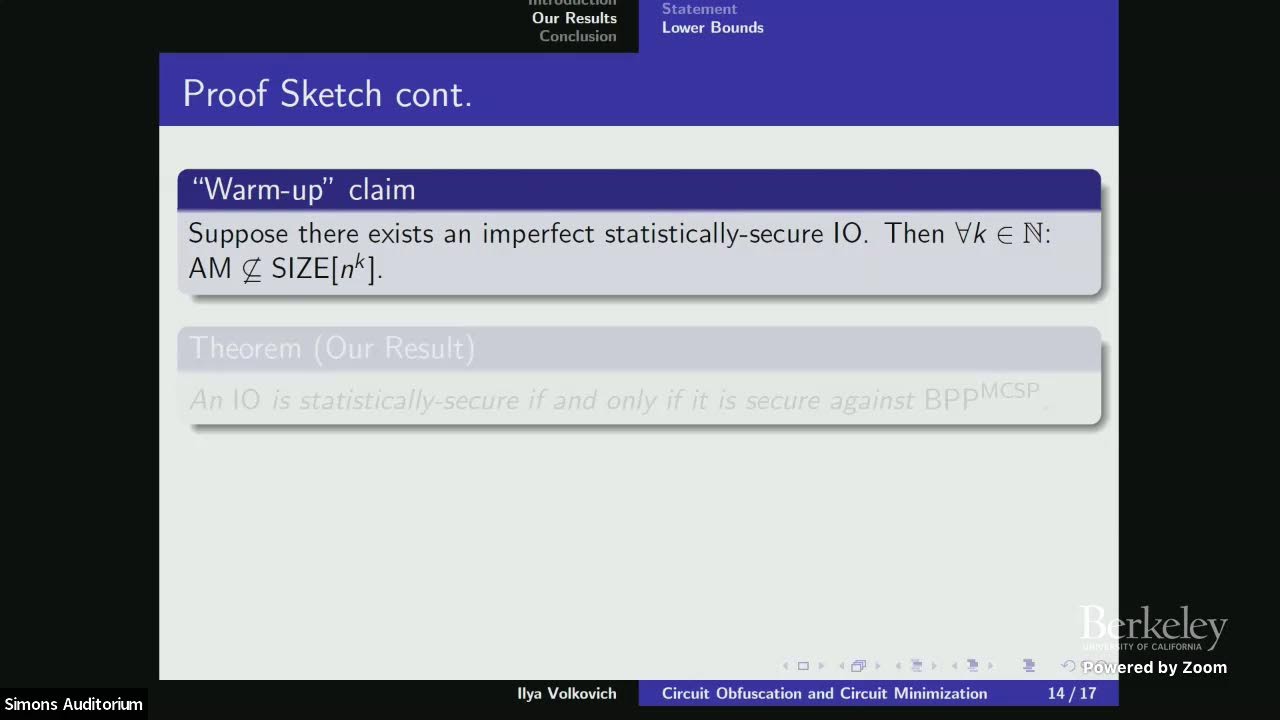
If there exists a perfect (imperfect) IO that is computationally-secure against non-uniform polynomial-size circuits, then we obtain fixed-polynomial lower bounds against NP (MA)
In addition, perfect computationally-secure IO against non-uniform polynomial-size circuits implies super-polynomial lower bounds against NEXP.
On the uniform side, perfect computationally-secure IO against *uniform* algorithms circuits implies that ZPEXP != BPP.
If MCSP is in BPP, then statistical security and computational security for IO are equivalent.
To the best of our knowledge, this is the first consequence of strong circuit lower bounds from the existence of an IO. The results are obtained via a construction of an optimal universal distinguisher, computable in randomized polynomial time with access to the MCSP oracle, that will distinguish any two circuit-samplable distributions with the advantage that is the statistical distance between these two distributions minus some negligible error term. This is our main technical contribution. As another application, we get a simple proof of the result by Allender and Das (Inf. Comput., 2017) that SZK is contained in BPP^MCSP.
https://simons.berkeley.edu/talks/ilya-volkovich-boston-college-2023-05-03
Minimal Complexity Assumptions for Cryptography
We study close connections between Indistinguishability Obfuscation (IO) and the Minimum Circuit Size Problem (MCSP), and argue that algorithms for one of MCSP or IO would empower the other one. Some of our main results are:
If there exists a perfect (imperfect) IO that is computationally-secure against non-uniform polynomial-size circuits, then we obtain fixed-polynomial lower bounds against NP (MA)
In addition, perfect computationally-secure IO against non-uniform polynomial-size circuits implies super-polynomial lower bounds against NEXP.
On the uniform side, perfect computationally-secure IO against *uniform* algorithms circuits implies that ZPEXP != BPP.
If MCSP is in BPP, then statistical security and computational security for IO are equivalent.
To the best of our knowledge, this is the first consequence of strong circuit lower bounds from the existence of an IO. The results are obtained via a construction of an optimal universal distinguisher, computable in randomized polynomial time with access to the MCSP oracle, that will distinguish any two circuit-samplable distributions with the advantage that is the statistical distance between these two distributions minus some negligible error term. This is our main technical contribution. As another application, we get a simple proof of the result by Allender and Das (Inf. Comput., 2017) that SZK is contained in BPP^MCSP.
Tags and Topics
Browse our collection to discover more content in these categories.
Video Information
Views
211
Likes
3
Duration
36:40
Published
May 4, 2023
Related Trending Topics
LIVE TRENDSRelated trending topics. Click any trend to explore more videos.
No specific trending topics match this video yet.
Explore All Trends