Unlocking Quantum Power: Scott Aaronson on Computational Supremacy 🌐
Join the free weekly virtual ICM seminar with Scott Aaronson as he explores quantum computational supremacy and its groundbreaking applications. Register now: https://supercomputingfrontiers.eu/2020/seminars/
ICM University of Warsaw
334 views • Apr 7, 2020
About this video
WORLDWIDE, WEEKLY -16 PM CEST | Free of charge - hit the registration link:
https://supercomputingfrontiers.eu/2020/seminars/
VIRTUAL ICM SEMINARS IN COMPUTER AND COMPUTATIONAL SCIENCE
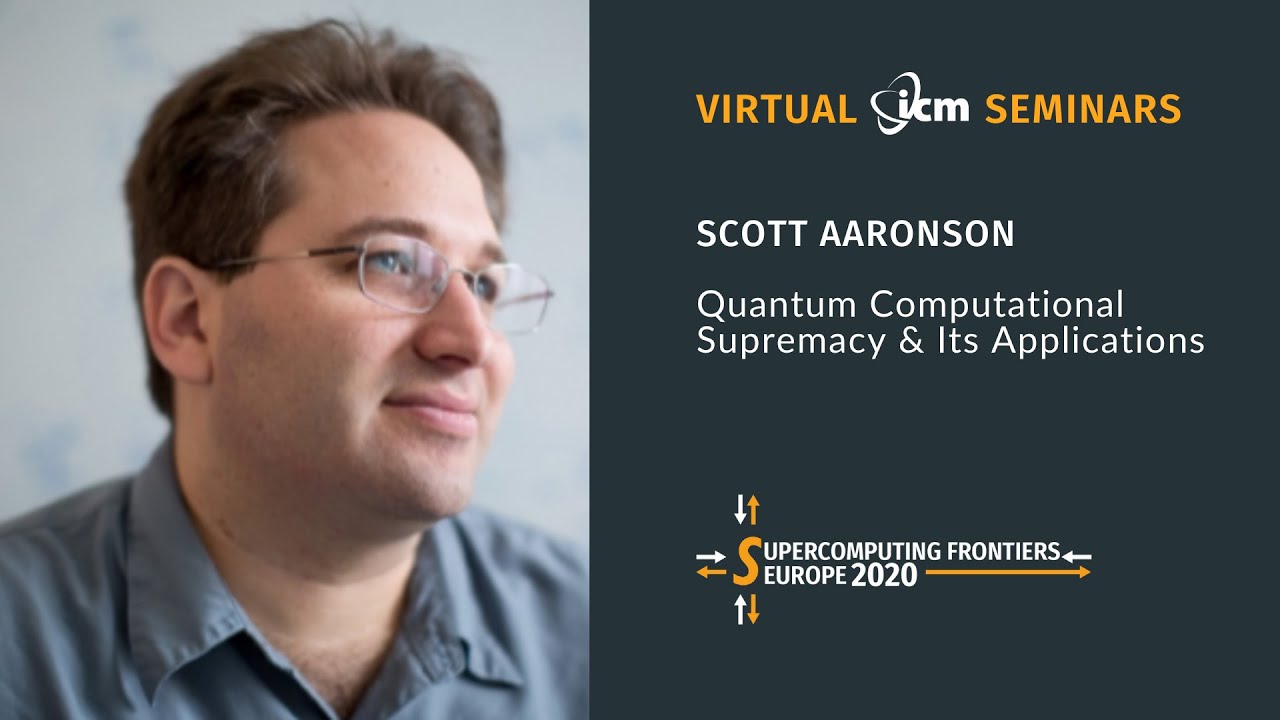
INAUGURAL SEMINAR – APRIL 1, 2020 | 16 PM CEST | SCOTT AARONSON, UT Austin
Title: Quantum Computational Supremacy and Its Applications
Abstract: Last fall, a team at Google announced the first-ever demonstration of “quantum computational supremacy”—that is, a clear quantum speedup over a classical computer for some task—using a 53-qubit programmable superconducting chip called Sycamore.
Google’s accomplishment drew on a decade of research in my field of quantum complexity theory. This talk will discuss questions like:
- What exactly was the (contrived) problem that Sycamore solved?
- How does one verify the outputs using a classical computer?
- And how confident are we that the problem is classically hard—especially in light of subsequent counterclaims by IBM and others?
I’ll end with a possible application for Google’s experiment—namely, the generation of trusted public random bits, for use (for example) in cryptocurrencies—that I’ve been developing and that Google and NIST are now working to test.
---
Scott Aaronson is David J. Bruton Centennial Professor of Computer Science at the University of Texas at Austin. He received his bachelor’s from Cornell University and his PhD from UC Berkeley. Before coming to UT Austin, he spent nine years as a professor in electrical Engineering and Computer Science at MIT. Aaronson’s research in theoretical computer science has focused mainly on the capabilities and limits of quantum computers. His first book, Quantum Computing Since Democritus, was published in 2013 by Cambridge University Press. He received the National Science Foundation’s Alan T. Waterman Award, the United States PECASE Award, and the Tomassoni-Chisesi Prize in Physics.
#quantumcomputing #Google #ICMSeminars
https://supercomputingfrontiers.eu/2020/seminars/
VIRTUAL ICM SEMINARS IN COMPUTER AND COMPUTATIONAL SCIENCE
INAUGURAL SEMINAR – APRIL 1, 2020 | 16 PM CEST | SCOTT AARONSON, UT Austin
Title: Quantum Computational Supremacy and Its Applications
Abstract: Last fall, a team at Google announced the first-ever demonstration of “quantum computational supremacy”—that is, a clear quantum speedup over a classical computer for some task—using a 53-qubit programmable superconducting chip called Sycamore.
Google’s accomplishment drew on a decade of research in my field of quantum complexity theory. This talk will discuss questions like:
- What exactly was the (contrived) problem that Sycamore solved?
- How does one verify the outputs using a classical computer?
- And how confident are we that the problem is classically hard—especially in light of subsequent counterclaims by IBM and others?
I’ll end with a possible application for Google’s experiment—namely, the generation of trusted public random bits, for use (for example) in cryptocurrencies—that I’ve been developing and that Google and NIST are now working to test.
---
Scott Aaronson is David J. Bruton Centennial Professor of Computer Science at the University of Texas at Austin. He received his bachelor’s from Cornell University and his PhD from UC Berkeley. Before coming to UT Austin, he spent nine years as a professor in electrical Engineering and Computer Science at MIT. Aaronson’s research in theoretical computer science has focused mainly on the capabilities and limits of quantum computers. His first book, Quantum Computing Since Democritus, was published in 2013 by Cambridge University Press. He received the National Science Foundation’s Alan T. Waterman Award, the United States PECASE Award, and the Tomassoni-Chisesi Prize in Physics.
#quantumcomputing #Google #ICMSeminars
Tags and Topics
Browse our collection to discover more content in these categories.
Video Information
Views
334
Likes
4
Duration
01:43:05
Published
Apr 7, 2020
Related Trending Topics
LIVE TRENDSRelated trending topics. Click any trend to explore more videos.
No specific trending topics match this video yet.
Explore All Trends