Unlocking Pseudorandomness: Quantum States and Secure Binary Strings 🔐
Explore how quantum states contribute to generating secure pseudorandom binary strings with minimal quantum assumptions, advancing cryptographic security.

Simons Institute for the Theory of Computing
257 views • Jul 19, 2023
About this video
Prabhanjan Ananth (UC Santa Barbara)
https://simons.berkeley.edu/talks/prabhanjan-ananth-uc-santa-barbara-2023-06-20
Minimum Quantum Assumptions for Cryptography Workshop
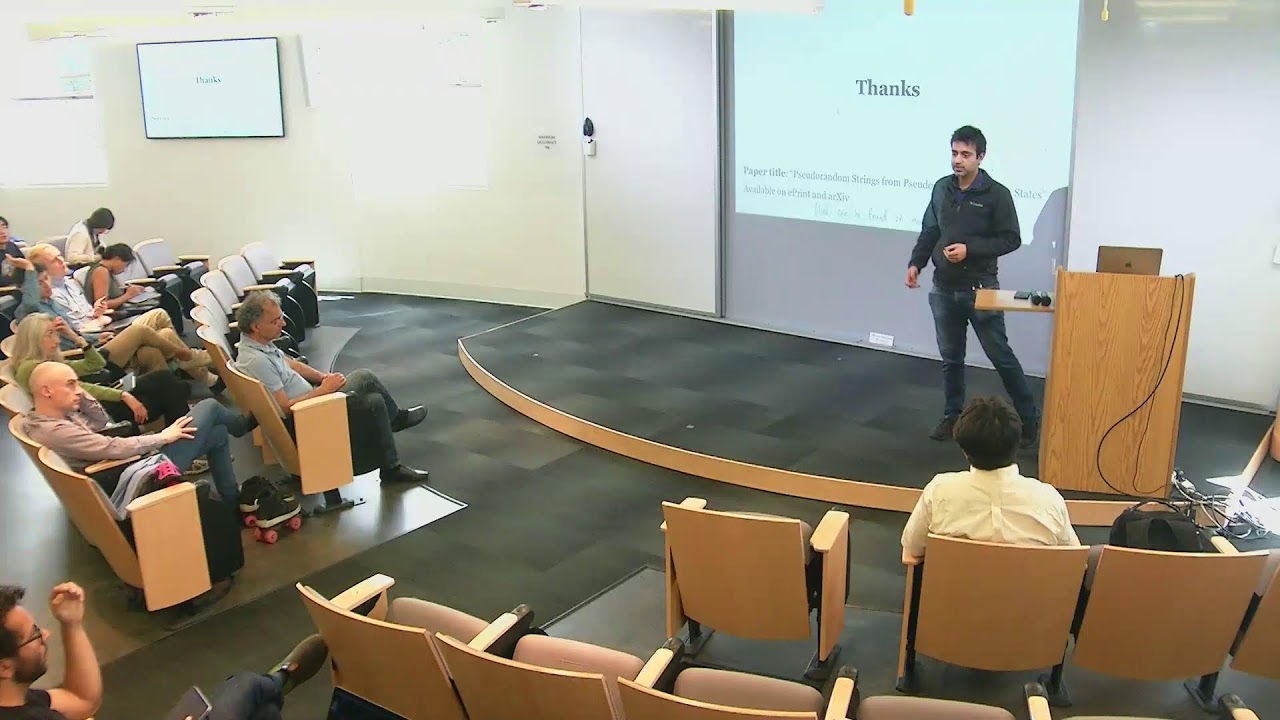
Pseudorandom generators (PRGs) are widely studied in theoretical computer science and in particular, cryptography. It is well-known in classical cryptography that one-way functions are a necessary assumption for the existence of PRGs. In joint work with Yao-Ting Lin (UCSB) and Henry Yuen (Columbia), we consider a variant of PRGs called quantum PRGs (QPRGs). Quantum PRGs are like PRGs except that (a) they are allowed to have a small determinism error and, (b) the generation is allowed to be a polynomial-time quantum algorithm. We explore the possibility of basing QPRGs on assumptions weaker than one-way functions. We show that QPRGs can be based on the existence of logarithmic-output pseudorandom quantum states, introduced by Ji, Liu, and Song. Our main contribution is to design a (pseudo)-deterministic extractor that can extract uniformly random strings (up to some small error) given Haar-random states. We explore cryptographic applications and variants of QPRGs.
https://simons.berkeley.edu/talks/prabhanjan-ananth-uc-santa-barbara-2023-06-20
Minimum Quantum Assumptions for Cryptography Workshop
Pseudorandom generators (PRGs) are widely studied in theoretical computer science and in particular, cryptography. It is well-known in classical cryptography that one-way functions are a necessary assumption for the existence of PRGs. In joint work with Yao-Ting Lin (UCSB) and Henry Yuen (Columbia), we consider a variant of PRGs called quantum PRGs (QPRGs). Quantum PRGs are like PRGs except that (a) they are allowed to have a small determinism error and, (b) the generation is allowed to be a polynomial-time quantum algorithm. We explore the possibility of basing QPRGs on assumptions weaker than one-way functions. We show that QPRGs can be based on the existence of logarithmic-output pseudorandom quantum states, introduced by Ji, Liu, and Song. Our main contribution is to design a (pseudo)-deterministic extractor that can extract uniformly random strings (up to some small error) given Haar-random states. We explore cryptographic applications and variants of QPRGs.
Tags and Topics
Browse our collection to discover more content in these categories.
Video Information
Views
257
Duration
41:58
Published
Jul 19, 2023
Related Trending Topics
LIVE TRENDSRelated trending topics. Click any trend to explore more videos.
No specific trending topics match this video yet.
Explore All Trends