Unlocking New Steganography Techniques Inspired by the Kuznetsov-Tsybakov Problem 🔍
Discover innovative approaches to steganography explored in the CERIAS Security Seminar at Purdue University, based on the Kuznetsov-Tsybakov problem, presented by Jarek Duda.
Purdue CERIAS
276 views • Aug 23, 2013
About this video
Recorded: 08/21/2013
CERIAS Security Seminar at Purdue University
New possibilities of steganography based on Kuznetsov-Tsybakov problem
Jarek Duda, Postdoc, Purdue University
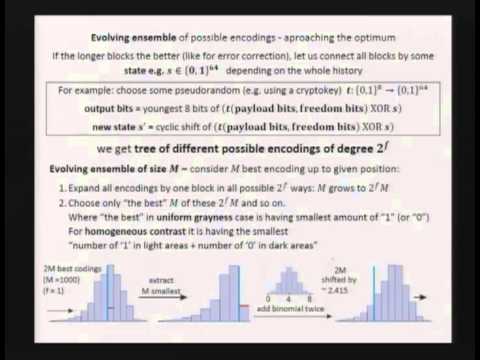
To hide information within a picture we usually replace the least significant bits. This approach is no longer available if there is only 1 bit/pixel like for Quick Response Codes we meet everyday now. I will talk about theoretical limitation and practical aspects of hiding information in such situations: by generating encoding sequences fulfilling given constraints, for example to enforce resemblance to given picture (grayness of pixel defines probability of using "1" there). If the receiver would know the constraints/picture, we could just use entropy coder for this purpose, but we would like to omit this requirement here. In Kuznetsov-Tsybakov problem only the sender knows simple constraints, but it turns out that we can approach the same channel capacity as if both sides would know them. I will talk about generalizations to statistical constraints and applications for example to picture codes, steganography or lossy compression.
Jaroslaw Duda has received MSc in Computer Science, Mathematics and Physics, and PhD in Computer Science and Physics from Jagiellonian University in Cracow, Poland. His main interest is information theory, both directly applied in computer science and as an integral part of different fields of science. He is currently a Postdoctoral Researcher in the Center for Science of Information and the Computer Science Department at Purdue University, USA, working with W. Szpankowski. (Visit: www.cerias.purdue.edu)
CERIAS Security Seminar at Purdue University
New possibilities of steganography based on Kuznetsov-Tsybakov problem
Jarek Duda, Postdoc, Purdue University
To hide information within a picture we usually replace the least significant bits. This approach is no longer available if there is only 1 bit/pixel like for Quick Response Codes we meet everyday now. I will talk about theoretical limitation and practical aspects of hiding information in such situations: by generating encoding sequences fulfilling given constraints, for example to enforce resemblance to given picture (grayness of pixel defines probability of using "1" there). If the receiver would know the constraints/picture, we could just use entropy coder for this purpose, but we would like to omit this requirement here. In Kuznetsov-Tsybakov problem only the sender knows simple constraints, but it turns out that we can approach the same channel capacity as if both sides would know them. I will talk about generalizations to statistical constraints and applications for example to picture codes, steganography or lossy compression.
Jaroslaw Duda has received MSc in Computer Science, Mathematics and Physics, and PhD in Computer Science and Physics from Jagiellonian University in Cracow, Poland. His main interest is information theory, both directly applied in computer science and as an integral part of different fields of science. He is currently a Postdoctoral Researcher in the Center for Science of Information and the Computer Science Department at Purdue University, USA, working with W. Szpankowski. (Visit: www.cerias.purdue.edu)
Tags and Topics
Browse our collection to discover more content in these categories.
Video Information
Views
276
Likes
4
Duration
43:29
Published
Aug 23, 2013
Related Trending Topics
LIVE TRENDSRelated trending topics. Click any trend to explore more videos.
No specific trending topics match this video yet.
Explore All Trends