Unlocking Cryptography: The Role of Compilers in Advanced Computations 🔐
Discover how modern cryptographic computations rely on specialized compilers to enhance security and efficiency. Join Madan Musuvathi's insightful talk from the Technion to understand the latest breakthroughs in this cutting-edge field.

הטכניון - מכון טכנולוגי לישראל
598 views • Dec 25, 2019
About this video
Talk given at the Computer Science Department, Technion, Israel on December 17, 2019.
Abstract:
There is a recent surge of interest in performing computations on encrypted data.
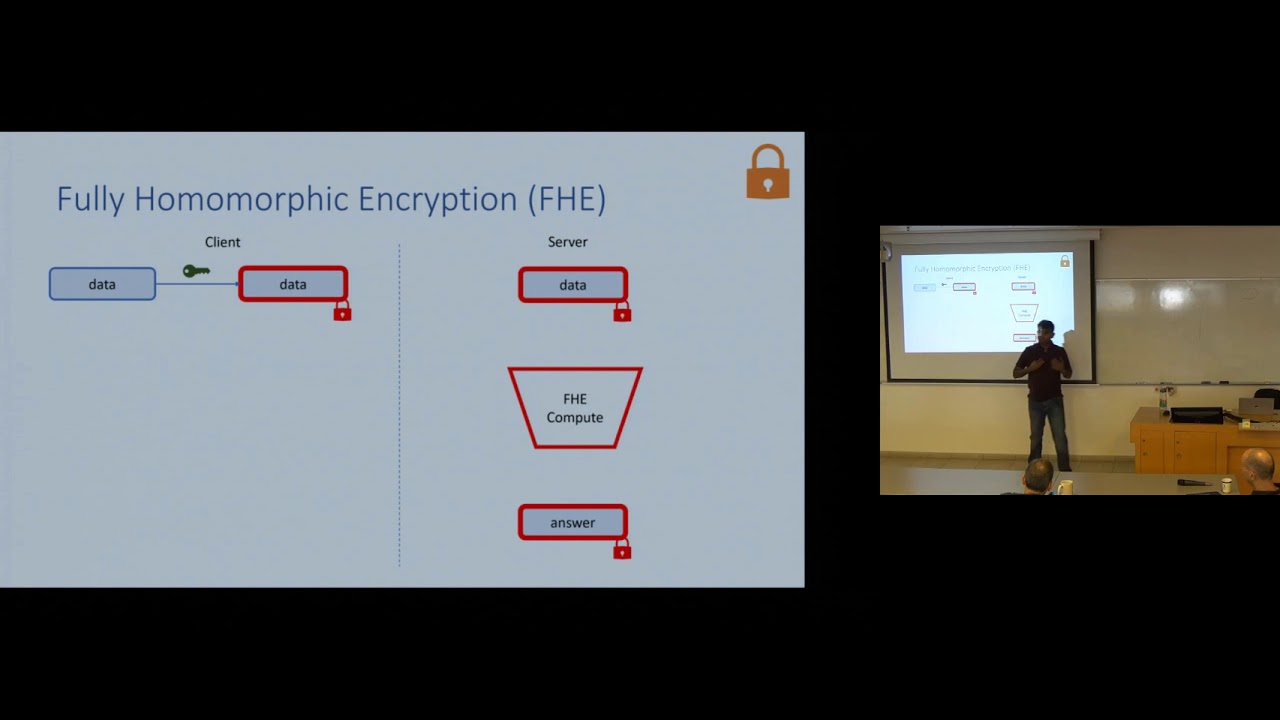
Techniques such as secure multi-party computations and fully-homomorphic encryption enable
rich privacy-preserving applications. On the other hand, building such applications is
hard due to the cryptographic expertise required to build them correctly, securely, and
efficiently. Excitingly, a compiler that raises the level of programming abstraction while
performing a slew of domain-specific optimizations can make a huge difference in building
these applications. I will provide an overview of recent work in this area while focusing
on our own work on a compiler for fully-homomorphic computations. Here the fundamental
problem reduces to mapping application level parallelism onto the vectorization
capabilities inherent in the encryption schemes.
Short Bio:
Madan Musuvathi manages the Research in Software Engineering (RiSE) group at Microsoft
Research. His interests primarily lie in the intersection of programming languages, formal
methods, and systems. His research has produced several software reliability tools that
are widely used within Microsoft and other companies. He received his Ph.D. from Stanford
University.
Abstract:
There is a recent surge of interest in performing computations on encrypted data.
Techniques such as secure multi-party computations and fully-homomorphic encryption enable
rich privacy-preserving applications. On the other hand, building such applications is
hard due to the cryptographic expertise required to build them correctly, securely, and
efficiently. Excitingly, a compiler that raises the level of programming abstraction while
performing a slew of domain-specific optimizations can make a huge difference in building
these applications. I will provide an overview of recent work in this area while focusing
on our own work on a compiler for fully-homomorphic computations. Here the fundamental
problem reduces to mapping application level parallelism onto the vectorization
capabilities inherent in the encryption schemes.
Short Bio:
Madan Musuvathi manages the Research in Software Engineering (RiSE) group at Microsoft
Research. His interests primarily lie in the intersection of programming languages, formal
methods, and systems. His research has produced several software reliability tools that
are widely used within Microsoft and other companies. He received his Ph.D. from Stanford
University.
Tags and Topics
Browse our collection to discover more content in these categories.
Video Information
Views
598
Duration
56:52
Published
Dec 25, 2019
Related Trending Topics
LIVE TRENDSRelated trending topics. Click any trend to explore more videos.