Understanding Security & Encoding in Fully Homomorphic Encryption 🔐
Discover how Rachel Player from Sorbonne Université explores the security mechanisms and encoding techniques in Fully Homomorphic Encryption, a key technology in post-quantum cryptography and lattice-based schemes.

The Alan Turing Institute
3.2K views • Aug 16, 2018
About this video
Abstract:
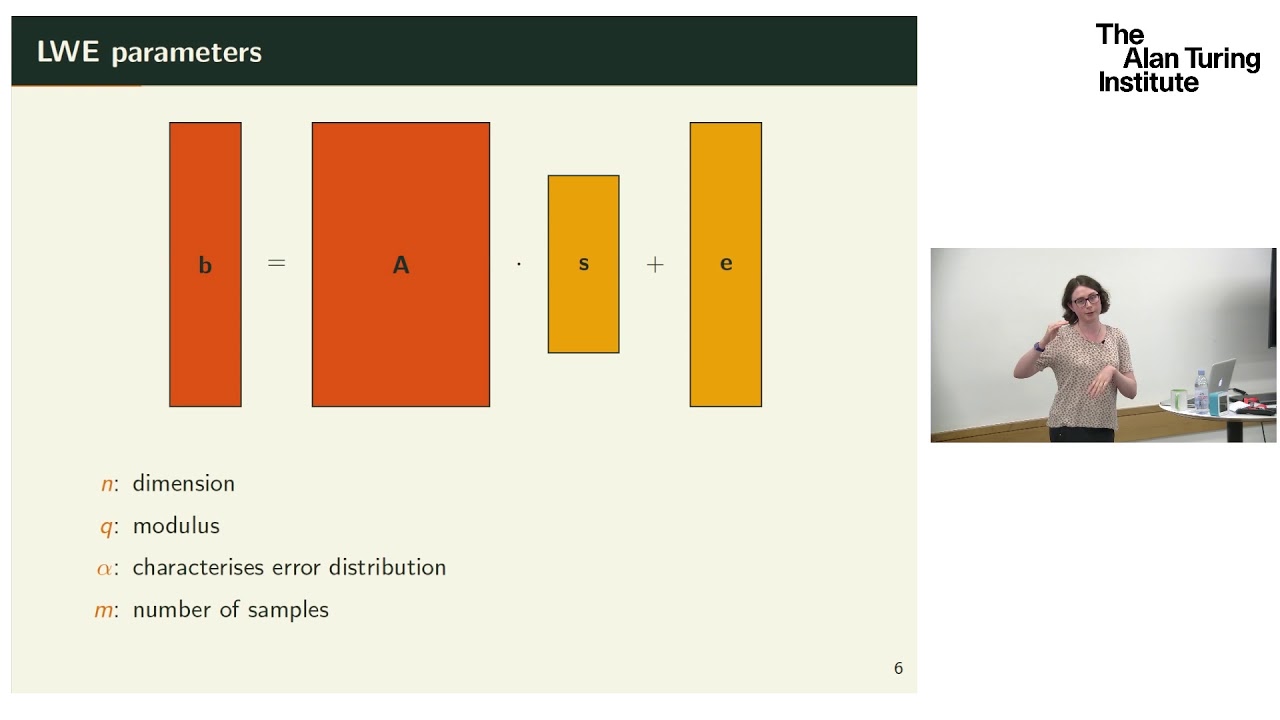
Many schemes proposed for standardisation in the ongoing NIST post-quantum cryptography process are in the area of lattice-based cryptography. In addition to its potential use in a post-quantum world, lattice-based cryptography has become popular due to its wide applicability, with a key application being Fully Homomorphic Encryption (FHE). In this talk we consider FHE schemes based on the Ring Learning with Errors (Ring-LWE) problem and focus on two matters of practical interest. The first is the selection of secure Ring-LWE parameters. In particular, we discuss the differing estimates used in the submissions to the NIST process for the running time of algorithms to solve Ring-LWE. The second is the choice of an appropriate encoding from raw data into the plaintext space, which can impact on efficiency. We discuss a variant of the Fan-Vercauteren FHE scheme which gives a plaintext space that is very convenient for encoding and enables the homomorphic evaluation of circuits with a higher depth.
This talk is based on the following joint works:
1. with Albrecht, Curtis, Deo, Davidson, Postlethwaite, Virdia, Wunderer: Estimate all the {LWE, NTRU} schemes! https://estimate-all-the-lwe-ntru-schemes.github.io/docs/
2. with Chen, Laine, Xia: High-Precision Arithmetic in Homomorphic Encryption: https://eprint.iacr.org/2017/809
Many schemes proposed for standardisation in the ongoing NIST post-quantum cryptography process are in the area of lattice-based cryptography. In addition to its potential use in a post-quantum world, lattice-based cryptography has become popular due to its wide applicability, with a key application being Fully Homomorphic Encryption (FHE). In this talk we consider FHE schemes based on the Ring Learning with Errors (Ring-LWE) problem and focus on two matters of practical interest. The first is the selection of secure Ring-LWE parameters. In particular, we discuss the differing estimates used in the submissions to the NIST process for the running time of algorithms to solve Ring-LWE. The second is the choice of an appropriate encoding from raw data into the plaintext space, which can impact on efficiency. We discuss a variant of the Fan-Vercauteren FHE scheme which gives a plaintext space that is very convenient for encoding and enables the homomorphic evaluation of circuits with a higher depth.
This talk is based on the following joint works:
1. with Albrecht, Curtis, Deo, Davidson, Postlethwaite, Virdia, Wunderer: Estimate all the {LWE, NTRU} schemes! https://estimate-all-the-lwe-ntru-schemes.github.io/docs/
2. with Chen, Laine, Xia: High-Precision Arithmetic in Homomorphic Encryption: https://eprint.iacr.org/2017/809
Tags and Topics
Browse our collection to discover more content in these categories.
Video Information
Views
3.2K
Likes
44
Duration
44:30
Published
Aug 16, 2018
User Reviews
4.4
(3) Related Trending Topics
LIVE TRENDSRelated trending topics. Click any trend to explore more videos.
No specific trending topics match this video yet.
Explore All Trends