Understanding Reduced Mass: Key Concepts & Applications in Two-Body Physics ⚛️
Learn about the concept of reduced mass, its calculation for systems like the hydrogen atom and positron, and how it simplifies the analysis of motion under central forces in physics.
Free Coaching classes
45 views • Jun 13, 2021
About this video
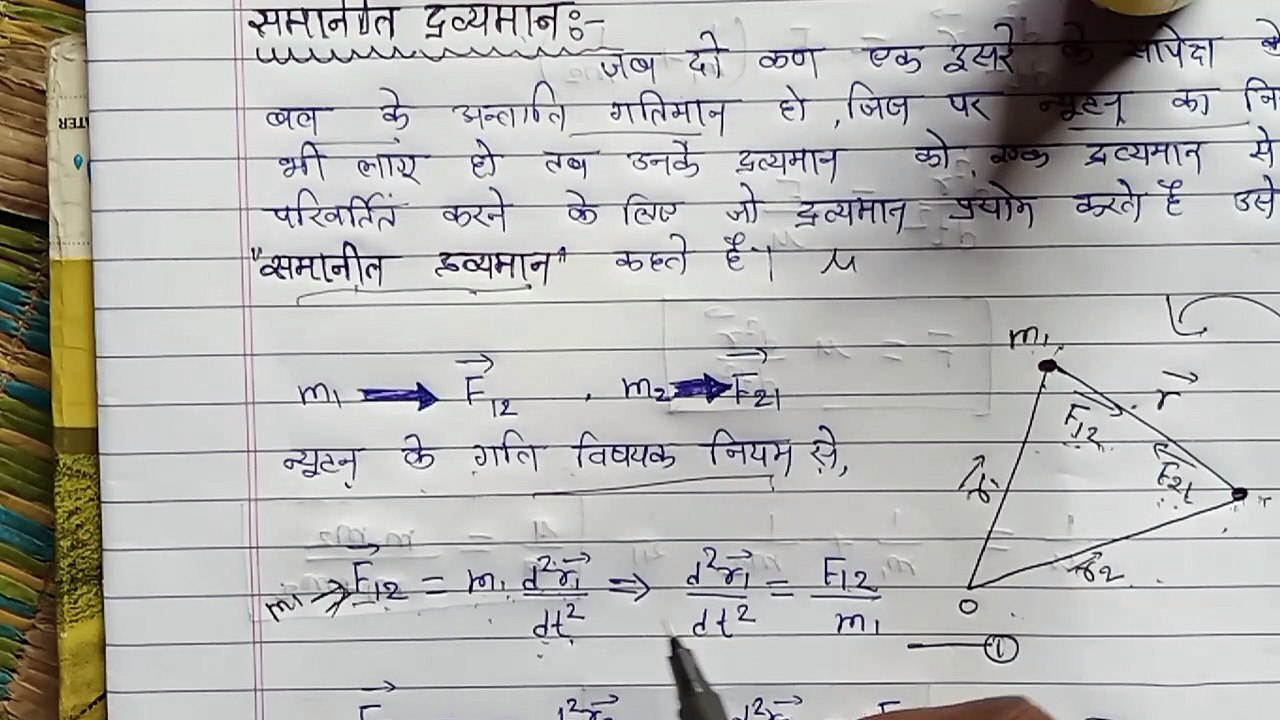
concept of reduced mass//motion under a central force<br /> In physics, the reduced mass is the "effective" inertial mass appearing in the two-body problem of Newtonian mechanics. It is a quantity which allows the two-body problem to be solved as if it were a one-body problem. Note, however, that the mass determining the gravitational force is not reduced. In the computation, one mass can be replaced with the reduced mass, if this is compensated by replacing the other mass with the sum of both masses. The reduced mass is frequently denoted by {\displaystyle \mu }\mu (mu), although the standard gravitational parameter is also denoted by {\displaystyle \mu }\mu (as are a number of other physical quantities). It has the dimensions of mass, and SI unit kg.<br />A conservative force is a force with the property that the total work done in moving a particle between two points is independent of the path taken.[1] Equivalently, if a particle travels in a closed loop, the total work done (the sum of the force acting along the path multiplied by the displacement) by a conservative force is zero.[2]<br /><br />A conservative force depends only on the position of the object. If a force is conservative, it is possible to assign a numerical value for the potential at any point and conversely, when an object moves from one location to another, the force changes the potential energy of the object by an amount that does not depend on the path taken, contributing to the mechanical energy and the overall conservation of energy. If the force is not conservative, then defining a scalar potential is not possible, because taking different paths would lead to conflicting potential differences between the start and end points.<br /><br />Gravitational force is an example of a conservative force, while frictional force is an example of a non-conservative force.<br />★★★★★★★★★★★★★★★★<br />follow us on <br />facebook:- https://touch.f<br />Circus of physics<br />Classical mechanics<br />Classical mechanics Lectures<br />Classical mechanics notes<br />Classical Dynamics of Particles and Systems<br />Physics lectures of classical mechanics<br />Classical mechanics for BS<br />Classical mechanics for M.Sc<br />Newtonian mechanics for single particle<br />Classical mechanics lectures in Hindi<br />Classical mechanics lectures in Urdu<br />Newtonian mechanics<br />Lagrangian Mechanics<br />Hamiltonian Mechanics<br />ADS Physics<br />B.Sc 1 year PHYSICS notes<br />B.Sc 1 year Mechanics<br />B.sc 1 year Vectors<br />B.Sc 2 year PHYSICS notes<br />B.Sc 3 year PHYSICS notes<br />B.Sc PHYSICS notes<br />Ads Physics<br />"circus of physics"<br />“imran abid”<br />BS physics<br />"BSc physics"<br />"MSC physics"<br />"IIT jam"<br />"csir net"<br />"net physical science"<br />"gate"<br />"2020"<br />"ncert physics"<br />"12th physics"<br />"11th physics"<br />"CBSE physics"<br />"PHYSICS"<br />"Mathematical Physics"<br />"Classical Mechanics"<br />"Special theory of relativity"<br />"Electromagnetic Theory"<br />"Maxwell's equations"<br />"Quantum Mechanics"<br />"Schrodinger equation"<br />"Thermodynamics and Statistical Physics"<br />"classical and quantum statistics"<br />"Solid State Physics"<br />"Nuclear and Particle Physics"<br />"spectroscopy"
Video Information
Views
45
Duration
10:59
Published
Jun 13, 2021
Related Trending Topics
LIVE TRENDSRelated trending topics. Click any trend to explore more videos.
No specific trending topics match this video yet.
Explore All Trends