Understanding Rapid Mixing in Gibbs States for Self-Correcting Quantum Systems 🔍
Explore how dynamical approaches reveal rapid mixing properties of Gibbs states within specific logical sectors, shedding light on the stability and fault tolerance of self-correcting quantum memories in this insightful talk by Thiago Bergamaschi.
Simons Institute for the Theory of Computing
157 views • Jun 18, 2025
About this video
Thiago Bergamaschi (UC Berkeley)
https://simons.berkeley.edu/talks/thiago-bergamaschi-uc-berkeley-2025-05-27
Quantum Algorithms, Complexity, and Fault Tolerance Reunion
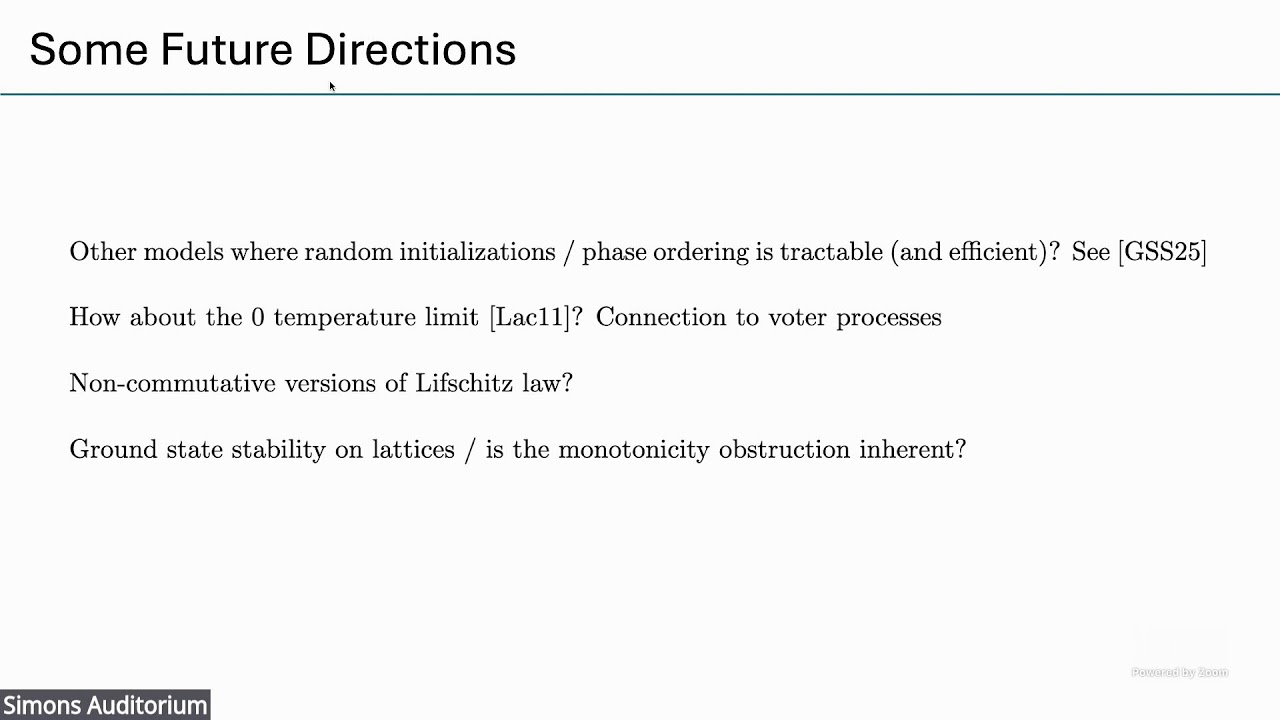
Self-correcting quantum memories store logical quantum information for exponential time in thermal equilibrium at low temperatures. By definition, these systems are slow mixing. This raises the question of how the memory state, which we refer to as the Gibbs state within a logical sector, is created in the first place.
In this paper, we show that when initialized from a ground state of the 4D toric code, a quasi-local quantum Gibbs sampler rapidly converges to the corresponding low-temperature Gibbs state within a logical sector, which then remains meta-stable. This illustrates a dynamical view of self-correcting quantum memories, where the “syndrome sector” rapidly converges to thermal equilibrium, while the “logical sector” remains stable.
The key technical ingredients behind our approach are new, low-temperature decay-of-correlation properties for these meta-stable states. We generalize our results to a broad class of self-correcting quantum memories on lattices with parity check redundancies.
Based on joint work with Reza Gheissari and Yunchao Liu.
https://simons.berkeley.edu/talks/thiago-bergamaschi-uc-berkeley-2025-05-27
Quantum Algorithms, Complexity, and Fault Tolerance Reunion
Self-correcting quantum memories store logical quantum information for exponential time in thermal equilibrium at low temperatures. By definition, these systems are slow mixing. This raises the question of how the memory state, which we refer to as the Gibbs state within a logical sector, is created in the first place.
In this paper, we show that when initialized from a ground state of the 4D toric code, a quasi-local quantum Gibbs sampler rapidly converges to the corresponding low-temperature Gibbs state within a logical sector, which then remains meta-stable. This illustrates a dynamical view of self-correcting quantum memories, where the “syndrome sector” rapidly converges to thermal equilibrium, while the “logical sector” remains stable.
The key technical ingredients behind our approach are new, low-temperature decay-of-correlation properties for these meta-stable states. We generalize our results to a broad class of self-correcting quantum memories on lattices with parity check redundancies.
Based on joint work with Reza Gheissari and Yunchao Liu.
Tags and Topics
Browse our collection to discover more content in these categories.
Video Information
Views
157
Likes
2
Duration
55:50
Published
Jun 18, 2025
Related Trending Topics
LIVE TRENDSRelated trending topics. Click any trend to explore more videos.
No specific trending topics match this video yet.
Explore All Trends