Understanding Queues in Linear Data Structures 📊
Learn how the queue data structure works, its similarities to stacks, and how it manages data using the First-In-First-Out principle in this comprehensive explanation.

Universitat Politècnica de València - UPV
68 views • Dec 20, 2024
About this video
Título: Linear data structures: queue
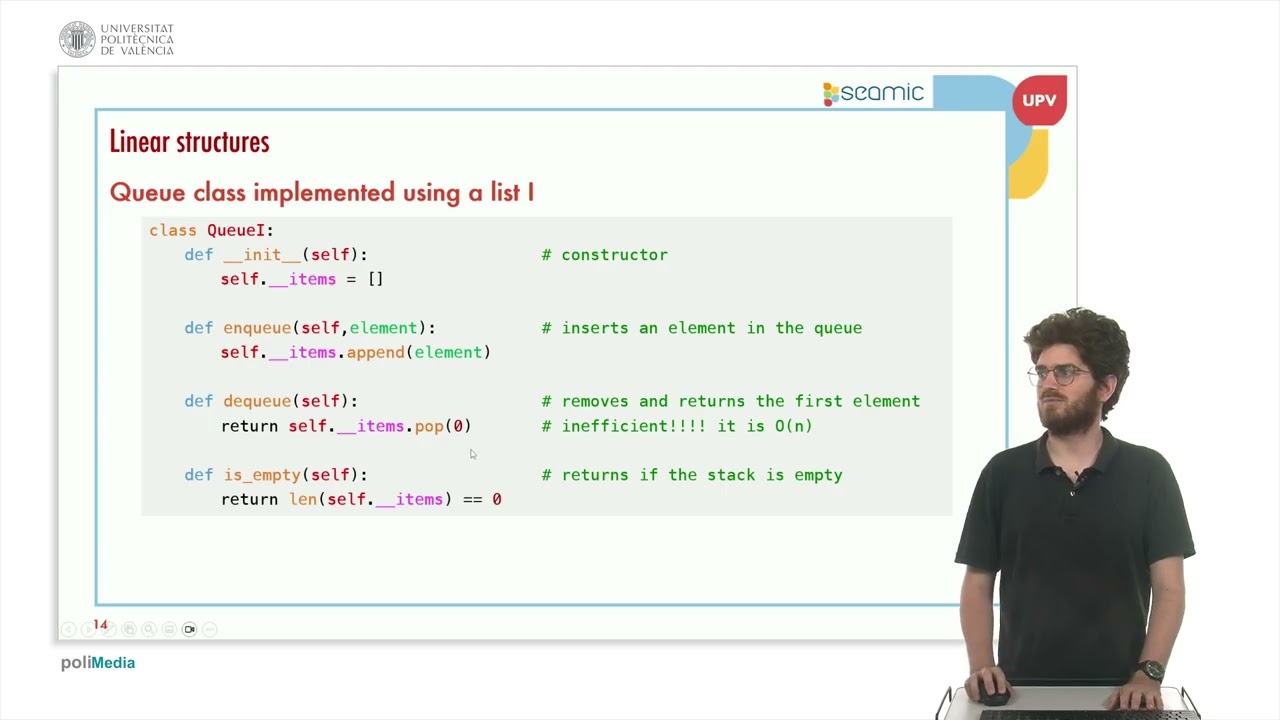
Descripción: In this video the queue data structure is explained, which is similar to a stack but uses the First-In-First-Out (FIFO) strategy instead of Last-In-First-Out (LIFO). A queue can be thought of as a line of people waiting for an event or in a ticketing machine.
The basic operations of a queue are adding and removing elements. Two ways to implement a queue are discussed, including using a list with a naive implementation and inserting elements at the beginning of the list. However, both methods have inefficiencies, such as having to move every element when removing an item or shifting all elements up when adding a new one.
The video concludes by mentioning that these issues will be resolved in a future video using linked lists, which will be covered in the next topic of this unit.
Autor/a: GALINDO JIMENEZ CARLOS SANTIAGO
Curso: Este vídeo es el 19/34 del curso SEAMIC Computer Science II. https://www.youtube.com/playlist?list=PL6kQim6ljTJtqJz2Qe0_6jAtLVluSFR5b
Curso: Este vídeo es el 76/120 del curso SEAMIC (Bachelor's Degree in Systems Engineering and Management for Innovation Challenges). https://www.youtube.com/playlist?list=PL6kQim6ljTJtWBXvKMuuaHPdgj4VcN6IH
+ Universitat Politècnica de València UPV: https://www.upv.es
+ Más vídeos en: https://www.youtube.com/valenciaupv
+ Accede a nuestros MOOC: https://upvx.es
#python #SEAMIC #data structures #queues #CS2
Descripción: In this video the queue data structure is explained, which is similar to a stack but uses the First-In-First-Out (FIFO) strategy instead of Last-In-First-Out (LIFO). A queue can be thought of as a line of people waiting for an event or in a ticketing machine.
The basic operations of a queue are adding and removing elements. Two ways to implement a queue are discussed, including using a list with a naive implementation and inserting elements at the beginning of the list. However, both methods have inefficiencies, such as having to move every element when removing an item or shifting all elements up when adding a new one.
The video concludes by mentioning that these issues will be resolved in a future video using linked lists, which will be covered in the next topic of this unit.
Autor/a: GALINDO JIMENEZ CARLOS SANTIAGO
Curso: Este vídeo es el 19/34 del curso SEAMIC Computer Science II. https://www.youtube.com/playlist?list=PL6kQim6ljTJtqJz2Qe0_6jAtLVluSFR5b
Curso: Este vídeo es el 76/120 del curso SEAMIC (Bachelor's Degree in Systems Engineering and Management for Innovation Challenges). https://www.youtube.com/playlist?list=PL6kQim6ljTJtWBXvKMuuaHPdgj4VcN6IH
+ Universitat Politècnica de València UPV: https://www.upv.es
+ Más vídeos en: https://www.youtube.com/valenciaupv
+ Accede a nuestros MOOC: https://upvx.es
#python #SEAMIC #data structures #queues #CS2
Tags and Topics
Browse our collection to discover more content in these categories.
Video Information
Views
68
Duration
4:07
Published
Dec 20, 2024
Related Trending Topics
LIVE TRENDSRelated trending topics. Click any trend to explore more videos.
No specific trending topics match this video yet.
Explore All Trends