Understanding Nondeterministic Finite Automata (NFA) | Theory of Computation 📘
Explore the fundamentals of Nondeterministic Finite Automata (NFA) in this comprehensive video. Perfect for students and enthusiasts looking to deepen their understanding of automata theory. Watch the full playlist here: https://www.youtube.com/playlist?l
Gate Instructors
10.4K views • Mar 23, 2015
About this video
Playlist for all videos on this topic: https://www.youtube.com/playlist?list=PLXVjll7-2kRnMt3PCXLAbK2rDh-27t4o8
Nondeterministic Finite Automata NFA Theory of Computation, Automata Theory, in hindi, lectures, iit, tutorial,Video lecture for gate exam preparation. What is the difference between deterministic and non-deterministic finite-state automata?
In deterministic finite automata, there's exactly one state transition for every input symbol-state pair. There are also no epsilon transitions, meaning that you're not allowed to change states without consuming anything from the input.
In non-deterministic finite automata, there can be 0 or more state transitions for every input-state pair. You can also have epsilon transitions. When there's no state transition for a given input-state pair, then we say that the automata had crashed, meaning that it can't proceed processing the input, and therefore it doesn't accept the input. When there's more than one choice for a state transition for a given input-state pair, then the machine can just follow all possible paths (think of it as parallel computation), if one of the paths ends up in an accept state, then we say that the automata accepted the input string.
Both automata are equivalent in terms of power though. It may seem that a non-deterministic automata is more powerful, but both automata are proven to be equivalent, meaning that they recognize the same class of languages called regular languages. The proof of equivalence is by construction in which you show that given a DFA, you can construct an equivalent NFA, and vice versa. The proof can be found in any textbook on theory of computation.
Definition of non deterministic finite automaton
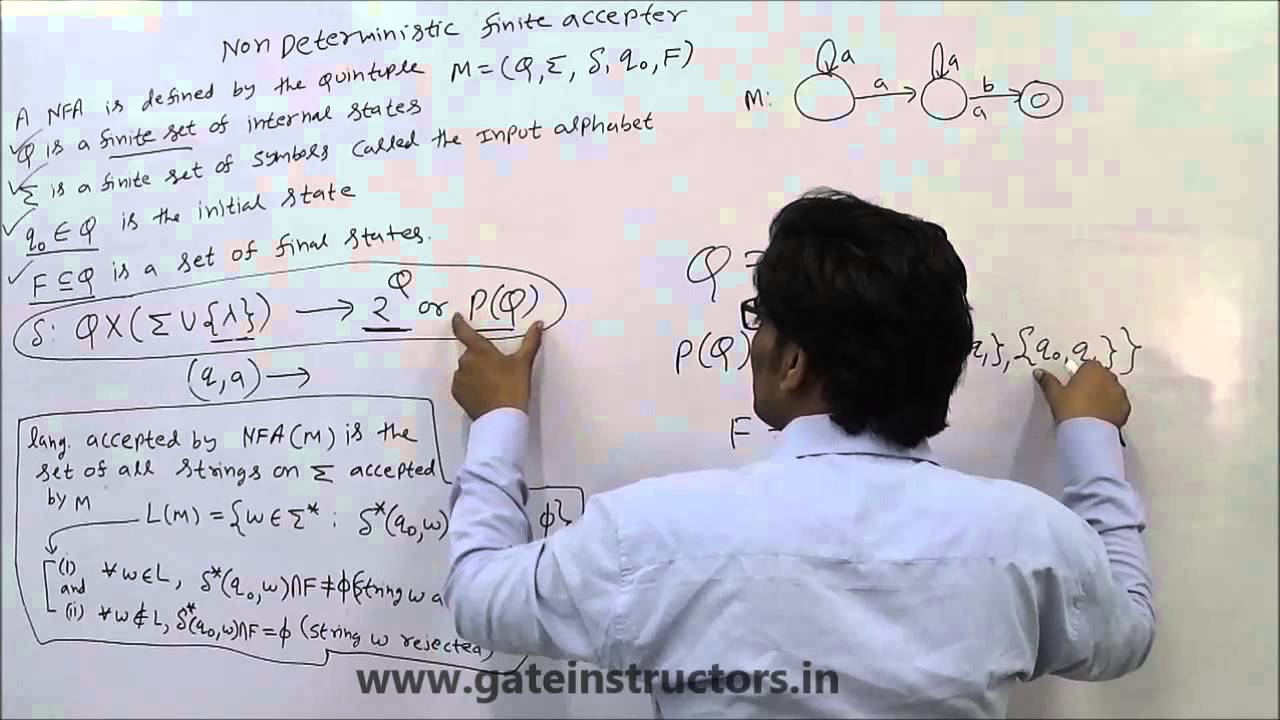
Let Q be a finite set and let be a finite set of symbols. Also let be a function from Q to 2Q , let q0 be a state in Q and let A be a subset of Q. We call the elements of Q a state, the transition function, q0 the initial state and A the set of accepting states.
Then a non deterministic finite automaton is a 5-tuple ( Q , , q0 , , A )
Notes on the definition
As in the case of DFA the set Q in the above definition is simply a set with a finite number of elements. Its elements can be interpreted as a state that the system (automaton) is in.
The transition function is also called a next state function . Unlike DFAs an NFA moves into one of the states given by (q, a) if it receives the input symbol a while in state q. Which one of the states in (q, a) to select is determined nondeterministically.
Note that is a function. Thus for each state q of Q and for each symbol a of (q, a) must be specified. But it can be the empty set, in which case the NFA aborts its operation.
As in the case of DFA the accepting states are used to distinguish sequences of inputs given to the finite automaton. If the finite automaton is in an accepting state when the input ends i.e. ceases to come, the sequence of input symbols given to the finite automaton is "accepted". Otherwise it is not accepted.
Note that any DFA is also a NFA.
nondeterministic finite automata ppt
nondeterministic finite automata solved examples
difference between deterministic and nondeterministic finite automata
nondeterministic finite automata exercises
nondeterministic finite automata regular expression
nondeterministic finite automata union
nondeterministic finite automata examples pdf
nondeterministic finite automata transition table
finite automata examples
lecture notes finite automata
non deterministic finite automata
regular expression
pushdown automata
finite automata tutorial
deterministic finite automata
nondeterministic finite automata
lecture notes finite automata
finite automata examples ppt
what is finite automata
nondeterministic finite automata examples
finite automata tutorial
finite automata examples with solution
deterministic finite automata solved examples
finite automata examples pdf
pushdown automata examples
pushdown automata solved examples
pushdown automata tutorial
turing machine
pushdown automata pdf
pushdown automata ppt
pushdown automata notes
context free grammar
Nondeterministic Finite Automata NFA Theory of Computation, Automata Theory, in hindi, lectures, iit, tutorial,Video lecture for gate exam preparation. What is the difference between deterministic and non-deterministic finite-state automata?
In deterministic finite automata, there's exactly one state transition for every input symbol-state pair. There are also no epsilon transitions, meaning that you're not allowed to change states without consuming anything from the input.
In non-deterministic finite automata, there can be 0 or more state transitions for every input-state pair. You can also have epsilon transitions. When there's no state transition for a given input-state pair, then we say that the automata had crashed, meaning that it can't proceed processing the input, and therefore it doesn't accept the input. When there's more than one choice for a state transition for a given input-state pair, then the machine can just follow all possible paths (think of it as parallel computation), if one of the paths ends up in an accept state, then we say that the automata accepted the input string.
Both automata are equivalent in terms of power though. It may seem that a non-deterministic automata is more powerful, but both automata are proven to be equivalent, meaning that they recognize the same class of languages called regular languages. The proof of equivalence is by construction in which you show that given a DFA, you can construct an equivalent NFA, and vice versa. The proof can be found in any textbook on theory of computation.
Definition of non deterministic finite automaton
Let Q be a finite set and let be a finite set of symbols. Also let be a function from Q to 2Q , let q0 be a state in Q and let A be a subset of Q. We call the elements of Q a state, the transition function, q0 the initial state and A the set of accepting states.
Then a non deterministic finite automaton is a 5-tuple ( Q , , q0 , , A )
Notes on the definition
As in the case of DFA the set Q in the above definition is simply a set with a finite number of elements. Its elements can be interpreted as a state that the system (automaton) is in.
The transition function is also called a next state function . Unlike DFAs an NFA moves into one of the states given by (q, a) if it receives the input symbol a while in state q. Which one of the states in (q, a) to select is determined nondeterministically.
Note that is a function. Thus for each state q of Q and for each symbol a of (q, a) must be specified. But it can be the empty set, in which case the NFA aborts its operation.
As in the case of DFA the accepting states are used to distinguish sequences of inputs given to the finite automaton. If the finite automaton is in an accepting state when the input ends i.e. ceases to come, the sequence of input symbols given to the finite automaton is "accepted". Otherwise it is not accepted.
Note that any DFA is also a NFA.
nondeterministic finite automata ppt
nondeterministic finite automata solved examples
difference between deterministic and nondeterministic finite automata
nondeterministic finite automata exercises
nondeterministic finite automata regular expression
nondeterministic finite automata union
nondeterministic finite automata examples pdf
nondeterministic finite automata transition table
finite automata examples
lecture notes finite automata
non deterministic finite automata
regular expression
pushdown automata
finite automata tutorial
deterministic finite automata
nondeterministic finite automata
lecture notes finite automata
finite automata examples ppt
what is finite automata
nondeterministic finite automata examples
finite automata tutorial
finite automata examples with solution
deterministic finite automata solved examples
finite automata examples pdf
pushdown automata examples
pushdown automata solved examples
pushdown automata tutorial
turing machine
pushdown automata pdf
pushdown automata ppt
pushdown automata notes
context free grammar
Tags and Topics
Browse our collection to discover more content in these categories.
Video Information
Views
10.4K
Likes
21
Duration
5:42
Published
Mar 23, 2015
User Reviews
3.9
(2) Related Trending Topics
LIVE TRENDSRelated trending topics. Click any trend to explore more videos.
No specific trending topics match this video yet.
Explore All Trends