Level Measurement in Closed Tanks with DP Transmitter
Learn how to accurately measure liquid levels in pressurized tanks using differential pressure (DP) transmitters for reliable readings.

InstruNexus
2.6K views • Oct 10, 2025
About this video
💧 Understanding Level Measurement in Closed Tanks
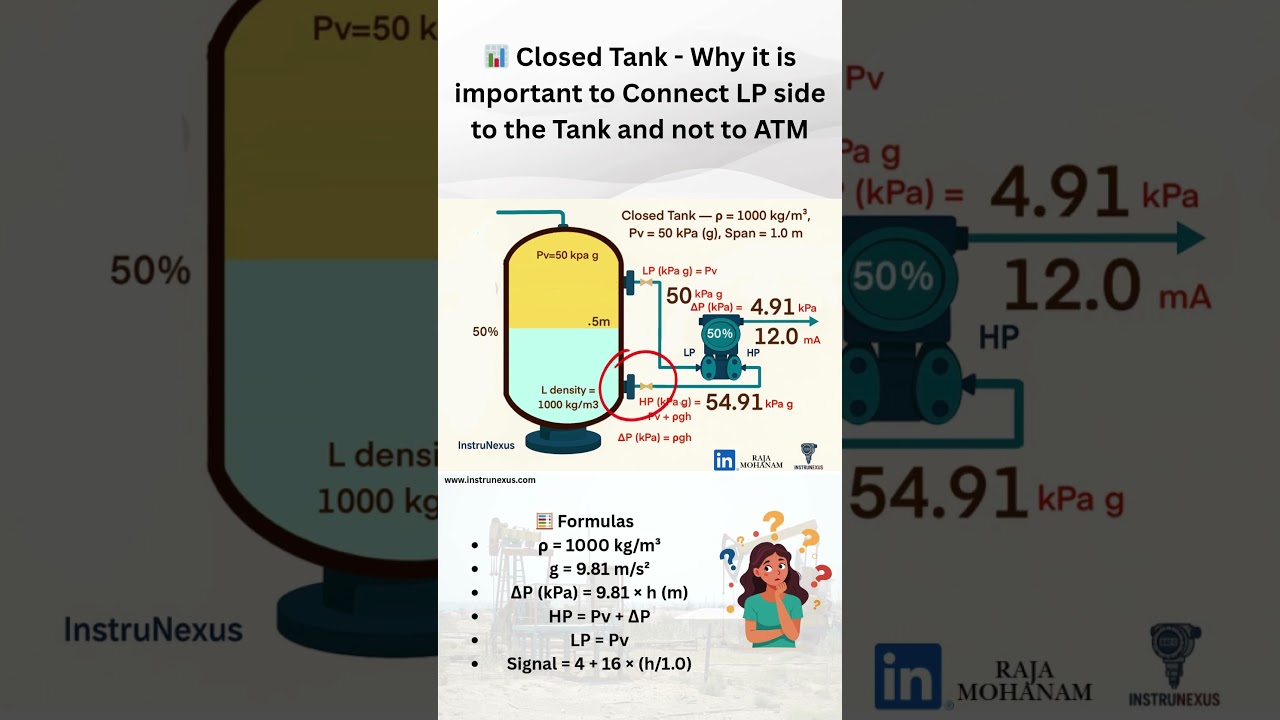
When you’re measuring liquid level in a closed or pressurized tank, it’s not just about the height of the liquid — the vapor pressure above it plays a crucial role.
Here’s the key:
In a differential pressure (DP) transmitter, the Low Pressure (LP) side is connected to the vapor space. This setup ensures that any vapor pressure in the tank is automatically compensated — so the transmitter only “feels” the true liquid head (ρgh).
✅ If the LP side is vented, changes in vapor pressure will directly affect the transmitter’s reading — leading to major level errors.
✅ If the LP side is connected properly, the vapor pressure cancels out, and the transmitter accurately measures only the liquid column.
🎯 In short:
“A properly connected LP line is the difference between an accurate level reading and a costly process error.”
This is a simple yet powerful concept every instrumentation engineer should master — especially during DP transmitter calibration and closed tank design.
Watsapp Channel : https://whatsapp.com/channel/0029VbBC5YC5kg70IIBfsS0N
Telegram : https://t.me/+HxsxzPaLkOczMTRl
You tube : https://www.youtube.com/@InstruNexus
Instagram : https://www.instagram.com/instrunexus/
Website : www.instrunexus.com
#Instrumentation #ProcessControl #LevelMeasurement #DPTransmitter #EngineeringSimplified #Instrunexus #Automation #oilandgas
When you’re measuring liquid level in a closed or pressurized tank, it’s not just about the height of the liquid — the vapor pressure above it plays a crucial role.
Here’s the key:
In a differential pressure (DP) transmitter, the Low Pressure (LP) side is connected to the vapor space. This setup ensures that any vapor pressure in the tank is automatically compensated — so the transmitter only “feels” the true liquid head (ρgh).
✅ If the LP side is vented, changes in vapor pressure will directly affect the transmitter’s reading — leading to major level errors.
✅ If the LP side is connected properly, the vapor pressure cancels out, and the transmitter accurately measures only the liquid column.
🎯 In short:
“A properly connected LP line is the difference between an accurate level reading and a costly process error.”
This is a simple yet powerful concept every instrumentation engineer should master — especially during DP transmitter calibration and closed tank design.
Watsapp Channel : https://whatsapp.com/channel/0029VbBC5YC5kg70IIBfsS0N
Telegram : https://t.me/+HxsxzPaLkOczMTRl
You tube : https://www.youtube.com/@InstruNexus
Instagram : https://www.instagram.com/instrunexus/
Website : www.instrunexus.com
#Instrumentation #ProcessControl #LevelMeasurement #DPTransmitter #EngineeringSimplified #Instrunexus #Automation #oilandgas
Video Information
Views
2.6K
Likes
29
Duration
1:01
Published
Oct 10, 2025
User Reviews
4.3
(2) Related Trending Topics
LIVE TRENDSRelated trending topics. Click any trend to explore more videos.
No specific trending topics match this video yet.
Explore All Trends