Understanding Cryptographic Protocols: Secure Communication Techniques 🔐
Learn how cryptographic protocols use encryption methods to ensure secure and reliable communication. Explore key concepts and best practices in cryptography today!

World Gurukul way of Learning Values and Wisdom
3.6K views • Nov 3, 2017
About this video
Module19 – Cryptography, Section 19.4 – Cryptographic protocol.
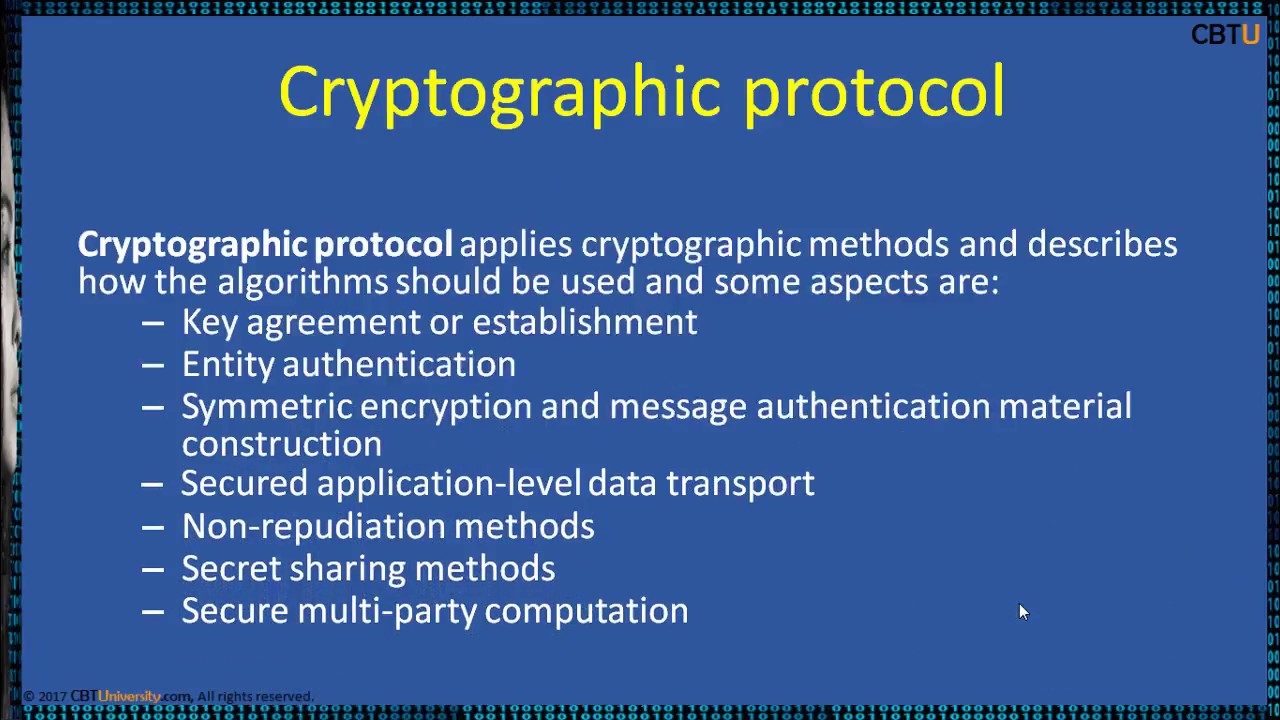
Cryptographic protocol applies cryptographic methods and describes how the algorithms should be used and some aspects are:
– Key agreement or establishment
– Entity authentication
– Symmetric encryption and message authentication material construction
– Secured application-level data transport
– Non-repudiation methods
– Secret sharing methods
– Secure multi-party computation
Crypto Protocols
• Internet Key Exchange (IKE)
• IPSec (Internet Protocol Security)
• Kerberos
• Off-the-Record Messaging (OTR)
• Point to Point Protocol (PPP)
• Signal Protocol
• Transport Layer Security (TLS)
• ZRTP (Z and Real-time Transport Protocol)
TLS is a cryptographic protocol that is used to secure web (HTTP/HTTPS) connections. TLS is used in applications such as web browsing, email, Internet faxing, instant messaging, and voice-over-IP (VoIP).
The 3 aspects of TLS are:
• It has an entity authentication mechanism, based on the X.509 system.
• A key setup phase, where a symmetric encryption key is formed by employing public-key cryptography.
• An application-level data transport function.
Cryptographic protocols can be verified formally to identify threats and done through below models:
• Dolev–Yao model
• Burrows–Abadi–Needham logic (BAN logic)
• Protocol composition logic (PCL)
• Strand space
• Alice & Bob notation
Projects and tools for Security protocol verification
– AVISPA and AVANTSSAR
– Casper / FDR compiler
– CryptoVerif, ProVerif
– Cryptographic Protocol Shapes Analyzer (CPSA)
– Knowledge In Security protocolS (KISS)
– Maude-NRL Protocol Analyzer (Maude-NPA)
– Scyther
– Tamarin Prover
Cryptographic protocol applies cryptographic methods and describes how the algorithms should be used and some aspects are:
– Key agreement or establishment
– Entity authentication
– Symmetric encryption and message authentication material construction
– Secured application-level data transport
– Non-repudiation methods
– Secret sharing methods
– Secure multi-party computation
Crypto Protocols
• Internet Key Exchange (IKE)
• IPSec (Internet Protocol Security)
• Kerberos
• Off-the-Record Messaging (OTR)
• Point to Point Protocol (PPP)
• Signal Protocol
• Transport Layer Security (TLS)
• ZRTP (Z and Real-time Transport Protocol)
TLS is a cryptographic protocol that is used to secure web (HTTP/HTTPS) connections. TLS is used in applications such as web browsing, email, Internet faxing, instant messaging, and voice-over-IP (VoIP).
The 3 aspects of TLS are:
• It has an entity authentication mechanism, based on the X.509 system.
• A key setup phase, where a symmetric encryption key is formed by employing public-key cryptography.
• An application-level data transport function.
Cryptographic protocols can be verified formally to identify threats and done through below models:
• Dolev–Yao model
• Burrows–Abadi–Needham logic (BAN logic)
• Protocol composition logic (PCL)
• Strand space
• Alice & Bob notation
Projects and tools for Security protocol verification
– AVISPA and AVANTSSAR
– Casper / FDR compiler
– CryptoVerif, ProVerif
– Cryptographic Protocol Shapes Analyzer (CPSA)
– Knowledge In Security protocolS (KISS)
– Maude-NRL Protocol Analyzer (Maude-NPA)
– Scyther
– Tamarin Prover
Tags and Topics
Browse our collection to discover more content in these categories.
Video Information
Views
3.6K
Likes
15
Duration
6:59
Published
Nov 3, 2017
User Reviews
4.0
(3) Related Trending Topics
LIVE TRENDSRelated trending topics. Click any trend to explore more videos.
No specific trending topics match this video yet.
Explore All Trends