Understanding 8 Essential Network Protocols: HTTPS, HTTP/3, HTTP, WebSocket, TCP, UDP, SMTP, FTP
In today's interconnected digital landscape, network protocols serve as the foundational communication rules that enable seamless data exchange across device...

GuiNet
10.1K views • Mar 7, 2025
About this video
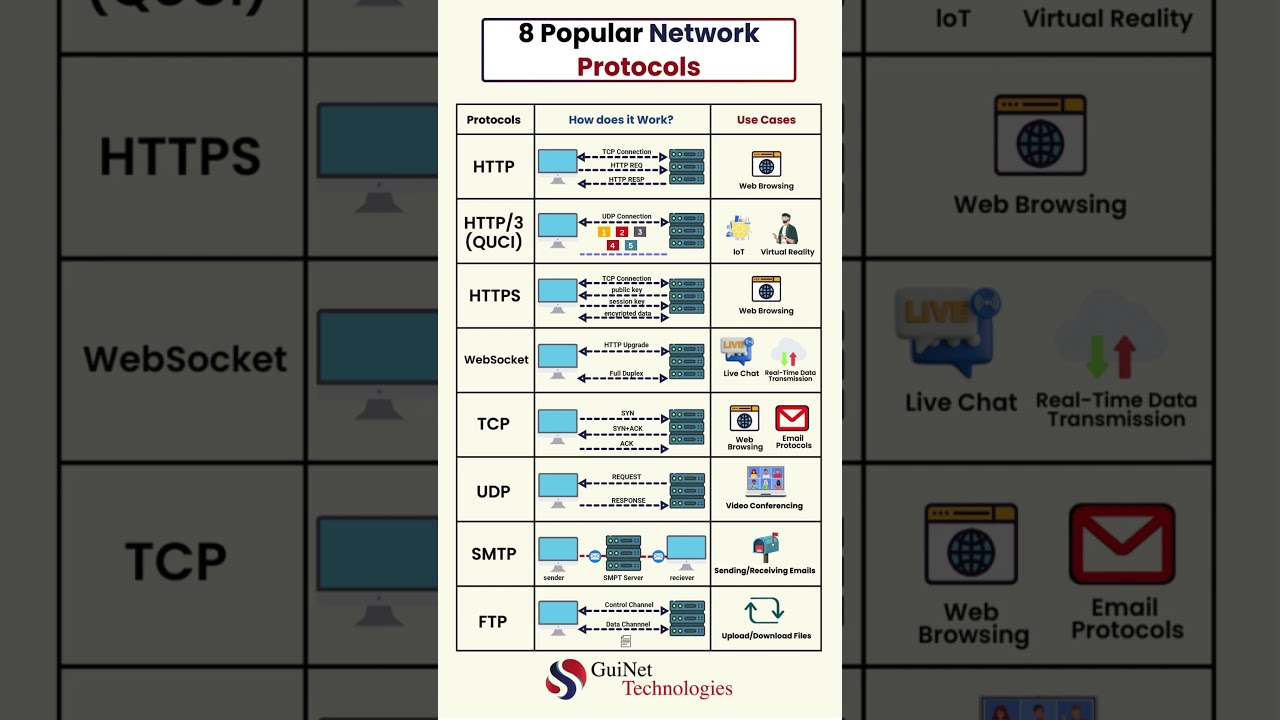
In today's interconnected digital landscape, network protocols serve as the foundational communication rules that enable seamless data exchange across devices and platforms. This comprehensive guide delves into eight pivotal network protocols: HTTPS, HTTP/3, HTTP, WebSocket, TCP, UDP, SMTP, and FTP.
HTTPS (Hypertext Transfer Protocol Secure): An extension of HTTP, HTTPS ensures secure communication over a computer network by encrypting data, safeguarding user privacy and data integrity.
HTTP/3: The latest iteration of the HTTP protocol, HTTP/3 introduces improved performance and security features, utilizing the QUIC transport protocol to enhance speed and reliability.
HTTP (Hypertext Transfer Protocol): The foundational protocol for the World Wide Web, HTTP facilitates the fetching of resources, such as HTML documents, enabling web browsing.
WebSocket: Designed for real-time communication, WebSocket provides full-duplex communication channels over a single TCP connection, making it ideal for applications like chat systems and live updates.
TCP (Transmission Control Protocol): A core protocol of the Internet Protocol Suite, TCP ensures reliable, ordered, and error-checked delivery of data between applications.
UDP (User Datagram Protocol): Contrasting TCP, UDP offers a connectionless datagram service that emphasizes reduced latency over reliability, suitable for applications like live broadcasts and online gaming.
SMTP (Simple Mail Transfer Protocol): The standard protocol for email transmission, SMTP is used to send and relay messages between mail servers.
FTP (File Transfer Protocol): One of the earliest protocols developed, FTP is used to transfer files between a client and server on a computer network.
Understanding these protocols is crucial for professionals in networking and cybersecurity, as they form the backbone of internet communication.
#NetworkProtocols #InternetCommunication #Cybersecurity
HTTPS (Hypertext Transfer Protocol Secure): An extension of HTTP, HTTPS ensures secure communication over a computer network by encrypting data, safeguarding user privacy and data integrity.
HTTP/3: The latest iteration of the HTTP protocol, HTTP/3 introduces improved performance and security features, utilizing the QUIC transport protocol to enhance speed and reliability.
HTTP (Hypertext Transfer Protocol): The foundational protocol for the World Wide Web, HTTP facilitates the fetching of resources, such as HTML documents, enabling web browsing.
WebSocket: Designed for real-time communication, WebSocket provides full-duplex communication channels over a single TCP connection, making it ideal for applications like chat systems and live updates.
TCP (Transmission Control Protocol): A core protocol of the Internet Protocol Suite, TCP ensures reliable, ordered, and error-checked delivery of data between applications.
UDP (User Datagram Protocol): Contrasting TCP, UDP offers a connectionless datagram service that emphasizes reduced latency over reliability, suitable for applications like live broadcasts and online gaming.
SMTP (Simple Mail Transfer Protocol): The standard protocol for email transmission, SMTP is used to send and relay messages between mail servers.
FTP (File Transfer Protocol): One of the earliest protocols developed, FTP is used to transfer files between a client and server on a computer network.
Understanding these protocols is crucial for professionals in networking and cybersecurity, as they form the backbone of internet communication.
#NetworkProtocols #InternetCommunication #Cybersecurity
Tags and Topics
Browse our collection to discover more content in these categories.
Video Information
Views
10.1K
Likes
45
Duration
0:12
Published
Mar 7, 2025
User Reviews
4.0
(2) Related Trending Topics
LIVE TRENDSRelated trending topics. Click any trend to explore more videos.
No specific trending topics match this video yet.
Explore All Trends