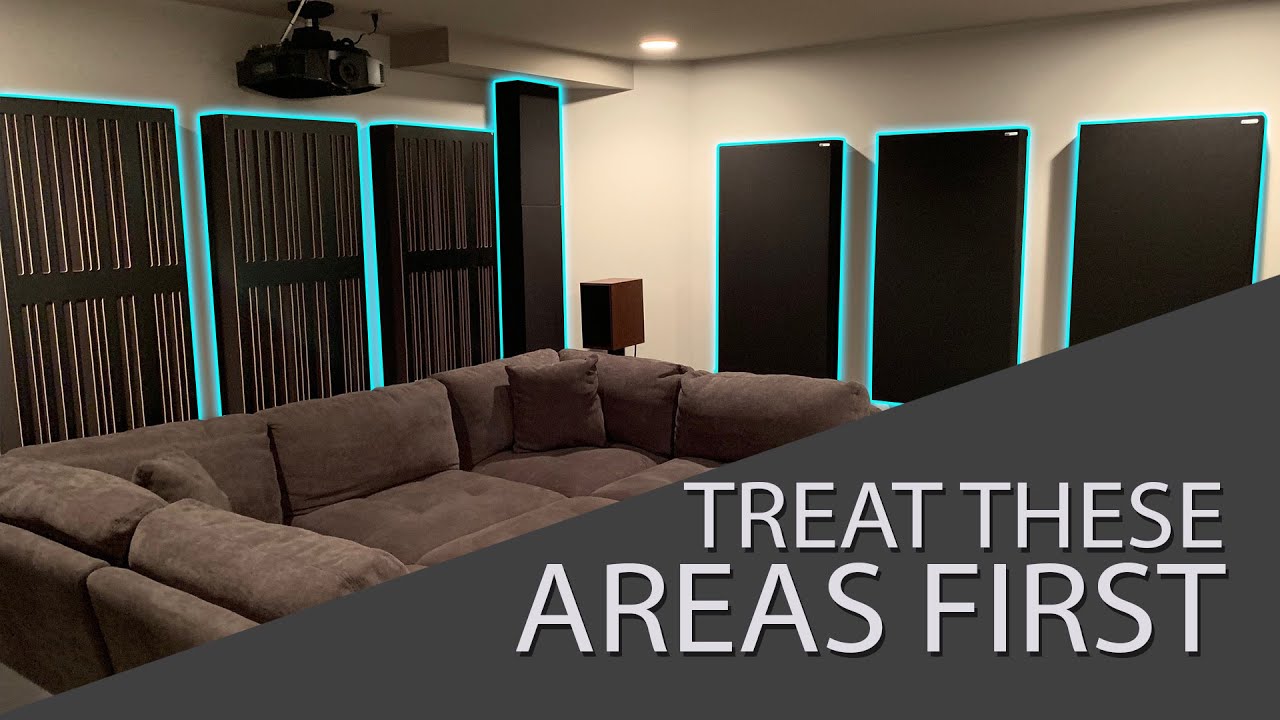
Treat These Areas First: Where to begin Acoustic Treatment
If you’re struggling to get your room under control of echo, comb filtering, and getting the right balance for listening clarity, check out our website where...

GIK Acoustics
342.1K views • Sep 21, 2021
About this video
If you’re struggling to get your room under control of echo, comb filtering, and getting the right balance for listening clarity, check out our website where you can get customized advice for your room and application.
https://www.gikacoustics.com/acoustic-advice-form/
Every single room has its own issues that require their own treatment strategy, but no matter what kind of room you’re treating: whether it’s mixing, mastering or recreational listening, certain methods will always be useful for beginning your treatment strategy.
If you want to improve your imaging there’s no better place to start than by treating your first reflections. The reflected sound that bounces off your walls and ceiling mixes with the original sound. When these reflections are delayed enough you hear them as reverb, but the early reflections arrive at the listening position with so little delay that you can’t parse the reflected sound from the original sound.
Remember that overlapping sound waves interfere with each other and cause phase interference. Those early reflections can arrive close enough to the original sound to create patterns of constructive and destructive interference that result in things like comb filtering.
The thickest panels you can afford and fit are always the best solution. While thinner panels would be able to tackle the reflective region of sounds, using a thinner panel means we’ve used up some of our budget and available space without treating the mid bass frequencies.
For example: The 242 is a fantastic panel for reflection reduction, but with just a modest investment increase we can use a 244 panel which will absorb more of the bass resonances that plague small rooms.
Rooms with ceilings in the 7-9’ range especially benefit from 244 panels on the ceiling first reflections as they are capable of hitting the height axis node that will cause frequency dips in the mid bass at seated ear level.
We have a handy video guide for finding your first reflections if you need help, but think of it this way: Imagine your speaker is a cue ball, your walls and ceiling are billiard table rails and your ear is a pocket.
You can “line up the shot” and know you are hitting the reflection point. Rather than expecting your head to remain in a singular location when you listen, it’s best to envision these billiard shots for every location your head goes to when you lean in or kick back or stand up. The more reflection angles you cover between you and your speakers, the larger the sweet spot will be for you to work/compose and listen in.
Mixing and mastering situations should favor pure broadband absorption for treatment of the first reflections for the most neutral impression of their speakers. However, in a recreational listening scenario like a high-fi room or home theatre, it’s not entirely wrong to use diffusion in these locations. While either option is unequivocally better than a reflective wall “the artist holding the brush” should seek a neutral look at their work rather than the hyped and deeper version that diffusion would impart.
The second step is to treat your corners with thick bass traps. All Rooms have Room modes. These are frequencies that correspond to the dimensions of the room. The three room modes that are the strongest are the wavelengths that measure the same as the height, depth, and width of the room. By treating the corners,we treat two room modes at once.
This concept extends to the horizontal corners that run along your room’s floor and ceiling. Though these areas can be more difficult to treat, they are still corners of your room and an opportunity to get a more and more linear and accurate low end response from your speakers.
In a perfect world you’ll be deploying bass traps that are thick enough to reach the lowest resonances that your room will impart on your ears. GIK’s soffit bass trap has great effect as low as 40Hz, making it the ideal choice of rooms in the 12-14’ range.
While a single soffit stood alone can only affect to about 40Hz, the coupling effect of several soffits run butted or stacked can reach lower and lower regions.
Defining a #1 as first reflections and corners as #2 is a very close call. However, if you’ll recall we’re recommending first reflection zones to be treated with thicker panels so it’s not as if you’d be leaving that region of the speaker entirely unaddressed if you’re starting there exclusively.
Just treating these three areas: first reflections, corners, and backwall, will bring your room’s audio quality up dramatically. Further improvements can be made by testing and experimenting with additional treatment. If you’re struggling to get your room under control, check out our website where you can get customized advice for your room and application.
https://www.gikacoustics.com/acoustic-advice-form/
Every single room has its own issues that require their own treatment strategy, but no matter what kind of room you’re treating: whether it’s mixing, mastering or recreational listening, certain methods will always be useful for beginning your treatment strategy.
If you want to improve your imaging there’s no better place to start than by treating your first reflections. The reflected sound that bounces off your walls and ceiling mixes with the original sound. When these reflections are delayed enough you hear them as reverb, but the early reflections arrive at the listening position with so little delay that you can’t parse the reflected sound from the original sound.
Remember that overlapping sound waves interfere with each other and cause phase interference. Those early reflections can arrive close enough to the original sound to create patterns of constructive and destructive interference that result in things like comb filtering.
The thickest panels you can afford and fit are always the best solution. While thinner panels would be able to tackle the reflective region of sounds, using a thinner panel means we’ve used up some of our budget and available space without treating the mid bass frequencies.
For example: The 242 is a fantastic panel for reflection reduction, but with just a modest investment increase we can use a 244 panel which will absorb more of the bass resonances that plague small rooms.
Rooms with ceilings in the 7-9’ range especially benefit from 244 panels on the ceiling first reflections as they are capable of hitting the height axis node that will cause frequency dips in the mid bass at seated ear level.
We have a handy video guide for finding your first reflections if you need help, but think of it this way: Imagine your speaker is a cue ball, your walls and ceiling are billiard table rails and your ear is a pocket.
You can “line up the shot” and know you are hitting the reflection point. Rather than expecting your head to remain in a singular location when you listen, it’s best to envision these billiard shots for every location your head goes to when you lean in or kick back or stand up. The more reflection angles you cover between you and your speakers, the larger the sweet spot will be for you to work/compose and listen in.
Mixing and mastering situations should favor pure broadband absorption for treatment of the first reflections for the most neutral impression of their speakers. However, in a recreational listening scenario like a high-fi room or home theatre, it’s not entirely wrong to use diffusion in these locations. While either option is unequivocally better than a reflective wall “the artist holding the brush” should seek a neutral look at their work rather than the hyped and deeper version that diffusion would impart.
The second step is to treat your corners with thick bass traps. All Rooms have Room modes. These are frequencies that correspond to the dimensions of the room. The three room modes that are the strongest are the wavelengths that measure the same as the height, depth, and width of the room. By treating the corners,we treat two room modes at once.
This concept extends to the horizontal corners that run along your room’s floor and ceiling. Though these areas can be more difficult to treat, they are still corners of your room and an opportunity to get a more and more linear and accurate low end response from your speakers.
In a perfect world you’ll be deploying bass traps that are thick enough to reach the lowest resonances that your room will impart on your ears. GIK’s soffit bass trap has great effect as low as 40Hz, making it the ideal choice of rooms in the 12-14’ range.
While a single soffit stood alone can only affect to about 40Hz, the coupling effect of several soffits run butted or stacked can reach lower and lower regions.
Defining a #1 as first reflections and corners as #2 is a very close call. However, if you’ll recall we’re recommending first reflection zones to be treated with thicker panels so it’s not as if you’d be leaving that region of the speaker entirely unaddressed if you’re starting there exclusively.
Just treating these three areas: first reflections, corners, and backwall, will bring your room’s audio quality up dramatically. Further improvements can be made by testing and experimenting with additional treatment. If you’re struggling to get your room under control, check out our website where you can get customized advice for your room and application.
Video Information
Views
342.1K
Likes
4.3K
Duration
5:45
Published
Sep 21, 2021
User Reviews
4.6
(68) Related Trending Topics
LIVE TRENDSRelated trending topics. Click any trend to explore more videos.