Types of Languages: Empty, Finite & Infinite | TOC
Learn about empty, finite, and infinite languages in computation theory. Understand their definitions and significance in formal languages. 📚
EduFulness EFN
20 views • Mar 14, 2026
About this video
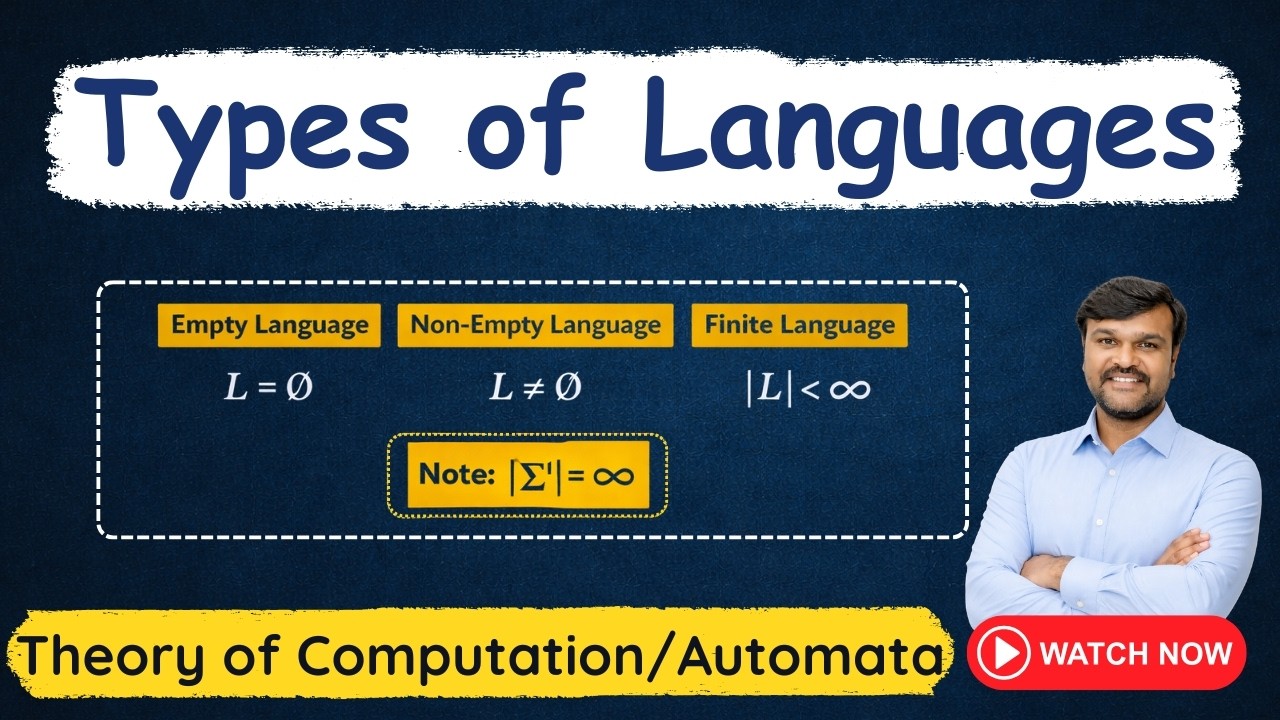
**Topic:** *Empty Language, Non-Empty Language, Finite Language and Infinite Language*
In this video, you will learn:
* What **Empty Language (∅)** means in Theory of Computation
* What **Non-Empty Language** means
* The definition of **Finite Language**
* The definition of **Infinite Language**
* The difference between **empty string (ε) and empty language (∅)**
* Examples to clearly understand different **types of languages**
In **Theory of Computation**, languages are classified based on the **number of strings they contain**.
**Empty Language (∅)**
An **empty language** is a language that **contains no strings**.
Example:
L = ∅
Important note:
* The empty language **does not even contain the empty string (ε)**.
**Non-Empty Language**
A **non-empty language** is a language that **contains at least one string**.
Example:
L = {a}
L = {ab, ba}
**Finite Language**
A **finite language** is a language that contains a **finite number of strings**.
Example:
L = {a, ab, abb}
The number of strings in the language is **limited**.
**Infinite Language**
An **infinite language** is a language that contains **infinitely many strings**.
Example:
L = { aⁿ | n ≥ 1 }
This language contains strings like:
a, aa, aaa, aaaa, ...
Important notes:
* **∅ (empty language)** is different from **{ε} (language containing empty string)**
* A language may be **finite or infinite depending on the number of strings**
Understanding these **language classifications** is essential for learning:
* **Formal Languages**
* **Automata Theory**
* **Language operations**
* **Regular and Context-Free Languages**
Questions related to **types of languages** are frequently asked in **university exams, GATE, UGC NET, and other competitive exams**.
---
Welcome to the **Theory of Computation complete playlist**, where we cover the **entire university-level TOC syllabus** step by step with **clear explanations and exam-oriented examples**.
This playlist is designed for:
* Computer Science & Engineering students
* IT / ECE students
* Beginners learning Automata Theory
* Learners preparing for **university exams & competitive exams**
All concepts are explained in **simple language**, with **clear logical flow and structured explanations**, exactly the way they are expected in **exams and interviews**.
---
## 🎓 Learn Theory of Computation Completely (Udemy Full Course)
This video is a **sample lecture** from my **complete Theory of Computation course on Udemy**, which covers **Automata Theory and Formal Languages in depth**.
👉 **Enroll in the Full Course (Best Discount Applied):**
https://www.udemy.com/course/theory-of-computation-automata-theory-for-2021/?couponCode=EFNMAR26BEST
---
## 📚 What You’ll Learn in the FULL Course
### 🔹 Foundations of TOC
* Introduction to Theory of Computation
* Alphabets, Strings and Languages
* Operations on Strings and Languages
* Kleene Closure and Positive Closure
### 🔹 Finite Automata
* Deterministic Finite Automata (DFA)
* Non-Deterministic Finite Automata (NFA)
* DFA vs NFA
* Conversion of NFA to DFA
* Regular Expressions
### 🔹 Context Free Grammars (CFG)
* Grammar Definitions
* Derivation and Parse Trees
* Ambiguous and Unambiguous Grammars
* Grammar Simplification
### 🔹 Pushdown Automata
* Introduction to PDA
* PDA Construction
* Relationship between **CFG and PDA**
### 🔹 Turing Machines
* Introduction to Turing Machines
* Design of Turing Machines
* Variants of Turing Machines
### 🔹 Decidability
* Decidable Problems
* Undecidable Problems
* Halting Problem
---
## 🚀 Why This Course?
✔ Covers the **complete TOC syllabus**
✔ Clear explanations with **step-by-step examples**
✔ Beginner-friendly teaching style
✔ Designed for **exam preparation and concept clarity**
✔ Perfect for **engineering students**
👍 Like | 💬 Comment | 🔔 Subscribe for the complete **Theory of Computation series**.
---
### 🔖 Hashtags
#TheoryOfComputation
#FormalLanguages
#AutomataTheory
#TOC
#ComputerScience
#TOCCourse
#EngineeringStudents
#CSE
#UniversityExams
In this video, you will learn:
* What **Empty Language (∅)** means in Theory of Computation
* What **Non-Empty Language** means
* The definition of **Finite Language**
* The definition of **Infinite Language**
* The difference between **empty string (ε) and empty language (∅)**
* Examples to clearly understand different **types of languages**
In **Theory of Computation**, languages are classified based on the **number of strings they contain**.
**Empty Language (∅)**
An **empty language** is a language that **contains no strings**.
Example:
L = ∅
Important note:
* The empty language **does not even contain the empty string (ε)**.
**Non-Empty Language**
A **non-empty language** is a language that **contains at least one string**.
Example:
L = {a}
L = {ab, ba}
**Finite Language**
A **finite language** is a language that contains a **finite number of strings**.
Example:
L = {a, ab, abb}
The number of strings in the language is **limited**.
**Infinite Language**
An **infinite language** is a language that contains **infinitely many strings**.
Example:
L = { aⁿ | n ≥ 1 }
This language contains strings like:
a, aa, aaa, aaaa, ...
Important notes:
* **∅ (empty language)** is different from **{ε} (language containing empty string)**
* A language may be **finite or infinite depending on the number of strings**
Understanding these **language classifications** is essential for learning:
* **Formal Languages**
* **Automata Theory**
* **Language operations**
* **Regular and Context-Free Languages**
Questions related to **types of languages** are frequently asked in **university exams, GATE, UGC NET, and other competitive exams**.
---
Welcome to the **Theory of Computation complete playlist**, where we cover the **entire university-level TOC syllabus** step by step with **clear explanations and exam-oriented examples**.
This playlist is designed for:
* Computer Science & Engineering students
* IT / ECE students
* Beginners learning Automata Theory
* Learners preparing for **university exams & competitive exams**
All concepts are explained in **simple language**, with **clear logical flow and structured explanations**, exactly the way they are expected in **exams and interviews**.
---
## 🎓 Learn Theory of Computation Completely (Udemy Full Course)
This video is a **sample lecture** from my **complete Theory of Computation course on Udemy**, which covers **Automata Theory and Formal Languages in depth**.
👉 **Enroll in the Full Course (Best Discount Applied):**
https://www.udemy.com/course/theory-of-computation-automata-theory-for-2021/?couponCode=EFNMAR26BEST
---
## 📚 What You’ll Learn in the FULL Course
### 🔹 Foundations of TOC
* Introduction to Theory of Computation
* Alphabets, Strings and Languages
* Operations on Strings and Languages
* Kleene Closure and Positive Closure
### 🔹 Finite Automata
* Deterministic Finite Automata (DFA)
* Non-Deterministic Finite Automata (NFA)
* DFA vs NFA
* Conversion of NFA to DFA
* Regular Expressions
### 🔹 Context Free Grammars (CFG)
* Grammar Definitions
* Derivation and Parse Trees
* Ambiguous and Unambiguous Grammars
* Grammar Simplification
### 🔹 Pushdown Automata
* Introduction to PDA
* PDA Construction
* Relationship between **CFG and PDA**
### 🔹 Turing Machines
* Introduction to Turing Machines
* Design of Turing Machines
* Variants of Turing Machines
### 🔹 Decidability
* Decidable Problems
* Undecidable Problems
* Halting Problem
---
## 🚀 Why This Course?
✔ Covers the **complete TOC syllabus**
✔ Clear explanations with **step-by-step examples**
✔ Beginner-friendly teaching style
✔ Designed for **exam preparation and concept clarity**
✔ Perfect for **engineering students**
👍 Like | 💬 Comment | 🔔 Subscribe for the complete **Theory of Computation series**.
---
### 🔖 Hashtags
#TheoryOfComputation
#FormalLanguages
#AutomataTheory
#TOC
#ComputerScience
#TOCCourse
#EngineeringStudents
#CSE
#UniversityExams
Video Information
Views
20
Likes
2
Duration
6:09
Published
Mar 14, 2026
Related Trending Topics
LIVE TRENDSRelated trending topics. Click any trend to explore more videos.
Trending Now