Unlocking the Secrets of the Computational Universe 🌌 by Leslie Valiant
Explore how computation shapes our understanding of the universe in Leslie Valiant's insightful lecture. Discover the profound connection between computation and the sciences, and how this perspective revolutionizes scientific discovery.

Institute for Advanced Study
4.3K views • Jan 6, 2016
About this video
Lens of Computation on the Sciences - November 22, 2014
The Computational Universe - Leslie Valiant, Harvard University
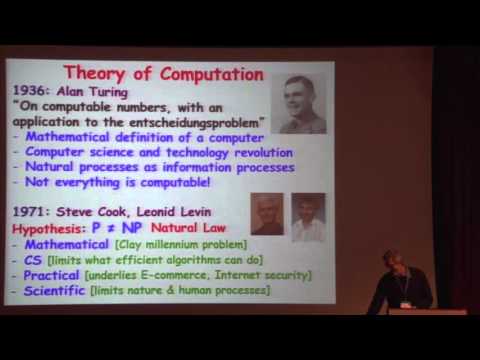
The idea that computation has its own laws and limitations emerged in the 1930s. Some of the early computing pioneers, most notably Turing and von Neumann, already understood that this idea had far reaching implications beyond technology. It offered a new way of looking at the world, in terms of computational processes. Turing and von Neumann themselves pursued this perspective in such areas as genetics, biological development, cognition, and the brain. There has been much progress in the intervening years in understanding computation. The question that arises for our generation is how to exploit this increasing knowledge to obtain insights into the natural world that cannot be obtained otherwise. Valiant will focus on biological evolution approached from this standpoint. The scientific question is to determine the molecular mechanism of biological evolution, to a level of specificity that it can be simulated by computer, and to understand why this mechanism can do the remarkable things that it has done within the time that has been available. The talk will explore the tools needed to approach how this come from machine learning, the field that studies how mechanisms that achieve complex functionality can arise by a process of adaptation rather than design.
Leslie Valiant is the T. Jefferson Coolidge Professor of Computer Science and Applied Mathematics in the School of Engineering and Applied Sciences at Harvard University. Valiant received his Ph.D. from Warwick University in 1974. Valiant’s work has ranged over several areas of theoretical computer science, particularly complexity theory, learning, and parallel computation. He also has interests in computational neuroscience, evolution, and artificial intelligence and is the author of two books, Circuits of the Mind (Oxford University Press, 1994) and Probably Approximately Correct (Basic Books, 2013). Valiant received the Nevanlinna Prize, the Knuth Award, the European Association for Theoretical Computer Science EATCS Award, and the A. M. Turing Award. He is a Fellow of the Royal Society and a member of the National Academy of Sciences. http://people.seas.harvard.edu/~valiant/
More videos on http://video.ias.edu
The Computational Universe - Leslie Valiant, Harvard University
The idea that computation has its own laws and limitations emerged in the 1930s. Some of the early computing pioneers, most notably Turing and von Neumann, already understood that this idea had far reaching implications beyond technology. It offered a new way of looking at the world, in terms of computational processes. Turing and von Neumann themselves pursued this perspective in such areas as genetics, biological development, cognition, and the brain. There has been much progress in the intervening years in understanding computation. The question that arises for our generation is how to exploit this increasing knowledge to obtain insights into the natural world that cannot be obtained otherwise. Valiant will focus on biological evolution approached from this standpoint. The scientific question is to determine the molecular mechanism of biological evolution, to a level of specificity that it can be simulated by computer, and to understand why this mechanism can do the remarkable things that it has done within the time that has been available. The talk will explore the tools needed to approach how this come from machine learning, the field that studies how mechanisms that achieve complex functionality can arise by a process of adaptation rather than design.
Leslie Valiant is the T. Jefferson Coolidge Professor of Computer Science and Applied Mathematics in the School of Engineering and Applied Sciences at Harvard University. Valiant received his Ph.D. from Warwick University in 1974. Valiant’s work has ranged over several areas of theoretical computer science, particularly complexity theory, learning, and parallel computation. He also has interests in computational neuroscience, evolution, and artificial intelligence and is the author of two books, Circuits of the Mind (Oxford University Press, 1994) and Probably Approximately Correct (Basic Books, 2013). Valiant received the Nevanlinna Prize, the Knuth Award, the European Association for Theoretical Computer Science EATCS Award, and the A. M. Turing Award. He is a Fellow of the Royal Society and a member of the National Academy of Sciences. http://people.seas.harvard.edu/~valiant/
More videos on http://video.ias.edu
Video Information
Views
4.3K
Likes
78
Duration
01:00:42
Published
Jan 6, 2016
User Reviews
4.6
(4) Related Trending Topics
LIVE TRENDSRelated trending topics. Click any trend to explore more videos.
No specific trending topics match this video yet.
Explore All Trends