The Challenge of Representing the Mathematical Mind
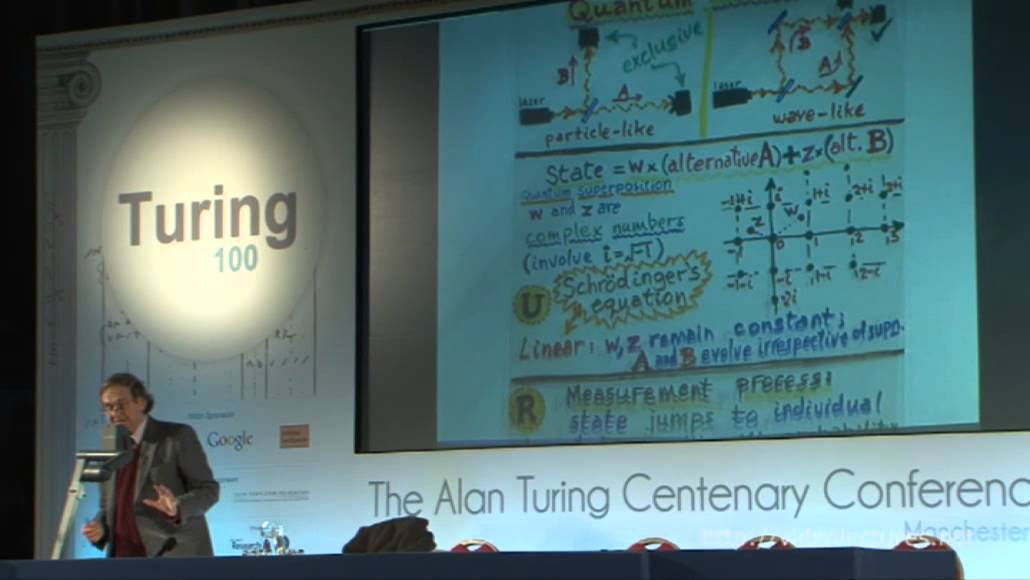
An exploration of the difficulties involved in modeling the mathematical reasoning processes of the human mind, presented at the Alan Turing Centenary Conference.

VideoLecturesChannel
41.4K views • Dec 6, 2012
About this video
VideoLectures.Net
View the talk in context: http://videolectures.net/turing100_penrose_mathematical_mind/
View the complete Alan Turing Centenary Conference Manchester, 2012: http://videolectures.net/turing100_conference2012_manchester/
Speaker: Sir Roger Penrose, Mathematical Institute, University of Oxford
License: Creative Commons CC BY-NC-ND 3.0
More information at http://videolectures.net/site/about/
More talks at http://videolectures.net/
Following Alan Turing's ground-breaking 1937 paper, which introduced his notion of the Universal Turing machine, he suggested, in 1939, generalizations based on ordinal logic and oracle machines, these being apparently motivated by attempts to model the mathematical mind in a way that could evade the apparent limitations presented by Gödel's incompleteness theorems. In this talk, I introduce the idea of a "cautious oracle" as a more human version of Turing's oracles. Nevertheless, I show that even this fails to capture the essence of the full capabilities of our understanding.
I raise the issue of possible physical processes that would appear to be needed in order to circumvent these Gödel-type restrictions. At the end of the talk, I report on some startling new experiments, which appear to point to new insights into the possible physical processes underlying conscious brain activity, and I speculate on how this might relate to the power of human understanding.
View the talk in context: http://videolectures.net/turing100_penrose_mathematical_mind/
View the complete Alan Turing Centenary Conference Manchester, 2012: http://videolectures.net/turing100_conference2012_manchester/
Speaker: Sir Roger Penrose, Mathematical Institute, University of Oxford
License: Creative Commons CC BY-NC-ND 3.0
More information at http://videolectures.net/site/about/
More talks at http://videolectures.net/
Following Alan Turing's ground-breaking 1937 paper, which introduced his notion of the Universal Turing machine, he suggested, in 1939, generalizations based on ordinal logic and oracle machines, these being apparently motivated by attempts to model the mathematical mind in a way that could evade the apparent limitations presented by Gödel's incompleteness theorems. In this talk, I introduce the idea of a "cautious oracle" as a more human version of Turing's oracles. Nevertheless, I show that even this fails to capture the essence of the full capabilities of our understanding.
I raise the issue of possible physical processes that would appear to be needed in order to circumvent these Gödel-type restrictions. At the end of the talk, I report on some startling new experiments, which appear to point to new insights into the possible physical processes underlying conscious brain activity, and I speculate on how this might relate to the power of human understanding.
Tags and Topics
Browse our collection to discover more content in these categories.
Video Information
Views
41.4K
Likes
577
Duration
01:33:09
Published
Dec 6, 2012
User Reviews
4.6
(8) Related Trending Topics
LIVE TRENDSRelated trending topics. Click any trend to explore more videos.
No specific trending topics match this video yet.
Explore All Trends