Understanding the 90-Degree Torque Issue ⚙️
Explore the engineering behind the 90-degree torque problem and how it impacts design and performance. Free trial at Brilliant.org!

New Mind
1.5M views • Jan 31, 2026
About this video
▶️ Visit https://brilliant.org/NewMind to get a 30-day free trial and 20% discount on the annual premium subscription
This video traces the engineering evolution of right-angle power transmission, from the primitive pin-and-face drives of Roman watermills to the complex split-torque systems of modern aviation.
ORIGINS OF ORTHOGONAL POWER
• First conceptualized by Roman architect Vitruvius in the 1st Century BC.
• Used a "pin-and-face" design to convert horizontal water wheel rotation to vertical millstone rotation.
• Relied on animal tallow for lubrication to mitigate high sliding friction.
THE MOVE TO IRON
• Steam power torque loads caused early wooden gears to deflect or fail, necessitating grey cast iron.
• "Mortise construction" combined iron rims with wooden cogs to dampen noise and absorb shock.
• Iron gears required rigid bedplates rather than timber framing to maintain perfect alignment.
PITCH CONE GEOMETRY
• Replaces cylinders with cones that intersect exactly where the shafts intersect.
• Matches the peripheral speed of driving and driven gears at every point from heel to toe.
• Creates "line contact" instead of point contact to increase power transmission capacity.
PRECISION MANUFACTURING
• William Gleason's 1874 Bevel Gear Planer revolutionized high-speed gear production.
• Mechanically simulated gear rolling to generate a mathematically ideal "Octoid" profile.
• Allowed bevel gears to operate at the thousands of RPM needed for internal combustion engines.
AUTOMOTIVE EVOLUTION
• Spiral Bevel gears introduced in 1913 to eliminate the "whine" of straight gears.
• Hypoid gears (1926) utilized an offset pinion to lower the driveshaft and vehicle floor.
• Extreme pressure lubricants developed to handle the sliding action of Hypoid teeth.
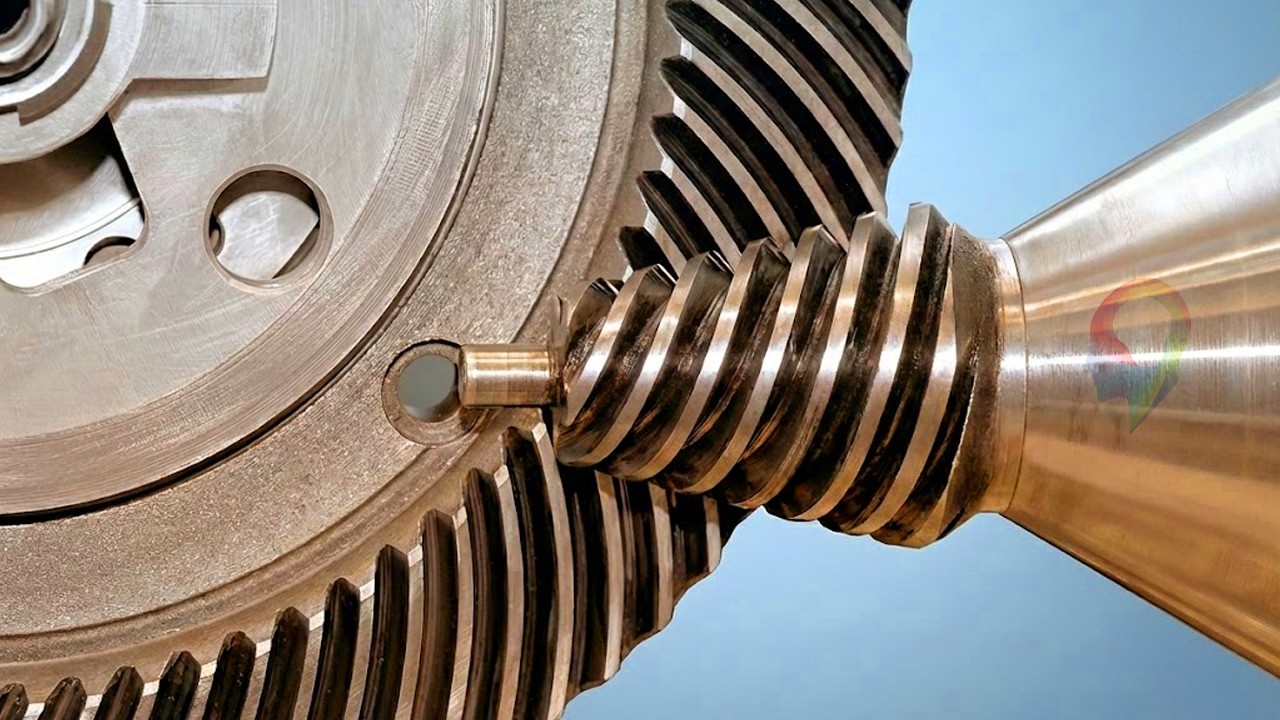
WORM DRIVES
• Capable of massive reduction ratios (50:1 to 100:1) in a single compact stage.
• Features "self-locking" properties where friction prevents the output from back-driving the input.
• Acts as a passive brake for safety-critical equipment like elevators.
AVIATION & SPLIT-TORQUE
• Zerol gears developed to provide spiral strength with zero spiral angle to reduce axial thrust.
• Face gear split-torque systems use a floating pinion to passively split torque 50/50.
• Allows dual engines to drive a single rotor without sensors or computer control.
------
SUPPORT NEW MIND ON PATREON
https://www.patreon.com/newmind
END CREDIT CARTOON BY
Tom Sloan circusitch@circusitch
#Engineering #MechanicalEngineering #Gears #PowerTransmission #BevelGears #WormDrive #HypoidGear #AutomotiveEngineering #Aviation #Manufacturing #SteamPower #Machining #IndustrialRevolution #GleasonWorks #SpiralBevel #ZerolGears #SplitTorque #Physics #Mechanisms #TechHistory
This video traces the engineering evolution of right-angle power transmission, from the primitive pin-and-face drives of Roman watermills to the complex split-torque systems of modern aviation.
ORIGINS OF ORTHOGONAL POWER
• First conceptualized by Roman architect Vitruvius in the 1st Century BC.
• Used a "pin-and-face" design to convert horizontal water wheel rotation to vertical millstone rotation.
• Relied on animal tallow for lubrication to mitigate high sliding friction.
THE MOVE TO IRON
• Steam power torque loads caused early wooden gears to deflect or fail, necessitating grey cast iron.
• "Mortise construction" combined iron rims with wooden cogs to dampen noise and absorb shock.
• Iron gears required rigid bedplates rather than timber framing to maintain perfect alignment.
PITCH CONE GEOMETRY
• Replaces cylinders with cones that intersect exactly where the shafts intersect.
• Matches the peripheral speed of driving and driven gears at every point from heel to toe.
• Creates "line contact" instead of point contact to increase power transmission capacity.
PRECISION MANUFACTURING
• William Gleason's 1874 Bevel Gear Planer revolutionized high-speed gear production.
• Mechanically simulated gear rolling to generate a mathematically ideal "Octoid" profile.
• Allowed bevel gears to operate at the thousands of RPM needed for internal combustion engines.
AUTOMOTIVE EVOLUTION
• Spiral Bevel gears introduced in 1913 to eliminate the "whine" of straight gears.
• Hypoid gears (1926) utilized an offset pinion to lower the driveshaft and vehicle floor.
• Extreme pressure lubricants developed to handle the sliding action of Hypoid teeth.
WORM DRIVES
• Capable of massive reduction ratios (50:1 to 100:1) in a single compact stage.
• Features "self-locking" properties where friction prevents the output from back-driving the input.
• Acts as a passive brake for safety-critical equipment like elevators.
AVIATION & SPLIT-TORQUE
• Zerol gears developed to provide spiral strength with zero spiral angle to reduce axial thrust.
• Face gear split-torque systems use a floating pinion to passively split torque 50/50.
• Allows dual engines to drive a single rotor without sensors or computer control.
------
SUPPORT NEW MIND ON PATREON
https://www.patreon.com/newmind
END CREDIT CARTOON BY
Tom Sloan circusitch@circusitch
#Engineering #MechanicalEngineering #Gears #PowerTransmission #BevelGears #WormDrive #HypoidGear #AutomotiveEngineering #Aviation #Manufacturing #SteamPower #Machining #IndustrialRevolution #GleasonWorks #SpiralBevel #ZerolGears #SplitTorque #Physics #Mechanisms #TechHistory
Tags and Topics
Browse our collection to discover more content in these categories.
Video Information
Views
1.5M
Likes
32.8K
Duration
19:39
Published
Jan 31, 2026
User Reviews
4.8
(295) Related Trending Topics
LIVE TRENDSRelated trending topics. Click any trend to explore more videos.
No specific trending topics match this video yet.
Explore All Trends