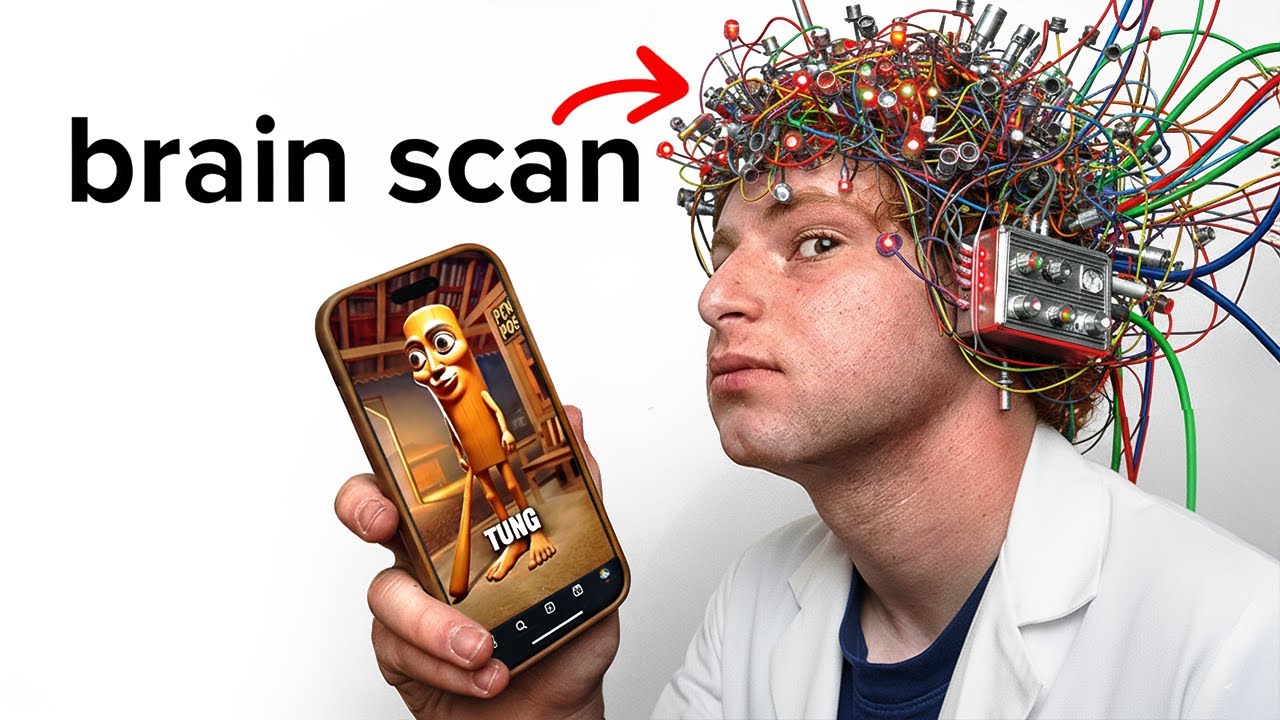
Testing If Brain Rot ACTUALLY Rots Your Brain
Take your personal data back with Incogni! Use code JACKGORDON at the link below and get 60% off an annual plan: https://incogni.com/jackgordon Here are the...

Jack Gordon
577.4K views • Jul 7, 2025
About this video
Take your personal data back with Incogni! Use code JACKGORDON at the link below and get 60% off an annual plan: https://incogni.com/jackgordon
Here are the full results of the experiment: https://docs.google.com/presentation/d/1oKu2vbz2JGxg-3NAz5qkozeV5Xwsc8skR3Hmz5PDDE8/edit?usp=sharing
SCIENTIFIC DISCLAIMER
The Institute for Advanced Consciousness Studies (IACS) acknowledges that this content is primarily for entertainment purposes, though the preliminary findings may warrant future investigation. While we're excited to support content creators raising awareness about technology's potential impact on cognitive function, this study has significant limitations:
Key Limitations:
Study Design Issues: "Brainrot" was poorly defined, making group analyses potentially invalid due to numerous confounding variables. The screen time measurements were inconsistent—we distinguished between general screen time and social media time, yet excluded YouTube from social media despite YouTube Shorts being as likely to encourage doomscrolling as TikTok or Instagram. We failed to account for Netflix/TV consumption, reading habits, education levels, or mind-body/exercise practices—all critical variables needed to isolate our variable of interest.
Methodological Constraints: Our EEG metrics were overly simplified, using only univariate measures instead of connectivity or multivariate analyses. We didn't account for neurodiversity, failed to include proper rest period comparisons, and didn't consider participants' motivation levels or how much they cared about task performance. Since "brainrot" typically involves visual content, visual attention may actually be preserved or enhanced, making our tasks potentially insensitive to detecting the intended effects.
Technical and Statistical Limitations: We didn't perform proper motion artifact removal from EEG data or follow standard academic preprocessing protocols. The study was statistically underpowered to detect effects even if present, and suffered from selection bias in participant recruitment. As the saying goes, "if the brain were simple enough to understand, we would be too simple to understand it" (attributed to Lyall Watson).
Research Team Credits:
Research Assistants: Ninette Simonian, Mari Shahmanyan, Katara Dakota, Ressan Eyngel Quinto
Task Design: Mari Shahmanyan
Visualization: Intheon's Neuropype software (Sean Mullen)
EEG Analysis: Ben Zhang
Research Director: Nicco Reggente, Ph.D.
For scientific inquiries or collaboration opportunities, contact: nicco@advancedconsciousness.org
Follow IACS:
YouTube: https://www.youtube.com/@iacslab
X: https://twitter.com/theiacs
TikTok: https://www.tiktok.com/@iacslab
Instagram: https://www.instagram.com/iacslab/
Facebook: https://www.facebook.com/advancedconsciousness
Our amazing Participants!
Jaydon - IG: @jaydon_carlson
Will - IG: @william.richman
Caroline :)
Thanh - IG: @wonton0
Brandon - IG: @krustyvlogss
Del - IG: @delritacoleman
Kamran - IG: @lights_kamran_akhtar
Abby - IG: @abbysemenick
Rafi - IG: @_rafiperez_
powEnvy - Tiktok: @powenvy
Gabriella - IG: @gabriellagodinezg
Bella - IG: @isabelladake
Halime - IG: @halime.y.z
Casey :)
Riley - IG: @fosseyyy
Carson - IG: @_carsonhayes_
Josh - YT: @JoshKreuger
follow my Instagram:
https://www.instagram.com/jackgordonyt/
Gang, THIS is what I use for ALL my sound design! Check out composer companion and use code Jack30 for 30% off: https://www.composercompanion.com
Produced by: Isabella Dake
Edited by: Brandon Voloch and Jack Gordon
Music by: Extreme Music, Jack Gordon, Artlist and Epidemic Sound
Assistant edited by: Jorge Moratal
Here are the full results of the experiment: https://docs.google.com/presentation/d/1oKu2vbz2JGxg-3NAz5qkozeV5Xwsc8skR3Hmz5PDDE8/edit?usp=sharing
SCIENTIFIC DISCLAIMER
The Institute for Advanced Consciousness Studies (IACS) acknowledges that this content is primarily for entertainment purposes, though the preliminary findings may warrant future investigation. While we're excited to support content creators raising awareness about technology's potential impact on cognitive function, this study has significant limitations:
Key Limitations:
Study Design Issues: "Brainrot" was poorly defined, making group analyses potentially invalid due to numerous confounding variables. The screen time measurements were inconsistent—we distinguished between general screen time and social media time, yet excluded YouTube from social media despite YouTube Shorts being as likely to encourage doomscrolling as TikTok or Instagram. We failed to account for Netflix/TV consumption, reading habits, education levels, or mind-body/exercise practices—all critical variables needed to isolate our variable of interest.
Methodological Constraints: Our EEG metrics were overly simplified, using only univariate measures instead of connectivity or multivariate analyses. We didn't account for neurodiversity, failed to include proper rest period comparisons, and didn't consider participants' motivation levels or how much they cared about task performance. Since "brainrot" typically involves visual content, visual attention may actually be preserved or enhanced, making our tasks potentially insensitive to detecting the intended effects.
Technical and Statistical Limitations: We didn't perform proper motion artifact removal from EEG data or follow standard academic preprocessing protocols. The study was statistically underpowered to detect effects even if present, and suffered from selection bias in participant recruitment. As the saying goes, "if the brain were simple enough to understand, we would be too simple to understand it" (attributed to Lyall Watson).
Research Team Credits:
Research Assistants: Ninette Simonian, Mari Shahmanyan, Katara Dakota, Ressan Eyngel Quinto
Task Design: Mari Shahmanyan
Visualization: Intheon's Neuropype software (Sean Mullen)
EEG Analysis: Ben Zhang
Research Director: Nicco Reggente, Ph.D.
For scientific inquiries or collaboration opportunities, contact: nicco@advancedconsciousness.org
Follow IACS:
YouTube: https://www.youtube.com/@iacslab
X: https://twitter.com/theiacs
TikTok: https://www.tiktok.com/@iacslab
Instagram: https://www.instagram.com/iacslab/
Facebook: https://www.facebook.com/advancedconsciousness
Our amazing Participants!
Jaydon - IG: @jaydon_carlson
Will - IG: @william.richman
Caroline :)
Thanh - IG: @wonton0
Brandon - IG: @krustyvlogss
Del - IG: @delritacoleman
Kamran - IG: @lights_kamran_akhtar
Abby - IG: @abbysemenick
Rafi - IG: @_rafiperez_
powEnvy - Tiktok: @powenvy
Gabriella - IG: @gabriellagodinezg
Bella - IG: @isabelladake
Halime - IG: @halime.y.z
Casey :)
Riley - IG: @fosseyyy
Carson - IG: @_carsonhayes_
Josh - YT: @JoshKreuger
follow my Instagram:
https://www.instagram.com/jackgordonyt/
Gang, THIS is what I use for ALL my sound design! Check out composer companion and use code Jack30 for 30% off: https://www.composercompanion.com
Produced by: Isabella Dake
Edited by: Brandon Voloch and Jack Gordon
Music by: Extreme Music, Jack Gordon, Artlist and Epidemic Sound
Assistant edited by: Jorge Moratal
Video Information
Views
577.4K
Likes
19.5K
Duration
16:15
Published
Jul 7, 2025
User Reviews
4.8
(115) Related Trending Topics
LIVE TRENDSRelated trending topics. Click any trend to explore more videos.
No specific trending topics match this video yet.
Explore All Trends