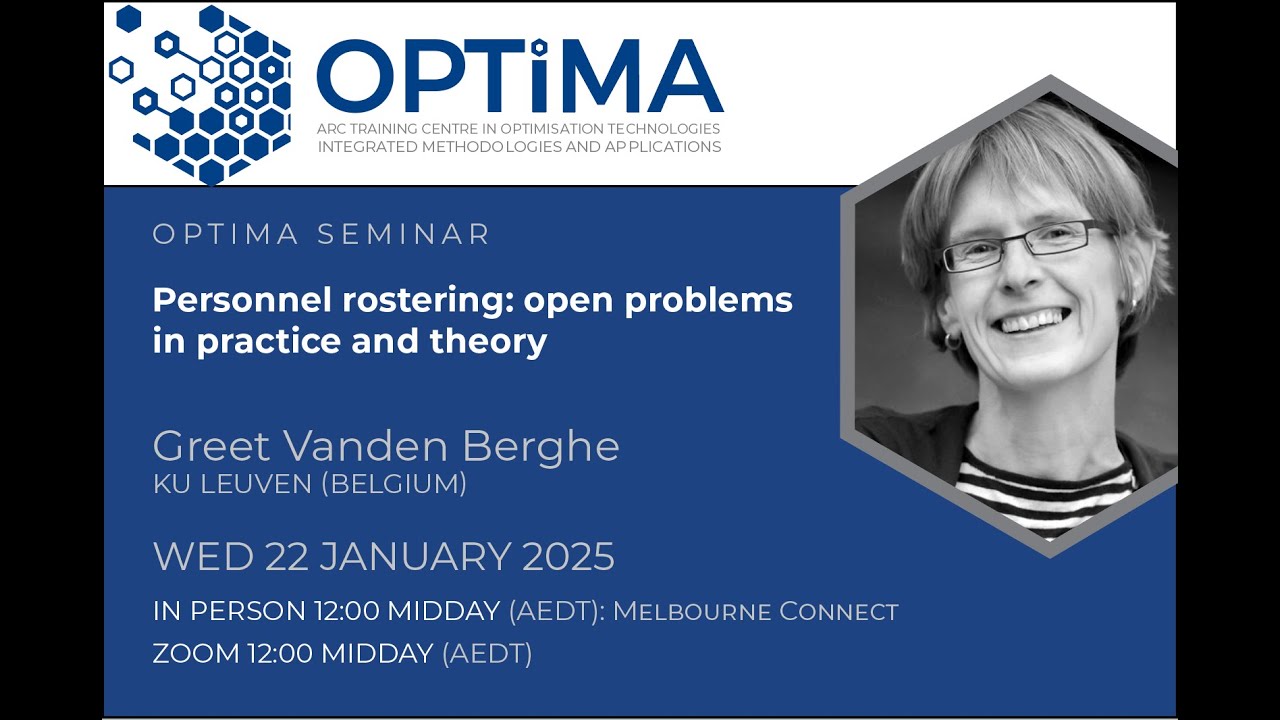
Solving Complex Personnel Rostering Challenges 🧩: Practical and Theoretical Insights
Discover the open problems and innovative solutions in personnel rostering, a key combinatorial optimization challenge with real-world impact. Join Greet Vanden Berghe from KE Leuven to explore cutting-edge research and practical approaches.

OPTIMA ARC
132 views • Jan 30, 2025
About this video
Speaker: Greet Vanden Berghe (KE Leuven)
Summary: Personnel rostering represents a fascinating combinatorial optimisation problem due to its relevance in practice and its computational difficulty.
The personnel rostering problem has yielded ample practice-oriented combinatorial optimisation approaches. Despite the vast amount of academic research results, it remains hard for novice developers to profit from general insights or re-usable models and algorithms. This `cold start’ issue can be partially explained by complicated regulations typical for personnel environments with 24/7 duties which are different in almost every organisation. The very same issue also persists due to the lack of a theoretical framework for nurse rostering.
This talk will focus on the challenging interplay between important practical and theoretical nurse rostering contributions.
Biography:
Greet Vanden Berghe’s primary research interest is related to operational research. She focuses in particular on solving complex industrial combinatorial optimization problems. Examples of such problems include timetabling, scheduling and vehicle routing problems and combinations thereof. Recently, she also became interested in dynamic combinatorial optimization, which intelligently employs data that becomes available during schedule execution. All these research activities involve mathematical modelling and the development of intelligent search algorithms such as heuristic search and decomposition methods.
Summary: Personnel rostering represents a fascinating combinatorial optimisation problem due to its relevance in practice and its computational difficulty.
The personnel rostering problem has yielded ample practice-oriented combinatorial optimisation approaches. Despite the vast amount of academic research results, it remains hard for novice developers to profit from general insights or re-usable models and algorithms. This `cold start’ issue can be partially explained by complicated regulations typical for personnel environments with 24/7 duties which are different in almost every organisation. The very same issue also persists due to the lack of a theoretical framework for nurse rostering.
This talk will focus on the challenging interplay between important practical and theoretical nurse rostering contributions.
Biography:
Greet Vanden Berghe’s primary research interest is related to operational research. She focuses in particular on solving complex industrial combinatorial optimization problems. Examples of such problems include timetabling, scheduling and vehicle routing problems and combinations thereof. Recently, she also became interested in dynamic combinatorial optimization, which intelligently employs data that becomes available during schedule execution. All these research activities involve mathematical modelling and the development of intelligent search algorithms such as heuristic search and decomposition methods.
Video Information
Views
132
Likes
5
Duration
01:08:44
Published
Jan 30, 2025